

The Growing Dominance of Bitcoin
Over the past few months, the cryptocurrency landscape has been undergoing a significant transformation. The largest of them all, Bitcoin, is showing an increasing dominance, while the second-largest, Ethereum, is losing ground alarmingly.
Indeed, the market share of Bitcoin has recently reached 63.98%, a level not seen since 2021. And Bitcoin may not stop there, as experts predict a rise in Bitcoin dominance to 70%.
This meteoric rise is mainly due to the positive repercussions of Donald Trump’s electoral victory, as well as the ongoing discussions about Bitcoin reserves held by several countries.
Simultaneously, Ethereum’s dominance is fading: its market share is now only 7%, a lowest since September 2019. “Ethereum dominance is on the verge of a new historical low”, commented crypto analyst Rekt Capital on X.
This trend does not seem solely tied to the current situation. For instance, XRP has seen its market weight double over the same period. Thus, Ethereum’s leadership erosion appears to be part of a broader reconfiguration in the crypto landscape.
A Lost Battle Already ?
Despite this setback for Ethereum, it is premature to bet on a “flippening,” which means a reversal of the hierarchy in favor of Bitcoin. The second cryptocurrency still plays a central role in the ecosystem, notably due to its smart contract deployment capabilities.
Furthermore, the recent market volatility, exacerbated by Trump’s trade tensions, has led to profit-taking on Bitcoin, partially erasing its previous gains. This indicates continued investor interest in cryptocurrency, even though its dominance remains subject to significant fluctuations.
Bitcoin seems on track to establish itself as the reigning cryptocurrency for the long haul. However, Ethereum retains strong fundamentals and remains a pivotal player in the sector.
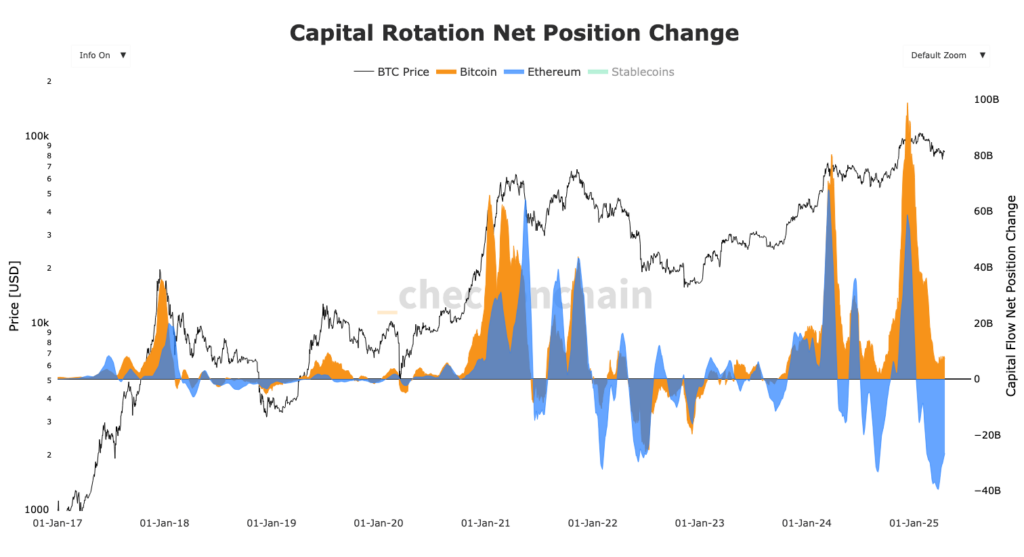
The capital rotation graph clearly demonstrates this massive sale of ETH in favor of BTC. However, these outflows typically correspond to market bottoms.
As indicated by CryptoGoos, ETH sellers are starting to weaken, and a trend reversal could occur at 1100 or below $1000 in case of a more significant drop.
In conclusion, Ethereum’s biggest adversaries are likely not Bitcoin but rather emerging competitors like Solana, XRP, SOL, or even Cardano.
Bitcoin lives in its own world and is no longer seen as “just a cryptocurrency” by the community. Bitcoin’s dominance grows year after year unless blockchain technology offers real usable products for the masses.
Bitcoin, in essence, already has its fully developed product: a robust blockchain to provide an ideal safe haven in times of crisis and economic downturns. In this battle, it is clear that ETH will never catch up to BTC.

