

A major security vulnerability has just been disclosed on the Zcash network, triggering a brutal collapse in the ZEC price and wiping billions of dollars from its market capitalization.
The market reacted with a ferocity rarely seen for a privacy coin that was already under pressure. The question now looming over investors: is this a local bottom, or the beginning of a prolonged capitulation?
Here is a full breakdown of a crash that calls into question the technical credibility of one of the oldest privacy-focused projects in the crypto ecosystem.
A Security Flaw Striking at the Heart of Zcash’s Credibility
The disclosure of a critical vulnerability in the Zcash protocol sent an immediate shockwave through the markets. For a project whose entire value proposition rests on privacy and cryptographic robustness, this kind of incident is far more than a simple technical bug — it is a direct attack on its very reason for existing.
Zcash relies on zero-knowledge proofs (zk-SNARKs) to guarantee transaction anonymity. If a flaw compromises this mechanism, the entire promise made to users collapses with it. The market understood this immediately: the sell-off was instant and overwhelming, erasing a market capitalization worth billions of dollars within just a few hours.
This kind of brutal sell-off triggered by a vulnerability announcement is characteristic of a confidence shock, which is far harder to absorb than a standard technical correction driven by broader market conditions. Institutional holders and funds specializing in privacy coins were likely the first to liquidate their positions, amplifying the downward pressure on an asset that was already thinly traded.
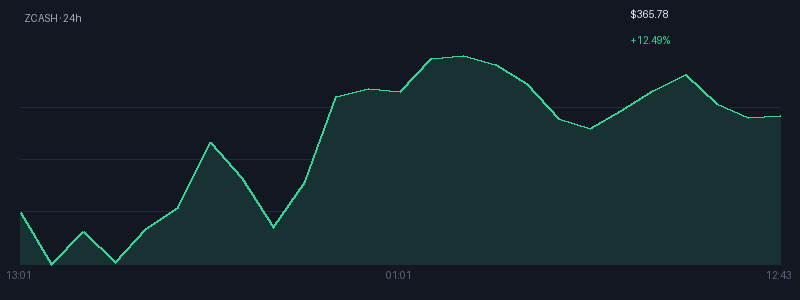
ZEC Under Pressure: What the Market Data Is Telling Us
Even before this flaw was revealed, ZEC had been locked in a structural downtrend for several months. The privacy coin had lost much of its momentum against competitors such as Monero (XMR), while also suffering progressive delistings across several major exchanges due to growing regulatory pressure on privacy-focused assets.
The crash triggered by this vulnerability hit an already weakened technical support structure. On the charts, ZEC broke through several key support levels without finding any meaningful buying interest to absorb the selling pressure. Trading volume spiked sharply during the drop — a classic capitulation signal — but no convincing technical bounce followed, suggesting an absence of institutional demand willing to step in and buy the dip.
On-chain data reinforces this reading: outflows from long-term holder wallets accelerated, while the number of active addresses dropped sharply. Market sentiment around ZEC has shifted into deeply negative territory, with the asset-specific Fear & Greed Index approaching capitulation levels last seen during previous bear markets.
Can ZEC Bounce Back? The Conditions for a Reversal
For Zcash to have any realistic chance of a credible recovery, several conditions need to be met. The first — and most urgent — is the release of a technically validated patch endorsed by the community, accompanied by an independent audit confirming that the vulnerability has been fully resolved. Without this step, any attempt at a price recovery risks being sold into quickly by opportunistic traders.
The Electric Coin Company (ECC), the organization behind Zcash, will also need to demonstrate its ability to manage crisis communications with full transparency. In the crypto ecosystem, how a team responds to a security incident can sometimes restore — or permanently destroy — user trust. Past precedents show that projects which communicate quickly, clearly, and with concrete solutions in hand can sometimes limit the long-term damage.
On the technical side, ZEC will need to reclaim significant resistance levels before any talk of a trend reversal becomes meaningful. A short-term technical bounce remains possible if opportunistic buyers step in at extreme oversold levels, but the underlying trend remains structurally bearish for as long as confidence in the protocol has not been restored. For privacy coins as a whole, this episode serves as a brutal reminder that cryptographic security is never guaranteed — and that the market shows no mercy when that security fails.

