

The ABA vs. stablecoins: War is declared
The American Bankers Association (ABA) is taking a stand against the stablecoin bill currently under review in the US Senate. Traditional banks take a very dim view of the possibility for stablecoin issuers to offer yields to their users. According to financial lobbies, this economic model directly threatens traditional bank deposits. Faced with this unprecedented pressure, US lawmakers are hesitating and delaying the vote. The initial compromise aimed at banning passive yields while allowing rewards linked to active use is no longer enough to appease traditional finance.
This offensive by the ABA comes at a critical time for the crypto ecosystem. Stablecoins represent the liquid fuel of all decentralized markets. If their economic model is hindered by severe restrictions, the entire liquidity of DeFi could suffer. Issuers like Tether and Circle have built their dominance precisely on their ability to generate yields through their reserves. Reducing this capability would amount to crippling the fundamental attractiveness of these instruments compared to traditional bank deposits.
The potential impact on the blockchain market is considerable. Yield farming and staking protocols that use stablecoins as collateral would be directly affected by restrictions on yields. The crypto trend towards institutional adoption of RWAs relies largely on the reliability and attractiveness of these instruments. A legislative gridlock would create prolonged regulatory uncertainty harmful to institutional flows. This scenario is exactly what the industry has been trying to avoid for years.
Senate gridlock, time is running out for crypto
Beyond lobbying, the legislative timing poses a major problem. The US Senate is facing a massive legislative bottleneck with competing priorities: national security, the federal budget, and presidential nominations. Analysts at Galaxy Research are adamant: if the bill does not move forward quickly, its chances of passing in 2026 will be almost zero. This legislative window is closing rapidly. Every week of delay mechanically reduces the probability of adoption before the congressional recess.
On Polymarket and Kalshi, traders quickly adjusted their positions in response to these delays. The odds of adoption before 2027 plummeted from over 75% to under 50% in just a few days. This movement on prediction markets reflects a resolutely bearish sentiment among the most informed political observers. The bill had nevertheless crossed a crucial milestone in mid-May by passing the Senate Banking Committee. Without a swift floor vote, this progress will lead nowhere.
Bitcoin and major altcoins have partially priced this uncertainty into their valuations. The fear and greed index remains in neutral territory, a sign that investors are watching without panicking just yet. A definitive burial of the bill would likely trigger a wave of selling on assets most exposed to the positive regulatory narrative. XRP forecasts and Ethereum forecasts would be the first impacted by this scenario. The crypto trend in the short term remains conditioned by every announcement from the Senate.
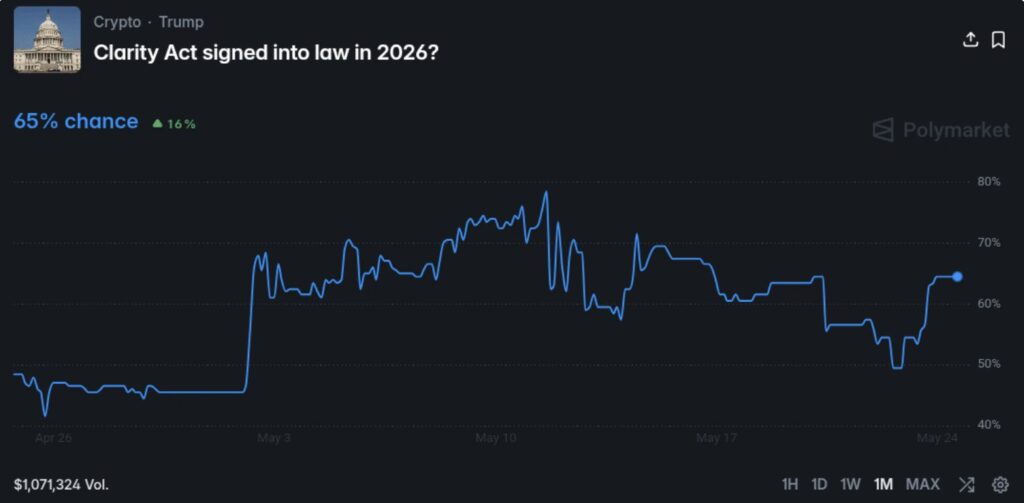
CLARITY Act: Which assets are in the crosshairs?
The CLARITY Act is crucial for the industry because it would clearly define which assets are securities and which are digital commodities. Without this framework, exchange platforms and DeFi developers remain exposed to enforcement actions by the SEC and the CFTC. XRP, Solana, and Cardano had the most to gain from a favorable clarification. Prolonged uncertainty maintains a regulatory risk premium in their current valuations.
A prolonged gridlock would delay the launch of new regulated products targeting US institutional investors. Bitcoin ETFs have proven that regulatory clarity unlocks massive institutional flows. The same mechanism would apply to the entire ecosystem if the CLARITY Act were enacted. Its absence keeps the market in a legal gray area that is structurally unfavorable to mainstream adoption.
DeFi protocols based on smart contracts are particularly vulnerable in the absence of a clear legal framework. US developers are hesitating to deploy new protocols under the threat of being classified as unregistered securities issuers. This brain drain towards more favorable jurisdictions weakens blockchain innovation made in the USA. The American Web3 sector needs this law to maintain its competitiveness against the European MiCA legislation already in force. Every month of delay costs the US ecosystem market share.
Can BTC aim for an ATH without the CLARITY Act?
The history of the crypto market proves that regulatory uncertainty does not prevent bull cycles. Bitcoin reached its 2021 ATH without a coherent US regulatory framework. Institutional flows via Bitcoin ETFs now constitute a structural accumulation floor independent of the legislative calendar. Some analysts believe that a regulatory status quo is better than a law excessively restricted by banks. The medium term Bitcoin forecast remains positive despite these legislative headwinds.
The bearish scenario remains credible if the bill is definitively buried in 2026. The altcoins most exposed to the positive regulatory narrative would suffer the most severe corrections. Crypto trading investors will need to monitor every statement from key senators as a leading directional indicator. Abandoning the bill would likely trigger a sectoral bear market for assets directly linked to status clarification. Risk management becomes a priority in this context of prolonged legislative uncertainty.
For investors looking to invest in crypto in this environment, diversification remains the most prudent strategy. Maintaining exposure to Bitcoin and Ethereum as assets less exposed to direct US regulatory risk is advisable. HODLing long term positions is justified by the historical resilience of the industry in the face of legislative hurdles. The 2025-2026 crypto bull run has the means to continue with or without the CLARITY Act. However, its adoption would undoubtedly constitute the most powerful institutional catalyst of the current cycle.
Sources:
- Polymarket
- BankXRP on X
Related Articles:

