

What’s Happening in the Crypto Market ?
The crypto market experienced moderate decline today, reflecting a cautious sentiment among investors.
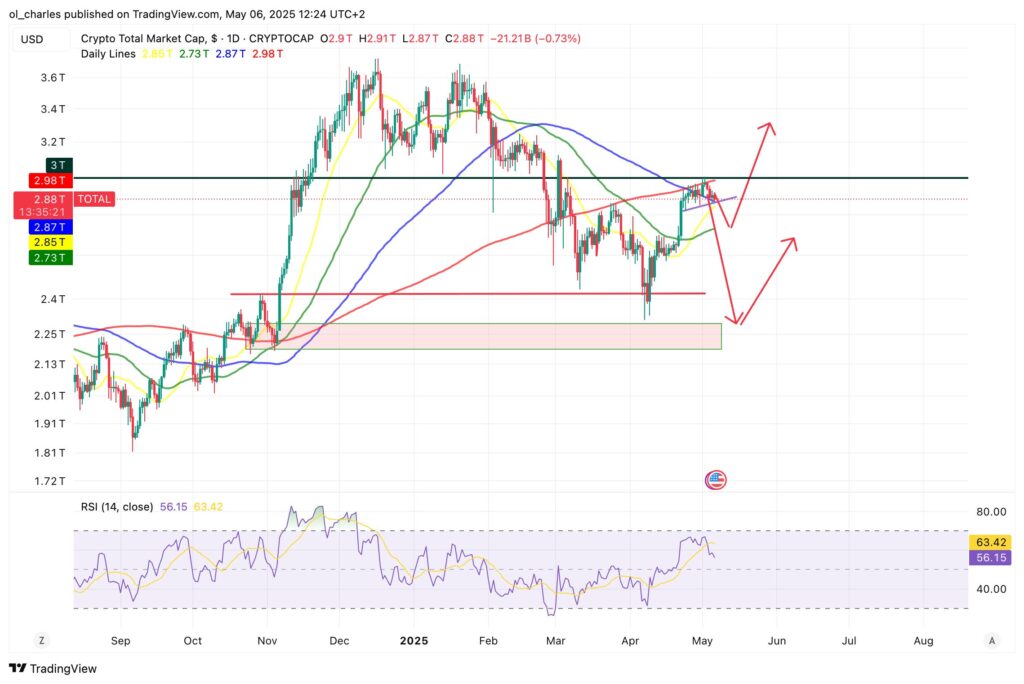
Indeed, the crypto market extended its downward trend today, with a 0.37% decrease in total market capitalization over the last 24 hours. This correction comes amidst mixed investor sentiment and ongoing macroeconomic uncertainty.
Despite this deceleration, the market capitalization remains high, hovering around 2.89 trillion dollars. However, the critical support level of 2.86 trillion dollars could be threatened if selling pressure intensifies. Such a scenario could potentially lead to further market decline towards the 50-day moving average at 2.74 trillion or possibly to the demand zone at 2.3 trillion if BTC falls below $74,000.
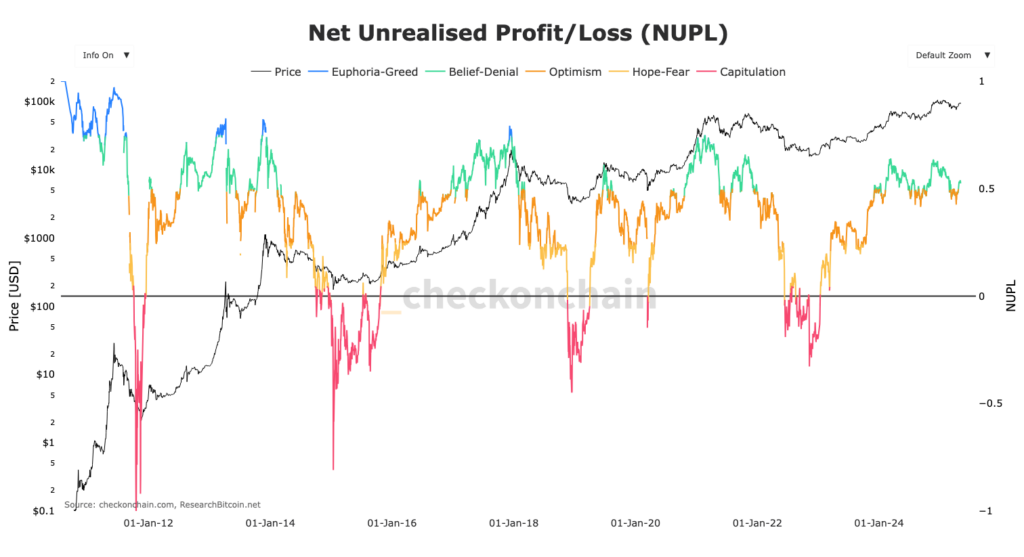
On-chain data provides nuanced insights. According to Glassnode, the Net Unrealized Profit/Loss (NUPL) index of Bitcoin stands at 0.52, reflecting cautious holders without widespread panic.
CryptoQuant notes a 15% decrease in flows to exchanges, suggesting limited selling pressure from retail participants. As tweeted by @CryptoAnalystX on May 5: “Market cap testing support at $2.88T. Low exchange flows + ETF strength = potential rebound.”
According to Axel, on-chain signals are still bullish:
“The current NUPL is at 8%, while its 30-day moving average remains negative and holds at -2%. As long as the NUPL does not exceed 40%, the selling pressure from this cohort will remain minimal, which is a bullish signal.”
Regulatory and Institutional Developments at Play
On the regulatory front, Republican lawmakers have introduced a new bill aimed at creating a comprehensive framework for digital assets. Building on the FIT21 law passed in 2024, this legislation focuses on reducing market concentration while fostering innovation and consumer protection.
Simultaneously, the SEC has unveiled the agenda for its upcoming roundtable, with a particular focus on tokenization. This event will be divided into two parts, likely addressing real-world assets (RWA) and broader financial instruments.
“The SEC’s focus on RWAs is significant. Tokenized assets could unlock trillions, which is bullish for the next crypto wave,” writes CryptoLawyer.
Strong Institutional Interest
While Bitcoin followed the broader downward trend with a slight 0.23% decrease, Bitcoin spot exchange-traded funds (ETFs) in the US saw new net inflows. This demonstrates persistent institutional interest, even amidst temporary price declines.
The largest net influx came from BlackRock’s iShares Bitcoin Trust, attracting $531 million in new investments.
On the blockchain, active addresses for Bitcoin rose by 8% in a week (Glassnode), indicating sustained network activity. With an MVRV ratio of 2.1, BTC is fairly valued, far from overheating.
Technical Analysis : Opportunities to Seize ?
Despite the market downturn, technical analysts are identifying key support levels for BTC. If traders adopt a “wait and see” approach, the cryptocurrency’s price could range in the short term. In case of a bullish breakthrough, Bitcoin could even reach $96,187.
Conversely, a downside break could send Bitcoin’s price down to $92,048. A drop below $86,000 would trigger panic and liquidation of many long positions, potentially leading to a cascade down to $73,000.
Raydium (RAY) is the biggest loser of the day, plummeting 15% to $2.30. Exchange volume surged by 130% (CoinMarketCap), confirming significant selling pressure. On-chain data from Dune Analytics reveals a 20% rise in net flows to exchanges, with 1.2 million RAY tokens transferred, indicating profit-taking or capitulation.
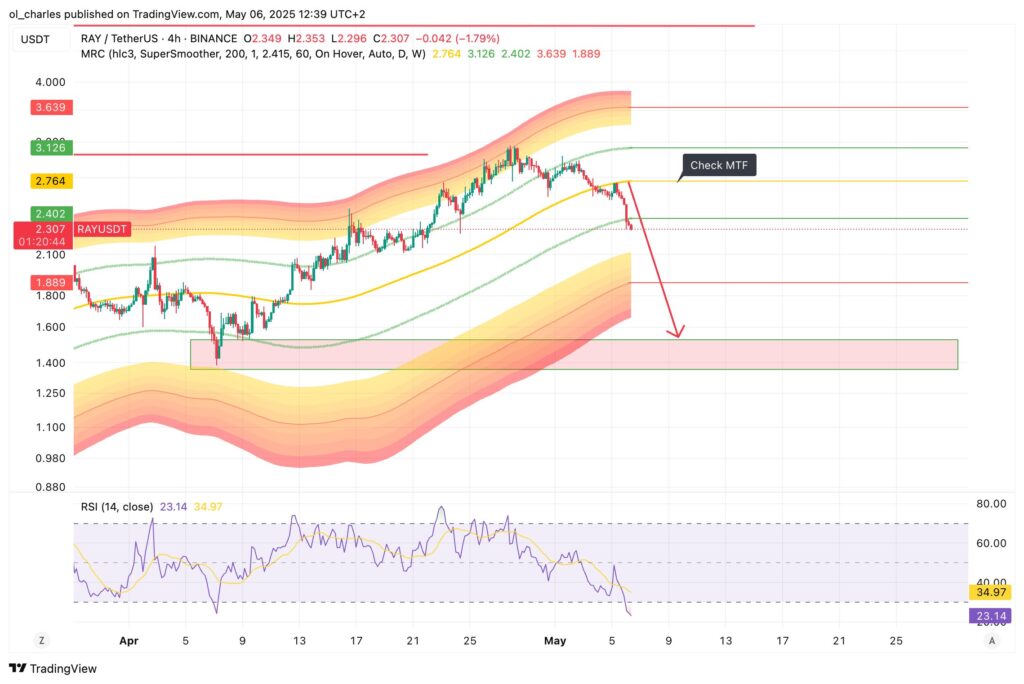
RAY’s RSI, at 20 in 4H, is in extremely oversold territory, a level that has often preceded short-term rebounds. In Q3 2024, a similar RSI triggered a 25% surge in 48 hours. However, the 50-day exponential moving average at $2.80 remains a distant resistance.
- Downside Risk: If selling persists, RAY could drop to $1.93 or $1.35-$1.47.
- Upside Potential: A reversal above $2.50 could target $3.00.
Despite the current moderate crypto market decline, savvy investors see opportunities. Regulatory frameworks are taking shape, while institutional interest in Bitcoin remains strong.
In this context, traders must remain vigilant and identify critical support levels. By carefully analyzing technical trends, they can leverage market fluctuations and seize the best investment opportunities.

