

EOS : Making a Comeback in 2025 ?
Imagine a blockchain capable of processing thousands of transactions in the blink of an eye, with minimal fees, designed to propel decentralized applications (dApps) to new heights. This is the promise of EOS, a historic player that shook the crypto world with its record ICO in 2017.
But in May 2025, as the market teems with new competitors, can EOS still stand up to the giants?
At the core of EOS lies a unique engine: the Delegated Proof of Stake (DPoS). This system enables ultra-fast transactions with almost zero fees, a dream for interaction-hungry dApps like blockchain games or DeFi platforms.
The idea? To make EOS a true “operating system” for decentralized applications, where developers can deploy their projects without going broke. Since 2021, the EOS Network Foundation (ENF) has been guiding this ecosystem with more transparent governance, aligning the interests of the community and creators.
However, the road is not without obstacles. Facing Layer 1 competitors like Solana or Layer 2 projects boosted by Ethereum, EOS must fight to remain competitive. Yet, EOS boasts robust technology and smooth transactions that still appeal. Despite this, it needs to convince a new generation of developers and users in a market where innovation reigns. With an ambitious roadmap and updates like Mandel, ENF is working hard to restore EOS’ reputation.
Technical Analysis and Price Outlook
In May 2025, EOS is making waves. Since May 7th, the token has shown outstanding weekly performance with a 28% surge, defying the general crypto market‘s gloom.
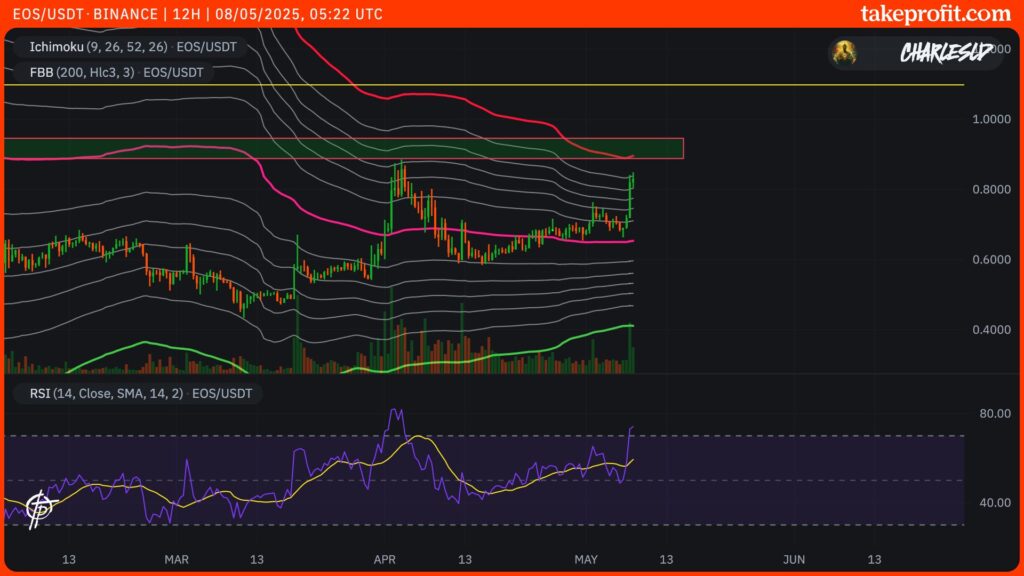
With a tightening FBB in 12 hours, the token shows bullish signals, with an RSI close to overbought at 72. However, there is still room as it reached 81 on April 4th.
The next resistance target is around $0.90, with the highest being at $1.09. A breakout of this latter would push EOS towards $1.30 and possibly towards $3 thereafter.
According to CryptoBull, it will be crucial to monitor volumes in case of a rise towards this 90 cents zone.
Challenges and Opportunities : The Future of EOS
The path to glory is fraught with challenges. Competition from Layer 1 and 2 projects, with their brand-new ecosystems, puts pressure on the token. To attract developers, it must offer intuitive tools, impeccable documentation, and enticing economic incentives.
Although governance has improved through ENF, it must remain agile to meet the demands of a demanding community. Yet, EOS has cards up its sleeve: proven technology, competitive costs, and a loyal community.
Recently, the blockchain announced its rebranding as “Vaulta” and the swap of its token at a 1:1 ratio under the new name “A”.
Users can make this exchange via a dedicated tool on the Vaulta website, while major platforms like Binance, Coinbase, or Bitget will manage the transition automatically. This announcement has helped boost EOS prices.
The Verdict : Should You Bet on EOS ?
Its DPoS technology and ENF’s efforts provide a solid foundation for a rebound, but fierce competition and the need for massive adoption remain significant obstacles. The recent price surges show that the market hasn’t forgotten EOS, but caution: conducting thorough research (DYOR – Do Your Own Research) is more necessary than ever.
Moreover, EOS is still far from its ATH of $15. But its rebranding and token name change could breathe new life into the blockchain.
If you wish to purchase the token, here’s a guide to get it on Bitget easily:
- Create a Bitget account – Sign up on Bitget with your email or phone, validate the code sent, and activate 2FA to secure your account.
- Verify your identity (KYC) – Submit an ID to complete the necessary KYC verification for trading.
- Add funds – Deposit cryptocurrencies (USDT, BTC) or fiat via a credit card (Visa, Mastercard) or bank transfer under “Deposit”.
- Access the market – Go to “Spot Market”, search for “EOS”, and select the EOS/USDT pair.
- Make the purchase – Choose a market order (immediate purchase) or limit order (fixed price), indicate the quantity, and confirm.

