

$292M DeFi Hack: Can Ethereum Plunge to $1,000?
The weekend of April 18, 2026, will go down in DeFi history. In just 46 minutes, an attacker drained 116,500 rsETH from KelpDAO’s LayerZero bridge, making off with the equivalent of $292 million. The mechanics of the exploit were incredibly simple: a fake verification attestation tricked the cross chain messaging system, allowing the bridge’s reserves to be released without any real counterpart. The stolen funds were immediately routed through Tornado Cash. This is the largest DeFi hack of 2026, surpassing the $285 million stolen from Drift Protocol in early April, and bringing total crypto losses to over $600 million in the past two weeks.
The contagion was immediate. Aave froze its rsETH markets on V3 and V4, with its token AAVE plunging by over 20% in a matter of hours. LayerZero (ZRO) dropped 22% in 24 hours. SparkLend, Fluid, and Ethena followed suit with suspensions. Meanwhile, users withdrew $10 billion in liquidity from the DeFi market, creating bank run optics that the space had not seen in months. To understand why this type of exploit spreads so quickly across the ecosystem, our guide on understanding cryptocurrencies explains the mechanics of DeFi composability.
Ansem Sounds the Alarm on ETH: Valid Thesis or Excessive Pessimism?
In this context, the remarks made by influencer and trader Ansem on April 19 did not go unnoticed. In a thread published on X, he argued that the investment thesis surrounding Ethereum has been eroding for several cycles: Solana has captured the bulk of retail activity, Layer 2s are struggling to generate real traction, and repeated DeFi vulnerabilities are eating away at the network’s core value proposition of reliability. According to his technical analysis, ETH is stuck in a prolonged downtrend, unable to break through its resistance levels. His worst case scenario: a return to $1,300, matching the lows of 2025.
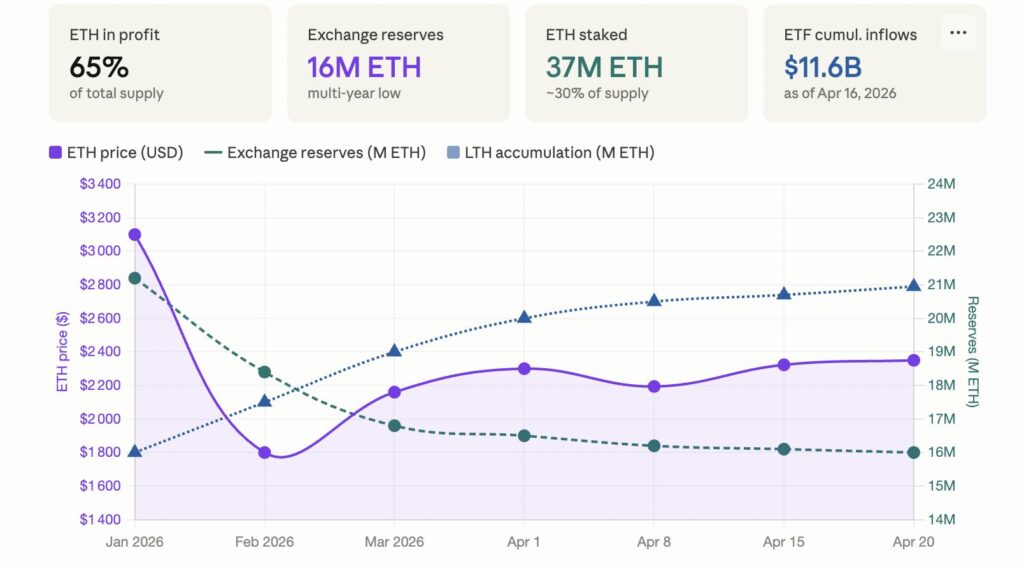
He is not an isolated voice. Technical indicators confirm a delicate situation. The daily 200 SMA has been declining since March 20, 2026. The MACD remains negative. The Fear & Greed Index shows a score of 26 (Fear). ETH is currently trading around $2,200, well below its ATH of $4,946 reached in August 2025. For traders looking to navigate this type of volatile environment, our crypto trading section details the appropriate risk management tools.
What the Bulls Are Saying: Final Capitulation or Entry Point?
Ansem’s bearish thesis has its detractors, and their arguments deserve attention. Trader Leo Lanza points out that global liquidity is expanding and the ISM has held above 50 for three months conditions that historically precede bull runs. The spot Ethereum ETF continues to attract institutional flows, and the US CLARITY Act could unlock billions of dollars in capital still waiting for a clear legal framework. In this scenario, Ethereum remains the best positioned asset to capture these flows thanks to its status as the smart contract leader. To track key levels in real time, our ETH price prediction is updated regularly.
On-chain data adds a layer of nuance. Approximately 65% of the ETH supply is currently in profit, and long term holders continue to accumulate. A breakout above $2,550 would technically invalidate Ansem’s bearish thesis and pave the way toward $2,700 and potentially $3,500 by the end of 2026 according to analyst consensus. The long term support at $2,000 to $2,100 is holding for now.
ETH at $1,000: Realistic Scenario or Pure Provocation?
Our reading of the situation is as follows. The KelpDAO hack is serious, but it is not an Ethereum problem in the strict sense: Aave’s core contracts were not compromised, Lido clarified that stETH is unaffected, and the exploit involves a cross chain misconfiguration, not a flaw in the Ethereum protocol itself. This distinction is crucial. A drop to $1,000 would require a confluence of disasters: an ETF collapse, a major macroeconomic crash, and a total flight of institutional investors. This scenario exists on paper but remains highly unlikely in the current context.
What is real, however, is the narrative damage. Every major DeFi exploit strengthens the arguments of detractors and slows down institutional adoption. 2026 is on track to be the worst year in history for crypto hacks, according to several security experts. Until this structural problem is addressed by minimum cross chain security standards, distrust will persist. If you are looking for where to buy ETH or diversify through a reliable exchange, our comparisons will guide you to the most secure platforms. And to structure your exposure in this uncertain environment, our guide on investing in crypto asks the right questions.
Sources:
- Coindesk — KelpDAO exploit
- lookonchain on X
- leolanza on X
Related Articles:

