
Ethereum: 3 Key indicators pointing to a rally towards $2,400
Will Ethereum break $2,400? Discover the 3 key indicators (ETFs, DEX, Futures) that could trigger a new crypto rally. Read now!



Will Ethereum break $2,400? Discover the 3 key indicators (ETFs, DEX, Futures) that could trigger a new crypto rally. Read now!
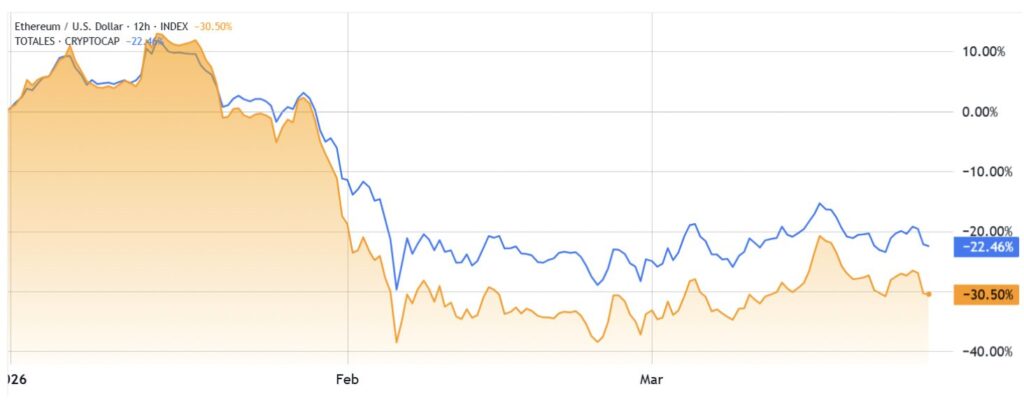
Ethereum is going through an uncomfortable compression phase. Following a 6% pullback that dragged the price back into the $2,050–$2,070 zone, the asset remains under pressure in a market that is nevertheless starting to show some signs of stabilization on Bitcoin. This decoupling is not insignificant. Since January 2026, ETH has posted a 31% underperformance, a figure that reflects a temporary disaffection of risk capital rather than a structural weakness of the protocol.
Three metrics are currently capturing the attention of analysis desks. Their evolution over the coming weeks will be decisive in determining whether ETH can trigger a reversal or if the corrective scenario will settle in for the long term.
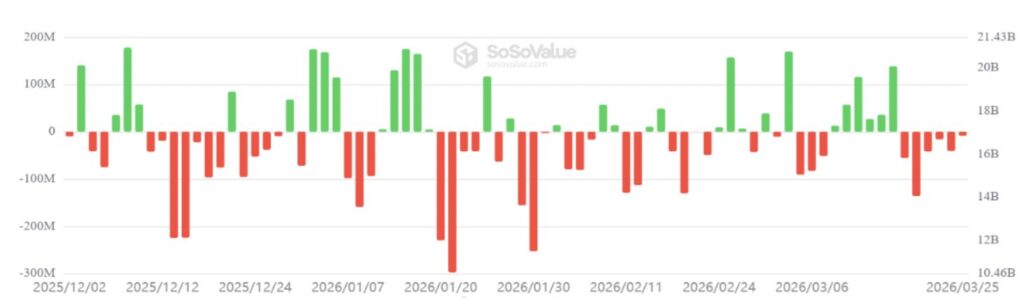
The first warning sign comes from the flows. After attracting roughly $70 billion over the past two years, US spot Ethereum ETFs hit a wall in early 2026, posting cumulative net outflows of around $32 million, a brutal reversal. On ETH specifically, Ethereum ETFs recorded approximately -$210 million in net outflows between March 5 and March 10, extending a streak of consecutive redemptions that directly weighs on the price.
What is important to understand here is that ETFs are not just an additional investment channel: they now constitute a fully fledged price discovery vector. During periods of net redemptions, Authorized Participants must sell ETH from the fund’s treasury to reimburse exiting shareholders, creating mechanical selling pressure on the spot market. As long as this tap remains closed, rallies will be limited in magnitude.
The second indicator concerns on-chain activity. DEX volumes on Ethereum are hovering around $904 million over 24 hours, with a weekly drop of -4.66%, illustrating a slowdown in demand for decentralized applications. The drop in volumes mechanically translates into fewer transactions, fewer fees burned via EIP-1559, and therefore a slightly inflationary pressure on the circulating supply, depriving ETH of a structural support that the market had taken for granted since the Merge.
For context, periods of sustained rallies on ETH have historically coincided with peaks in DeFi activity. A rebound in volumes on major protocols like Uniswap, Aave, or Curve would be a serious early signal to consider before taking any aggressive bullish position.
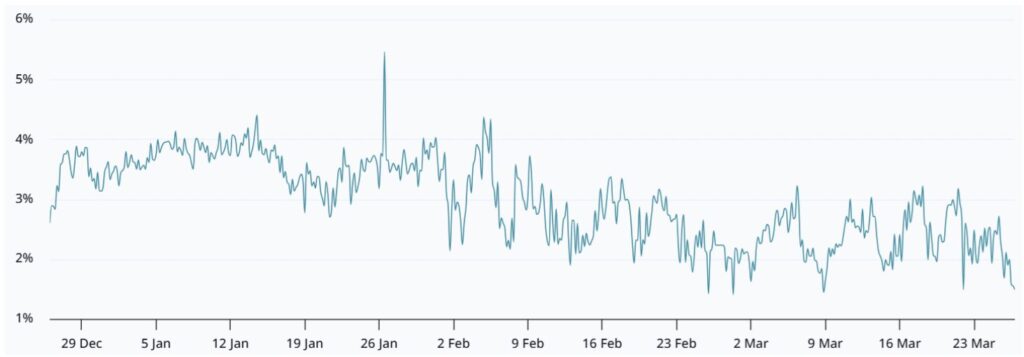
The third point of vigilance is the dynamics of derivatives. The funding rate for ETH perpetual futures recently slipped into negative territory. This signals a shift toward seller dominance. Short sellers are now paying longs to keep their positions open. This reversal comes as ETH continues to underperform parts of the market and struggles to build momentum above key resistances.
Paradoxically, this is a metric with a dual interpretation: a negative funding rate does not automatically guarantee a continuation of the decline. However, it shows that traders are positioning themselves defensively in the short term. A low leverage market is also a market less vulnerable to a violent flush. The floor is potentially more solid, but the rebound will be slower to initiate.
The $2,050 support is the absolute pivot level to watch. The $1,837–$1,940 zone represents the next major support cluster, aligned with the March 2026 lows and the historical accumulation zones of Q4 2024. Holding this level on a daily close is not negotiable to maintain a neutral to bullish bias.
For a recovery scenario to truly take hold, it will first be necessary to reclaim $2,200, a resistance that has already rejected several attempts. Beyond this threshold, $2,500 represents a major psychological and structural barrier. Meanwhile, the $2,700–$2,800 zone constitutes the last significant supply zone. Momentum indicators like the RSI and the MACD will be crucial to confirm this move.
Personally, I would not be an aggressive buyer before confirmation above $2,200 with volume. The current zone may represent a progressive accumulation opportunity for long term investors, but it does not yet constitute an entry signal for a momentum trade. Notably, Ethereum surpassed 2 million daily active addresses in February 2026, beating the peak of the 2021 bull market, while smart contracts calls exceeded 40 million per day. A useful reminder that the fundamental thesis remains intact, even if the price does not reflect it yet. The market is testing patience. This is often when the least rational decisions are made.
Sources:
Related Articles:

Crypto analyst with over 7 years of trading experience and a strong background in the iGaming and cryptocurrency industries, I cover crypto news with a rigorous yet accessible approach. Passionate about blockchain since 2019, I have published more than 1,200 articles and guides on cryptocurrencies, DeFi, and blockchain, recognized for their reliability and clarity.
Specializing in on-chain trading and whale activity analysis, I decode blockchain flows to anticipate market trends before they become obvious.
One of my articles was cited by Éric Larchevêque, co-founder of Ledger, highlighting the quality and credibility of my analysis.
My goal remains unchanged: to make crypto accessible and understandable for everyone, from beginners to experienced investors.
Follow me on LinkedIn and X to stay updated with my latest insights.
DISCLAIMER
This article is for informational purposes only and should not be considered as investment advice. Trading cryptocurrencies involves risks, and it is important not to invest more than you can afford to lose.
InvestX is not responsible for the quality of the products or services presented on this page and cannot be held liable, directly or indirectly, for any damage or loss caused by the use of any product or service featured in this article. Investments in crypto assets are inherently risky; readers should conduct their own research before taking any action and invest only within their financial means. This article does not constitute investment advice.





Risk Warning : Trading financial instruments and/or cryptocurrencies carries a high level of risk, including the possibility of losing all or part of your investment. It may not be suitable for all investors. Cryptocurrency prices are highly volatile and can be influenced by external factors such as financial, regulatory, or political events. Margin trading increases financial risks.
CFDs (Contracts for Difference) are complex instruments with a high risk of rapid capital loss due to leverage. Between 74% and 89% of retail investor accounts lose money when trading CFDs. You should assess whether you understand how CFDs work and whether you can afford to take the high risk of losing your money.
Before engaging in financial or cryptocurrency trading, you must be fully informed about the associated risks and fees, carefully evaluate your investment objectives, level of experience, and risk tolerance, and seek professional advice if needed. InvestX.fr and the InvestX application may provide general market commentary, which does not constitute investment advice and should not be interpreted as such. Please consult an independent financial advisor for any investment-related questions. InvestX.fr disclaims any liability for errors, misinvestments, inaccuracies, or omissions and does not guarantee the accuracy or completeness of the information, texts, graphics, links, or other materials provided.
Some of the partners featured on this site may not be regulated in your country. It is your responsibility to verify the compliance of these services with local regulations before using them.

