

Can “Ethereum” avoid a crash below $2,000?
Currently trading around $2,100, Ethereum is displaying a worrying structure. According to recent market data, the cryptocurrency is bearing the full brunt of Harvard’s strategic withdrawal. This $86.8 million liquidation is not a simple portfolio adjustment but a strong derisking signal from major institutional players.
And this is understandable given the turn the ETH chart is taking. ETH has once again left its multiyear historical range with its low at $2,130. Below this level, ETH validates a fake out on the HTF. Furthermore, ETH is on the verge of breaking its bullish trendline that it has been building for several months. This weakness points to a return to $1,800 in the coming days and perhaps even towards $1,500 in the coming weeks.
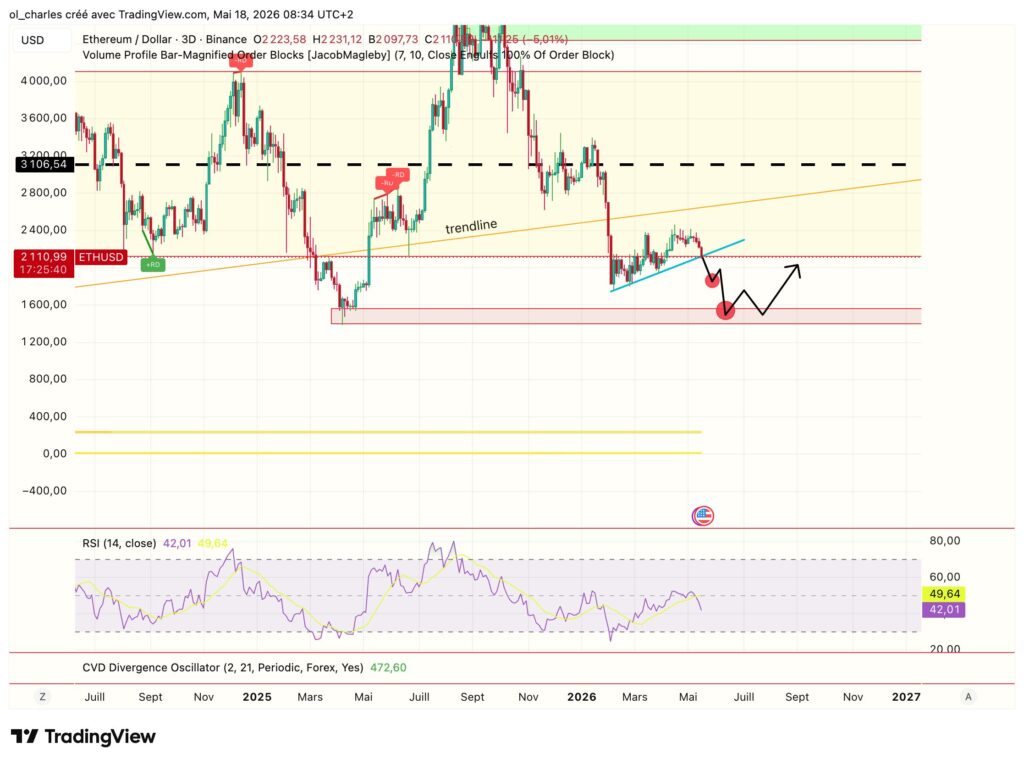
Nevertheless, the old adage says to buy the panic. A daily close holding above $2,130 could restart the engine.
However, technical analysis shows that selling pressure is intensifying considerably. Crypto whales are accumulating short positions, betting on an imminent breakdown of the immediate support located at $2,000. This psychological level is currently the last line of defense before a much more severe correction. Ether is moving further and further away from its ATH, and this brutal retracement is sowing doubt among investors.
Momentum indicators, such as the RSI and the MACD, confirm this exhaustion of the bullish trend. The market seems trapped in a descending channel, and every attempted rally is quickly stifled by new selling. If buyers capitulate, the drop could accelerate exponentially in the coming days.
How low can the price of Ether (ETH) fall?
In a bearish scenario, losing $2,000 would trigger a cascade of liquidations, plunging the price toward $1,900. This 12 hour order block support level will be decisive for the rest of the cycle. If it breaks, Ether could enter a prolonged phase of decline, wiping out hopes of a new bull run in the short term and sending the second largest cryptocurrency on the market back to $1,500.
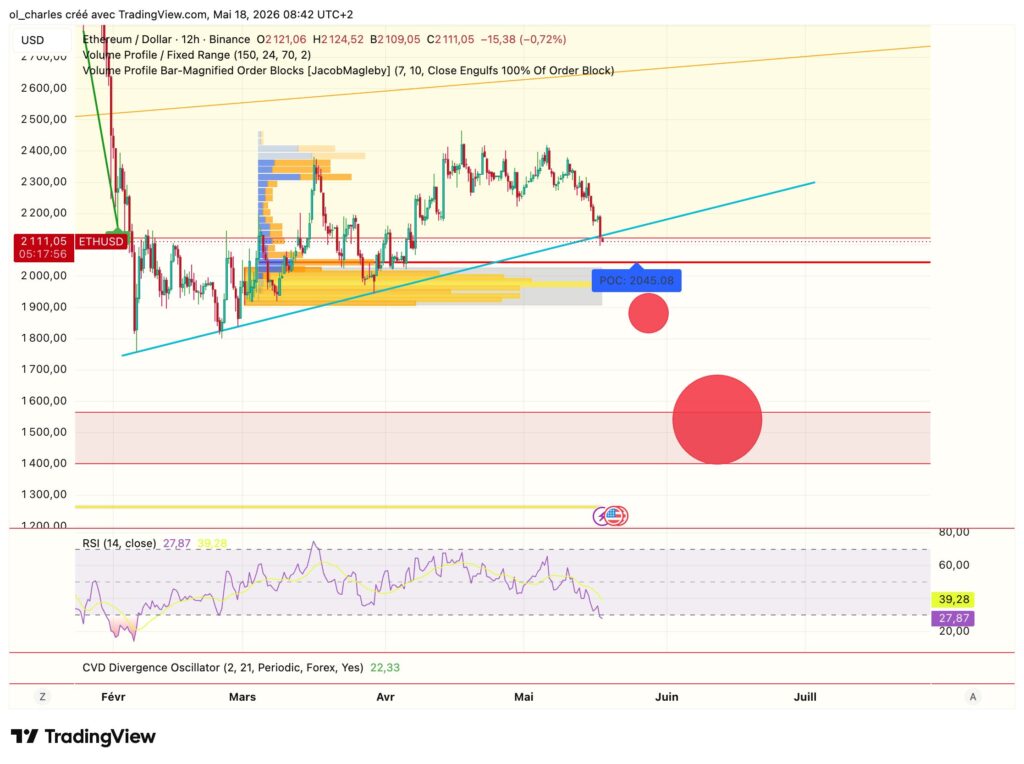
Conversely, a bullish scenario remains possible if the bulls regain control of the price action. A bounce from current levels would require a breakout above local resistances to invalidate the bearish structure. Additionally, the 12H RSI is oversold and the POC at $2,000 could hold the price for some time, which would leave room for buyers to step in. This level will therefore be crucial in the coming days. Any signs of accumulation at this level should be closely monitored.
However, in the face of institutional capital flight, caution is advised and buying volumes are sorely lacking.
The market needs a powerful catalyst to reverse this negative dynamic and revive investor interest. Is this the right time to accumulate aggressively or should we prepare for another bloody purge on altcoins?
But the catalyst for Ethereum could very well be the CLARITY Act. Indeed, according to the CEO of Sharplink, Joseph Chalom, ETH could “explode” if the bill is passed and launched. The X account Ethereum Daily states that Ethereum has a competitive advantage on the Clarity Act’s decentralization test. According to them, “blockchains like Sui, Avalanche, Hedera, Tron and almost all of Ethereum’s competitors fail on several points”:
“Ethereum is quietly emerging as the big winner in crypto thanks to the CLARITY Act. Ethereum gets the top tier of the ‘monetary premium’, the same prestigious category as Bitcoin. The two main bearish arguments against Ethereum (SEC risk and the risk of being replaced by faster blockchains) have just disappeared.”
Sources:
Related Articles:

