

JPMorgan deploys a new on-chain behemoth
JPMorgan is taking another step forward in its Web3 strategy. The bank has just filed an application with the SEC to launch the JPMorgan OnChain Liquidity-Token Money Market Fund, dubbed JLTXX. This tokenized money market fund will operate exclusively on the Ethereum blockchain. The choice of network is no coincidence: it confirms Ethereum’s dominance as the go-to settlement layer for institutional finance.
The fund will be managed by Kinexys Digital Assets, the internal crypto division of JPMorgan. It will invest in US Treasury bills and repurchase agreements (repos), with transactions settled in a matter of minutes. This operational efficiency stands in stark contrast to the usual delays of traditional finance. For institutional players managing billions of dollars in daily liquidity, this speed gain represents a direct and measurable competitive advantage.
This is not the bank’s first move in this arena. In late 2025, JPMorgan had already launched MONY, its first tokenized fund. With JLTXX, the ambition goes up a notch. The bank is no longer testing, it is industrializing. For investors looking to understand the underlying dynamics driving Ethereum forecasts, this type of structural institutional adoption is precisely the catalyst to watch over the medium term.
GENIUS Act: JPMorgan targets stablecoin reserves
The structure of JLTXX was not designed by chance. The fund was architected to comply with the GENIUS Act, the US legislation on stablecoins enacted in July 2025. By positioning itself as an eligible reserve asset for stablecoin issuers, JPMorgan is targeting a colossal market. Issuers of dollar-pegged tokens must hold liquid and secure reserves: JLTXX is designed to fulfill exactly this role.
The real-world asset tokenization market RWA has grown by over 400% since early 2025, reaching an ATH of $37 billion. This momentum is not slowed down by the price volatility of cryptocurrencies. It follows its own logic, driven by the real operational needs of financial institutions. BlackRock, Fidelity, and now JPMorgan are building the foundations of the next cycle on Ethereum, regardless of short-term market sentiment.
The implication for the DeFi ecosystem is direct. The smart contracts managing these tokenized funds generate gas fees and structural network activity. Unlike speculative volumes that disappear during bear market phases, this institutional utility is long-lasting. It is exactly this type of fundamental demand that supports price floors during corrections and differentiates Ethereum from other competing networks.
Ethereum establishes itself as the institutional standard
The repeated choice of Ethereum by the world’s largest financial institutions is no longer a coincidence. It is a consolidating consensus. JPMorgan thus joined BlackRock with its iShares Staked Ethereum Trust ETF (ETHB) on the same network. This institutional convergence around Ethereum creates a powerful network effect: the more institutions deploy on it, the more indispensable the network becomes, and the higher the risk of leaving it.
Ethereum’s proof of stake plays a key role in this adoption. Institutional staking allows large corporate treasuries to generate a yield on their ETH positions, transforming the asset into a productive instrument. This is a decisive argument for asset managers subject to performance obligations.
For retail investors looking to invest in crypto by aligning with institutional flows, Ethereum currently presents a solid fundamental profile. The fundamental analysis of the network points to growing and structural utility. Securing your ETH on a Ledger or a MetaMask remains the recommended setup for those adopting a HODL strategy over the medium term.
Can ETH explode to a new ATH this year?
The question deserves a nuanced answer. The fundamentals clearly argue in favor of a revaluation of ETH. Every new tokenized fund deployed on Ethereum mechanically reduces the circulating supply available on secondary markets. This value capture mechanism is direct: the more the network is used to settle institutional transactions, the more the demand for ETH as the network’s fuel increases structurally.
On the technical side, the Ethereum forecasts from on-chain models indicate key resistance zones to watch. The weekly RSI and the MACD suggest a momentum that is rebuilding after recent corrections. The open interest on ETH contracts is quietly increasing, a signal that fresh capital is entering the market without excessive euphoria. The overall fear and greed index remains in neutral territory, leaving significant room for growth.
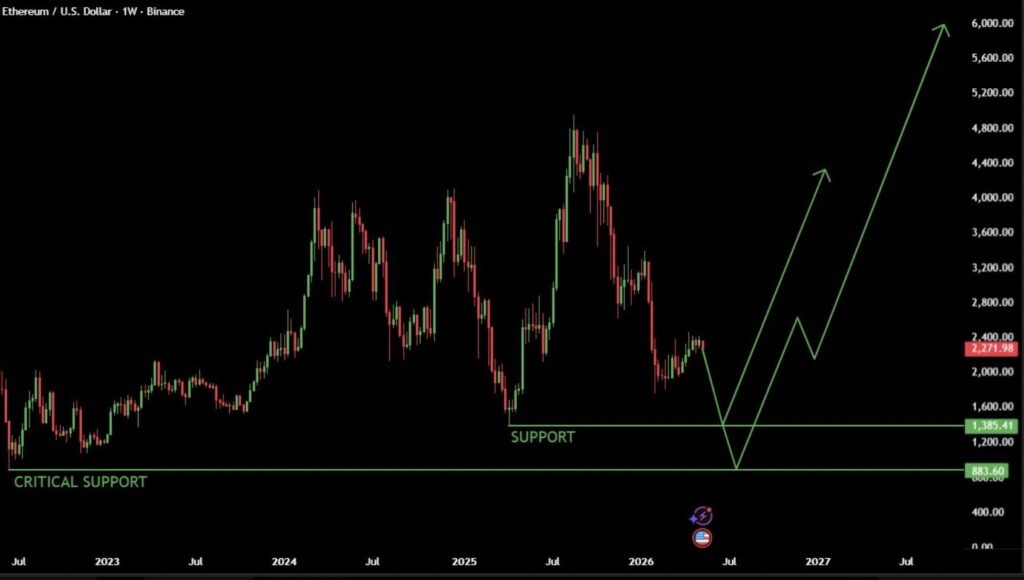
Our take: JPMorgan and JLTXX represent much more than just another financial product. It is the definitive validation of Ethereum as the infrastructure of tomorrow’s global finance. For those who buy Ethereum with long-term conviction, the convergence between institutional adoption and continuous network improvement paints a fundamental scenario rarely seen this solid. The crypto trend on ETH remains bullish on higher timeframes, and the institutional crypto bull run is already underway, silently.
Sources:
- BSCNews on X
- tokenterminal on X
- TradingView
Related Articles:

