
Pi Network: April 6th update – Will the price explode?
Discover the latest Pi Network update on April 6th! Will the price surge after 526 million KYC verifications? Get the insights you need.


Discover the latest Pi Network update on April 6th! Will the price surge after 526 million KYC verifications? Get the insights you need.
In the realm of highly community-driven crypto projects, Pi Network has just reached a significant operational milestone. The Core Team has officially confirmed the distribution of the first cycle of KYC rewards, revealing the true scale of the work accomplished by its decentralized network. The figures published on the official blog are precise and verifiable. Exactly 526,970,631 validations were completed by 1,094,680 human validators, successfully verifying the identity of 18 million users worldwide.
Each Pioneer’s KYC application required an average of 20 validations before reaching a final decision. This process breaks down an application into several distinct tasks assigned to different validators. Each task requires at least two independent validations for the liveness video, identity document, and photo. This design preserves privacy while ensuring accuracy.
The compensation for this collective effort is also accurately documented. The price per validation was calculated at 0.0504179 PI per successful validation, which is 21 times the base mining rate. This includes the 16,568,774 PI from the reward pool, supplemented by 10 million PI sponsored by the Pi Foundation to cover the network’s bootstrapping phase.
The date of April 6, 2026, is a strict deadline with no room for maneuver. “This is not an optional update. It is a security and compatibility hard fork,” confirmed the Pi OpenMainnet 2025 account, describing the upgrade as a step toward network unification. As stated in the official announcement:
“Every Mainnet node operator must complete the upgrade to remain synchronized,” and “any node missing this deadline risks immediate disconnection from the Mainnet.”
This deadline primarily concerns desktop node operators. Those who mine exclusively via the mobile app generally do not need to take any direct action regarding this update. The latest desktop node version listed on the official page is version 0.5.4.
This clarification is worth highlighting for community members who may be unduly worried. The vast majority of mobile users are not directly affected by this technical migration. It is the infrastructure operators who bear the responsibility for compliance by April 6.
The strategic dimension of this update goes beyond simple technical maintenance. The Pi Day 2026 blog indicates that Protocol 20 lays the foundation for smart contract capabilities and that other protocol changes are being gradually integrated to align the blockchain with newer versions. This suggests that the latest node requirement is part of a broader rollout linked to future ecosystem features.
Unlike centralized KYC platforms that rely on a single third-party provider, Pi Network has distributed the work and rewards across its community. This approach diffuses value among users rather than concentrating it in the hands of a centralized provider. The Core Team plans to introduce new KYC tasks, creating additional opportunities for participation.
This model is structurally interesting beyond Pi Network: it demonstrates that a blockchain can build a functional, large-scale decentralized workforce, compensated in a native token, for tasks requiring human judgment. This is precisely the argument the Core Team puts forward to position Pi as a “human-in-the-loop” infrastructure for the AI economy.
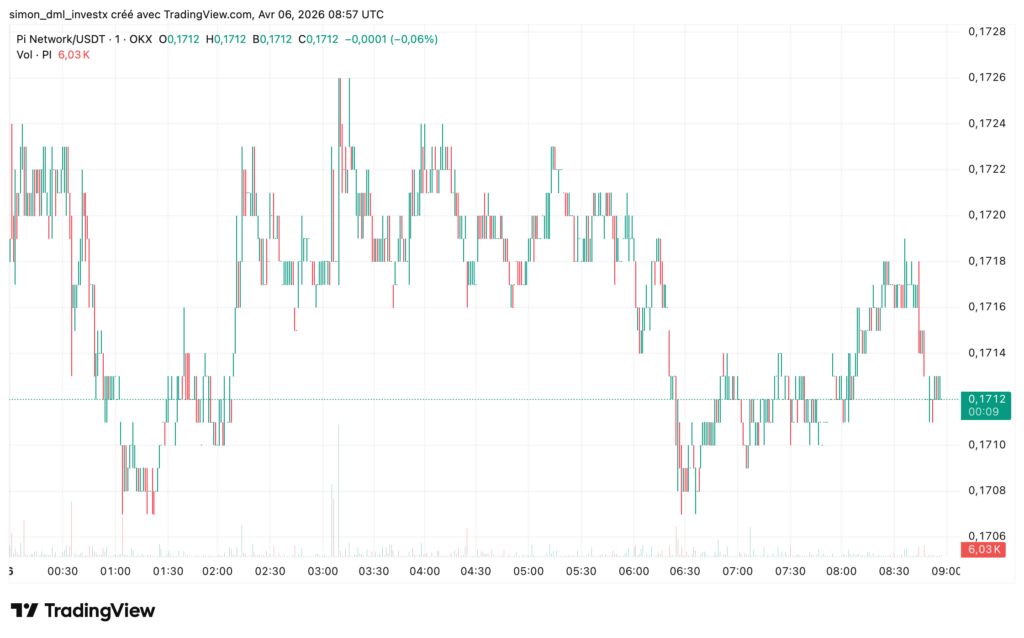
In terms of price, the PI token is trading around $0.17 on over-the-counter (OTC) markets after testing the $0.30 zone during its stint on Kraken. After the Kraken listing propelled the token near $0.29, the price slipped to approximately $0.176 on March 28 as market sentiment weakened. The compression of the Bollinger Bands visible on the daily chart suggests that a directional move is brewing, the outcome of which will largely depend on the rollout of the April 6 update and the activation of smart contracts planned with Protocol v23.0.
Our take on this matter: Pi Network remains a project with operational fundamentals that are stronger than its sometimes skeptical image in crypto media might suggest. 526 million validations on a decentralized infrastructure is a concrete technical achievement that few projects can showcase at this stage. The real question for traders remains the actual launch of the public Mainnet and the activation of smart contracts. Without these elements, institutional liquidity will remain limited, and price predictions will stay speculative.
Sources:
Related Articles:

Crypto analyst with over 7 years of trading experience and a strong background in the iGaming and cryptocurrency industries, I cover crypto news with a rigorous yet accessible approach. Passionate about blockchain since 2019, I have published more than 1,200 articles and guides on cryptocurrencies, DeFi, and blockchain, recognized for their reliability and clarity.
Specializing in on-chain trading and whale activity analysis, I decode blockchain flows to anticipate market trends before they become obvious.
One of my articles was cited by Éric Larchevêque, co-founder of Ledger, highlighting the quality and credibility of my analysis.
My goal remains unchanged: to make crypto accessible and understandable for everyone, from beginners to experienced investors.
Follow me on LinkedIn and X to stay updated with my latest insights.
DISCLAIMER
This article is for informational purposes only and should not be considered as investment advice. Trading cryptocurrencies involves risks, and it is important not to invest more than you can afford to lose.
InvestX is not responsible for the quality of the products or services presented on this page and cannot be held liable, directly or indirectly, for any damage or loss caused by the use of any product or service featured in this article. Investments in crypto assets are inherently risky; readers should conduct their own research before taking any action and invest only within their financial means. This article does not constitute investment advice.



Risk Warning : Trading financial instruments and/or cryptocurrencies carries a high level of risk, including the possibility of losing all or part of your investment. It may not be suitable for all investors. Cryptocurrency prices are highly volatile and can be influenced by external factors such as financial, regulatory, or political events. Margin trading increases financial risks.
CFDs (Contracts for Difference) are complex instruments with a high risk of rapid capital loss due to leverage. Between 74% and 89% of retail investor accounts lose money when trading CFDs. You should assess whether you understand how CFDs work and whether you can afford to take the high risk of losing your money.
Before engaging in financial or cryptocurrency trading, you must be fully informed about the associated risks and fees, carefully evaluate your investment objectives, level of experience, and risk tolerance, and seek professional advice if needed. InvestX.fr and the InvestX application may provide general market commentary, which does not constitute investment advice and should not be interpreted as such. Please consult an independent financial advisor for any investment-related questions. InvestX.fr disclaims any liability for errors, misinvestments, inaccuracies, or omissions and does not guarantee the accuracy or completeness of the information, texts, graphics, links, or other materials provided.
Some of the partners featured on this site may not be regulated in your country. It is your responsibility to verify the compliance of these services with local regulations before using them.

