

Nine wallets, 80 positions, 98% win rate
The case has sent shockwaves through the crypto ecosystem. According to onchain detectives at Bubblemaps, a cluster of nine wallets generated massive profits by betting exclusively on US military actions in the Middle East. These addresses, created just days before the first American strikes in late February 2026, boasted a 98% win rate across more than 80 positions. This level of performance has less to do with technical analysis and more to do with access to classified information. Nicolas Vaiman, CEO of Bubblemaps, described this activity as the “craziest pattern ever seen on Polymarket“.
These shadow traders anticipated major geopolitical events with surgical precision. They predicted the exact date of the US strikes, the removal of Iranian Supreme Leader Ali Khamenei, and the announcement of the ceasefire. The statistical probability of achieving such a success rate on low probability bets purely by chance is infinitesimal. This type of performance brings to mind documented cases of institutional pump and dump schemes but in an unprecedented geopolitical format. The blockchain made it possible to track every movement with a level of precision that traditional financial markets simply cannot offer.
To cover their tracks, these crypto whales deliberately lost small amounts on minor bets. This tactical sophistication was designed to outsmart onchain surveillance algorithms. The funds were then quickly extracted through centralized exchanges like Bybit, Binance and HTX. The speed and method of this capital exfiltration reinforce the theory of an operation orchestrated by insiders with classified information. The immutable transparency of the blockchain ultimately backfired on the alleged perpetrators.
Prediction markets: A 20 billion bull run
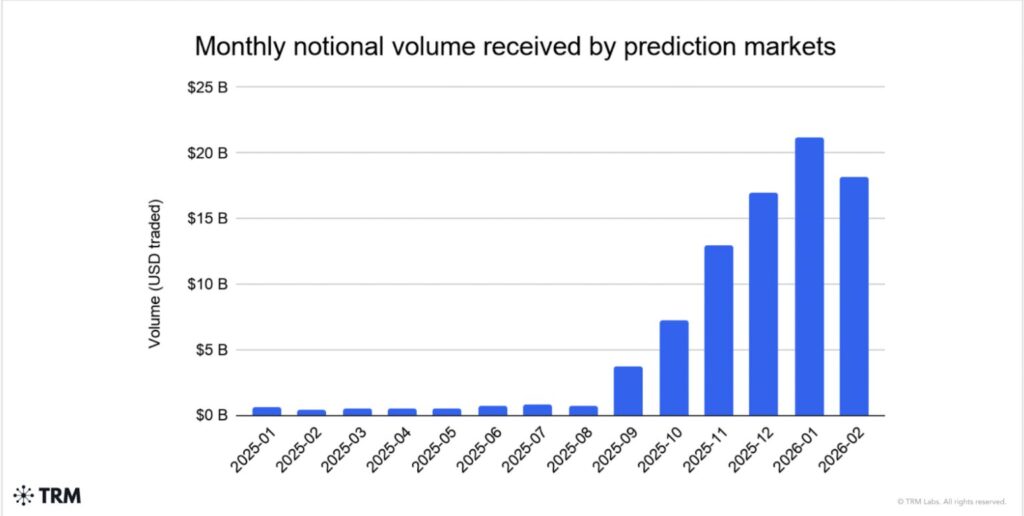
The craze for prediction markets shows no signs of slowing down. According to TRM Labs, monthly volumes on these platforms have skyrocketed, jumping from $1.2 billion in early 2025 to nearly $20 billion by early 2026. This bull run is driven by the financialization of geopolitical events, which are now traded with the same enthusiasm as Bitcoin or Ethereum. The democratization of these platforms has created a liquid market accessible to everyone, including the most unscrupulous actors. Volume has become both a strength and a structural vulnerability for this ecosystem.
This abundant liquidity inevitably attracts malicious smart money. Last month, a US Army soldier was indicted for using classified intelligence to pocket over $400,000 on Polymarket. This case, combined with the recent suspicious gains regarding Iran, highlights a new form of insider trading where national defense secrets become an unfair competitive advantage. Crypto trading on prediction markets reveals its darkest corners here. Retail investors find themselves structurally disadvantaged against actors holding sovereign information.
The paradox of Polymarket lies in its absolute transparency. While identities remain anonymous, every transaction is immutable and public on the blockchain. Investigators can track capital flows and identify statistical anomalies with a precision that traditional markets cannot provide. This double edged sword of Web3 transparency paves the way for federal investigations unprecedented in the history of decentralized finance. The CFTC is now intensifying its surveillance of these platforms, a development that operators can no longer ignore.
Regulation comes to Polymarket
American regulators are facing an unprecedented challenge. Polymarket operates in a DeFi space where smart contracts automatically execute bets without any identifiable intermediary. However, the CFTC has sufficient legal tools to prosecute individuals who use non public information for profit, regardless of the medium used. The indictment of the US soldier proved that onchain anonymity does not guarantee legal impunity. Federal investigators have now mastered clustering analysis techniques to link anonymous wallets to real identities.
The question of implementing KYC (Know Your Customer) measures on Polymarket divides the crypto community. On one hand, these measures would reduce the risk of insider trading and protect retail investors. On the other, they would break the growth momentum and the fundamental appeal of a permissionless DeFi platform. This dilemma is at the heart of the crypto trend toward institutional compliance. The crypto taxation applied to these prediction gains also provides a legal angle of attack for authorities. A regulatory bear market in this segment seems inevitable.
The uncensorable nature of the blockchain nevertheless remains the last line of defense for these platforms. Even if Polymarket were shut down in one jurisdiction, decentralized copies would immediately emerge on other networks. This phenomenon illustrates the fundamental tension between individual sovereignty guaranteed by cryptography and national security imperatives. Developers will have to find a balance between openness and compliance to avoid a forced administrative shutdown. The confidence fear and greed index toward these platforms is now in uncertain territory.
Can Polymarket survive the scandals?
The credibility of Polymarket is now being put to the test. While the platform continues to break records for active users, the proven presence of government insiders could trigger a brutal confidence correction among retail investors. The fundamental question is simple: why bet if the dice are loaded by actors with classified information? This question eats away at the core value proposition of prediction markets, which relies on the aggregation of dispersed information to converge toward the truth. A rigged market cannot fulfill this epistemic function.
Investors looking to invest in crypto on these platforms must now factor in this structural asymmetric risk. Participating in a market where certain actors hold sovereign information inaccessible to the general public is a form of uncompensated risk taking. Onchain transparency remains the best tool to identify these anomalies and protect retail capital. Onchain fundamental analysis tools like those from Bubblemaps play a crucial role here as a decentralized watchdog. Their ability to identify statistically impossible patterns is the best response the ecosystem can provide to these abuses.
The future of prediction markets will depend on the ability of the Web3 community to self regulate before regulators impose restrictive frameworks. Mechanisms for statistical anomaly detection integrated directly into smart contracts could provide a technological answer to this problem. The confidence price prediction for Polymarket remains negative in the short term as long as federal investigations remain open. The prediction market crypto bull run could well turn into a major regulatory correction if the industry does not take the lead. This case will go down as a turning point in the history of decentralized finance.
Sources:
- FranceCryptos on X
- TRM Labs
- ProMint_X on X
Related Articles:

