

The Falcon Upgrade: Solana’s Ultimate Shield?
The threat of a quantum apocalypse still looms large over the crypto ecosystem. If tomorrow’s supercomputers manage to crack current private keys, the entire security of Web3 would collapse, leading to a catastrophic scenario. To counter this existential risk, Solana’s core developers, Anza and Firedancer (backed by Jump Crypto), have conducted independent research. Their conclusion is unanimous: the network must adopt Falcon, an ultra-secure post-quantum digital signature scheme.
What is Falcon and why choose it? This protocol stands out for its compact signatures, a vital feature for maintaining the performance of a high throughput and low latency blockchain like Solana. Unlike other heavy solutions that could slow down the network and cause a bottleneck in the DeFi ecosystem, Falcon guarantees a seamless transition. The first code implementations are already available on the GitHub repositories of both teams.
This technological foresight sends a strong signal to the market. As preparations for the next bull run intensify, reassuring institutional players about the network’s long-term viability is crucial. Solana proves its ability to innovate without compromising on speed, thereby consolidating its position as a technological leader against its direct competitors.
A meticulously planned roadmap to avoid chaos
Although the quantum threat is not expected to materialize for several years, the Solana Foundation refuses to fly blind. It has unveiled a three-phase roadmap to integrate Falcon without disrupting users.
The first stage focuses on continuous research and performance testing. Then, if the threat becomes imminent, post-quantum cryptography will be enforced for all new wallets created on the network, preventing any unpleasant surprises.
Finally, the third phase will involve migrating existing wallets to this new security standard. The objective is clear: to avoid any massive market bug caused by a technical error. Moreover, the Solana ecosystem is no stranger to resilience. Blueshift’s Winternitz Vault, a cryptographic primitive resistant to quantum attacks, has already been running smoothly on the mainnet for over two years.
Developers assure that these modifications will have no significant impact on current performance. By avoiding rushed protocol changes, Solana maintains the stability of its decentralized infrastructure. This pragmatic approach allows traders and investors to stay focused on price action and rally opportunities, without fearing a sudden security breach.
Nevertheless, the implementation remains complex and sensitive to side-channel attacks. In short, side-channel attacks do not attempt to crack Falcon’s codes. Instead, they exploit information leaks that occur during the program’s execution on a physical computer. If the code is not constant-time, an attacker with physical or close access to the machine such as a server, hardware wallet, or smartphone can observe these variations and deduce information about the private key. Therefore, this primarily endangers wallets and validator nodes rather than the signatures themselves.
What is the impact on SOL?
On a fundamental level, this preemptive upgrade is an extremely positive catalyst. By removing the quantum risk from the equation, Solana becomes one of the most future-proof blockchains on the market. This narrative could attract massive capital, especially since spot ETFs and institutional products demand flawless long-term security guarantees.
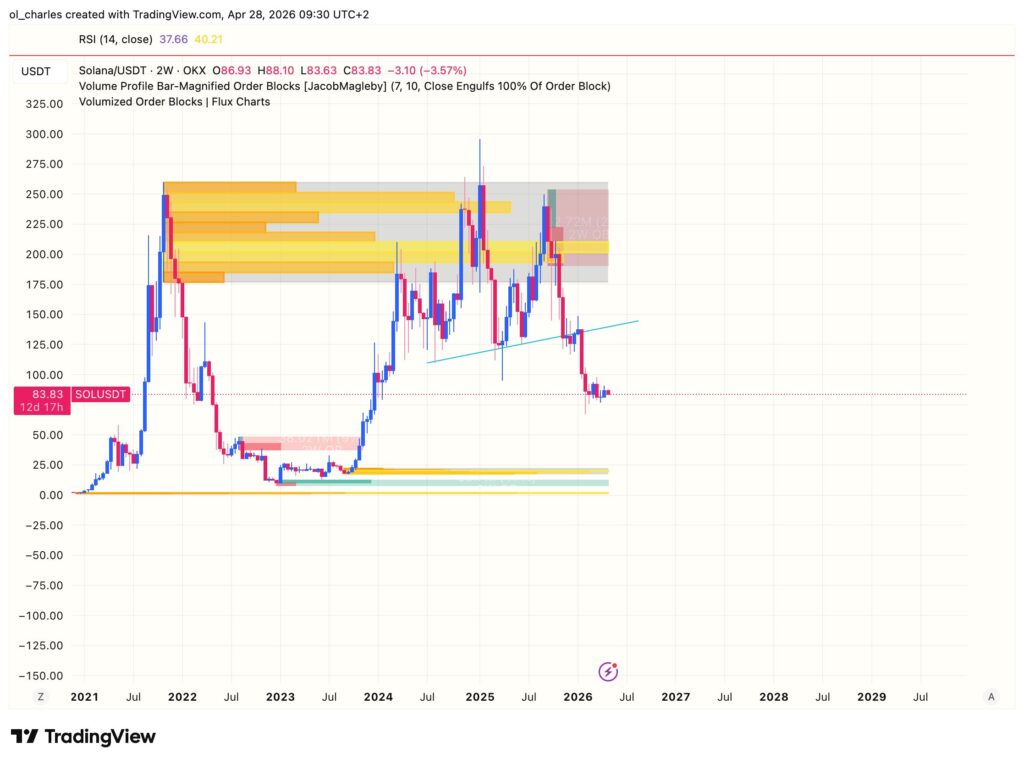
Technically, the SOL token is showing signs of weakness and bearish divergences. This announcement is expected to have a more profound impact on the fundamentals and the long-term trend, rather than the short and medium-term trend, which appears bearish as long as the token fails to hold above $92.
Sources:
Related Articles:

