

The XRP Ledger vs DeFi hacks: A unique architecture
For several years, losses linked to security flaws in DeFi have been piling up at an alarming rate. The XLS 66d amendment integrates lending logic directly into the protocol, eliminating a large portion of the risks associated with autonomous smart contracts. It is precisely this original architectural choice that sets the XRP Ledger apart from its competitors, a choice that makes perfect sense today as hacks multiply across other chains.
Unlike Ethereum or Solana, whose DeFi ecosystems rely heavily on external contracts and cross chain bridges, the XRPL took the opposite approach right from its inception in 2012 by integrating financial functions directly at the protocol level. This structural discipline allows the network to avoid the attack surface created by additional application layers, which are often responsible for the worst hacks in the industry.
The difference is not just a marketing pitch. On blockchains like Ethereum, lending or exchange protocols are contracts deployed outside the core network. A single flaw in a third party protocol code is enough to compromise hundreds of millions of dollars, without the network itself being at fault. This is the recurring pattern seen in every major hack over the past few years.
On the XRPL, the ledger itself now governs borrowing terms, repayments and authorizations without going through an intermediary layer. This native transaction finality eliminates the need for external bridges, which account for the majority of thefts recorded in DeFi. For crypto investors looking to assess the real risks of their positions, this distinction is fundamental.
David “JoelKatz” Schwartz, former CTO of Ripple and one of the original architects of the XRP Ledger, indicated that the acquisition of Hidden Road by Ripple represents a defining moment for the XRPL. The prime broker processes over $10 billion per day on traditional rails.
XLS 66d: The native lending game changer
It is in this context that the XLS 66d amendment takes on particular importance. Ripple collaborated with Immunefi to organize an Attackathon with a $200,000 reward pool from October 27 to November 29, 2025. Over 60,000 security researchers tested the protocol mechanisms, including interest calculations and loan settlement logic.
On January 28, 2026, the XLS 66d amendment entered the validator voting phase following the release of XRPL version 3.1.0. All 34 validators began voting on the activation of native lending directly on the XRP Ledger. The activation threshold requires an 80% consensus maintained for two consecutive weeks, a particularly robust governance mechanism.
The protocol integrates fixed rate and fixed term loans directly at the ledger level, while pool administrators manage underwriting, servicing and first loss capital. This creates an institutional grade framework with on chain transparency and deterministic behavior.
For users wanting to understand how to invest in cryptocurrency using secure on chain tools, this type of infrastructure represents a concrete step forward.
This is exactly what institutions are waiting for
The security argument for the XRPL is not just an abstract technical matter. Under bullish conditions, XRP could reach $3.50 to $5.00 by the end of 2026 if the lending protocol activates correctly and gains significant traction among institutional borrowers. These projections are conditional but they reflect a real logic: banks, custodians and regulated funds need accounting predictability and risk segregation before committing capital on chain.
Single Asset Vaults change the way credit structures operate on the XRPL by isolating risk at the vault level. Each loan is contained within a dedicated vault linked to a single asset, such as XRP or RLUSD. This design replicates the compartmentalization mechanisms that financial institutions demand in traditional finance, but on a decentralized infrastructure.
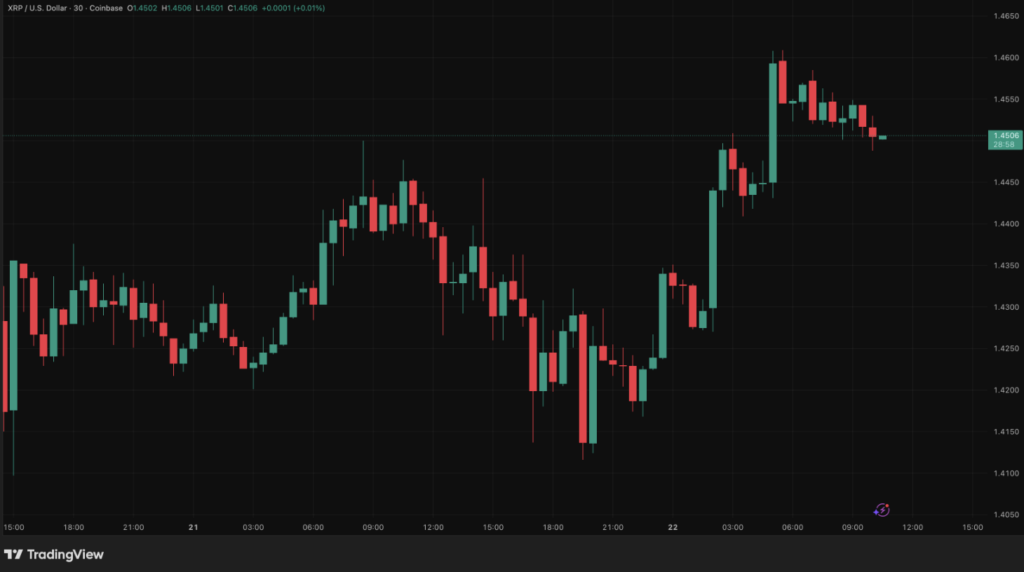
On the crypto trading side, technical signals for XRP remain constructive. The token is defending key structural supports in a context of capital rotation favorable to altcoins, with volumes increasing without the price correcting proportionally, a usual sign of quiet accumulation.
Can the XRPL become the standard for institutional DeFi?
The real question is no longer whether the XRPL is secure. Thirteen years without a major protocol flaw is an empirical demonstration that few networks can claim. The question is whether this architecture will be recognized as the benchmark model as losses pile up elsewhere.
Our analysis is that the XRPL is positioning itself in a niche that no one truly occupied, that of secure institutional DeFi. It is not the most experimental network in the sector and that is not its ambition. It is precisely this architectural conservatism that makes it a serious candidate today for the capital flows that institutions were hesitant to commit on chain.
Ripple presented its vision for institutional DeFi on the XRP Ledger, specifying that the network relies on its fundamental strengths: a native DEX, low fees, fast settlement times and an architecture compatible with regulatory compliance.
For investors wanting to follow these developments in detail, XRP price predictions and tracking the amendments currently being voted on remain the top indicators to watch in the coming weeks.
Sources:
Related Articles:

