

XRP Ledger and ZK Proofs: The Institutional Catalyst
Paris Blockchain Week 2026 has delivered its most foundational announcement yet. Boundless and XRPL Commons have officially announced the native integration of a Zero-Knowledge (ZK) verifier directly on the XRP Ledger. This is no cosmetic update: it is a technological building block that directly addresses the two main hurdles preventing major financial institutions from using a public blockchain for their sensitive operations.
The dilemma was real. Institutions want the speed and efficiency of the XRPL, but they cannot publicly expose their transaction amounts, counterparties, or trading strategies on a fully transparent blockchain. ZK proofs solve this problem cleanly: transactions remain verifiable without revealing their content, allowing entities to stay compliant with KYC/KYB requirements while preserving operational confidentiality.
Odelia Torteman, Director of Adoption at XRPL Commons, was clear about the implications: this native infrastructure unlocks use cases previously impossible on public blockchains. Major stablecoins like RLUSD, USDC, and USDT can now circulate on the XRPL within a confidential and regulatory compliant framework. To understand why this combination is so rare in the ecosystem, our guide on blockchain and smart contracts details the technical constraints that this type of integration overcomes. XRP holders will be closely watching the next steps of the rollout.
Protection Against MEV Bots is a Major Selling Point
The ZK integration brings an additional advantage often underestimated in mainstream analysis. By allowing off-chain proofs to be generated and verified natively on the network, the XRPL now protects order flows against MEV bots (Maximal Extractable Value). These bots, which siphon millions of dollars a day on Ethereum by front running visible transactions in the mempool, can no longer operate on transactions with encrypted content.
For institutional trading desks, this is a decisive argument. Executing large orders on a public blockchain without MEV protection is like playing poker with your cards facing up. The XRPL has just closed this vulnerability. Markus Infanger, Vice President of RippleX, was set to present the XRPL at Paris Blockchain Week as a cutting edge financial infrastructure. This positioning now makes perfect sense against competitors like Ethereum or Solana, which still struggle to solve this problem natively. To secure your XRP assets, using a Ledger wallet remains the gold standard for institutional cold storage.
What the Numbers Say About the XRP Market
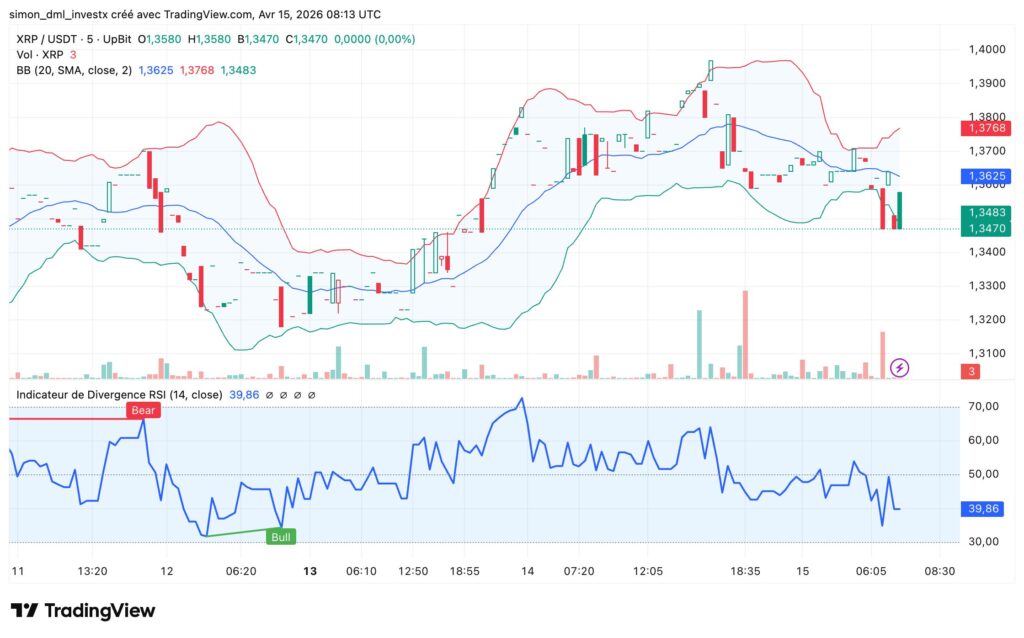
Market data confirms that traders anticipated this event. Volumes on XRP options have skyrocketed by 215%, reaching $3.76 million, a classic signal of aggressive positioning ahead of a major catalyst. The price is currently consolidating around $1.35, in a technical compression that has lasted for several weeks.
The long term chart setup is particularly interesting. Analysts point to an ascending triangle that is nine years old and approaching its apex. This type of structure, when it breaks out to the upside with volume, historically generates the most powerful moves of the cycle. The immediate resistance to watch is at $1.40: a weekly close above this level would radically shift the momentum. To follow XRP price predictions and understand the mechanics of the XRP blockchain, the $2.50 target put forward by several analysts remains conditional on this breakout. Traders looking to position themselves can compare fees and available liquidity on specialized exchanges before entering the market.
Tomorrow’s Standard for Institutional DeFi?
The true scope of this announcement goes beyond the XRP ecosystem alone. By combining confidentiality and regulatory compliance on a fast and low cost public blockchain, the XRPL offers an architecture that regulators cannot easily dismiss. This is exactly what banks and funds are looking for as they seek to enter decentralized finance without sacrificing their reporting obligations.
Crypto RWAs and the tokenization of traditional assets are the most closely followed narratives by institutions in 2026. The XRPL now positions itself as the best equipped infrastructure to host them, ahead of competitors that have not yet natively integrated this level of programmable privacy. For investors looking to buy XRP or simply understand what is at stake, the question is no longer whether institutions will adopt the XRPL, but how quickly their technical teams will validate the infrastructure and begin real world deployments. Storing your XRP on a Ledger Nano X remains the most secure solution for long term investors.
Sources:
- CoinDesk
- beincrypto on X
- CoinGapeMedia on X
- TradingView
Related Articles:

