
Solana vs. Ethereum: Which crypto to buy in 2026?
SOL vs ETH: Expert analysis & price predictions. Will Solana outperform Ethereum? Discover key scenarios and investment insights for 2026.

SOL vs ETH: Expert analysis & price predictions. Will Solana outperform Ethereum? Discover key scenarios and investment insights for 2026.
The crypto market is going through a widespread correction phase. Ethereum is trading in a range between $1,994 and $2,020, while Solana is consolidating around $82 to $83. Behind these depressing figures, however, the internal dynamics of the Solana network tell a radically different story.
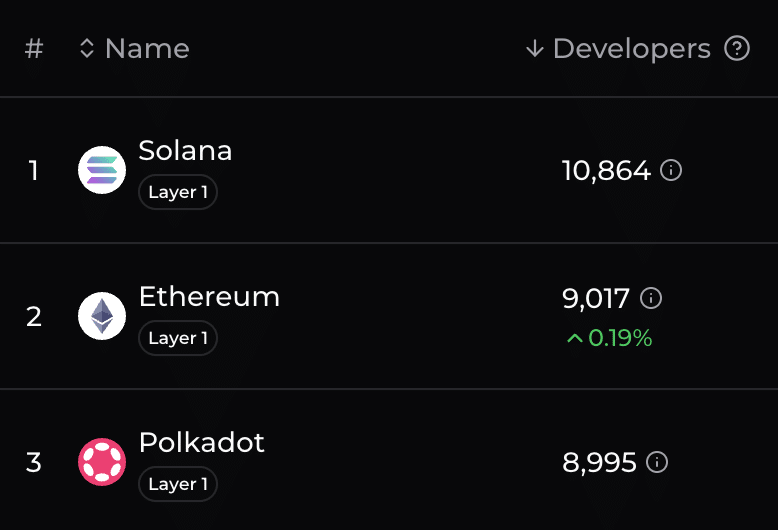
Solana has just surpassed Ethereum in total unique developers, now leading all blockchains with 10,864 developers, which is nearly 20% more than Ethereum. This is a structural shift that has not occurred since 2016.
What makes this figure particularly significant is that developers always precede user adoption. When creators migrate to an ecosystem, applications follow, and with them come liquidity and volumes. The effects of this growth are already playing out in real time: Solana DEX volumes now surpass all other blockchains across all timeframes, a metric confirmed by DefiLlama.
The USD1 supply on Solana has grown from $160 million to $850 million in just 60 days, with daily volumes ranging between $200 million and $300 million. USDC also continues its massive expansion on the network, fueling on-chain activity.
When a stablecoin enters a network on a massive scale, it represents liquidity waiting to be deployed. In February 2026, stablecoin transactions on Solana exceeded $650 billion, while the RWA market capitalization reached $1.71 billion. These flows are not speculative; they reflect real and growing utility.
This is where the analysis becomes actionable for traders. Since dropping below 0.05 following the crash last October, the SOL/ETH ratio has been struggling to reclaim this psychological level. However, on the weekly timeframe, this ratio has never closed below the 0.04 zone, reinforcing the strength of this support.
This accumulation zone around 0.04 is the key to understanding the short-term scenario. If fundamentals continue to diverge positively in favor of Solana while the ratio holds this support, bullish pressure will organically build up. Momentum indicators such as the RSI and the MACD will be crucial in validating a reversal.
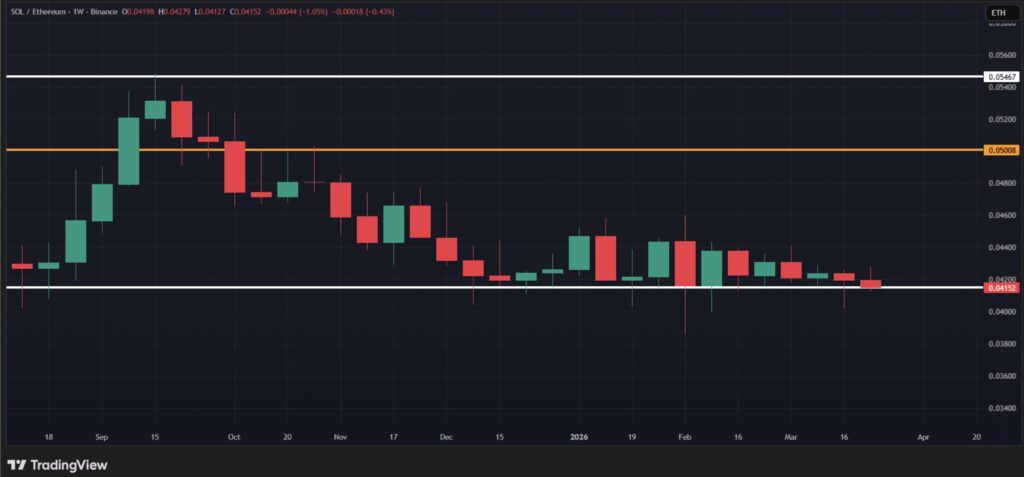
Two scenarios are at play. From a bearish perspective, a break below the 0.04 support would invalidate the momentum and expose SOL to a deeper retracement against ETH, especially if global liquidity continues to flee altcoins. Conversely, if buyers defend this level, the next target is reclaiming 0.05, which would allow SOL to significantly outperform Ether in Q2 2026.
What is striking is the disconnect between the fundamentals and the price. A blockchain that surpasses Ethereum in developers, dominates DEXs across all timeframes, and sees its stablecoin adoption explode in 60 days does not fit the profile of an asset in structural decline. The current correction looks more like an accumulation opportunity for a progressive DCA strategy than a capitulation signal. The market always ends up valuing what works. Solana works.
Sources:
Related Articles:

Crypto analyst with over 7 years of trading experience and a strong background in the iGaming and cryptocurrency industries, I cover crypto news with a rigorous yet accessible approach. Passionate about blockchain since 2019, I have published more than 1,200 articles and guides on cryptocurrencies, DeFi, and blockchain, recognized for their reliability and clarity.
Specializing in on-chain trading and whale activity analysis, I decode blockchain flows to anticipate market trends before they become obvious.
One of my articles was cited by Éric Larchevêque, co-founder of Ledger, highlighting the quality and credibility of my analysis.
My goal remains unchanged: to make crypto accessible and understandable for everyone, from beginners to experienced investors.
Follow me on LinkedIn and X to stay updated with my latest insights.
DISCLAIMER
This article is for informational purposes only and should not be considered as investment advice. Trading cryptocurrencies involves risks, and it is important not to invest more than you can afford to lose.
InvestX is not responsible for the quality of the products or services presented on this page and cannot be held liable, directly or indirectly, for any damage or loss caused by the use of any product or service featured in this article. Investments in crypto assets are inherently risky; readers should conduct their own research before taking any action and invest only within their financial means. This article does not constitute investment advice.

Risk Warning : Trading financial instruments and/or cryptocurrencies carries a high level of risk, including the possibility of losing all or part of your investment. It may not be suitable for all investors. Cryptocurrency prices are highly volatile and can be influenced by external factors such as financial, regulatory, or political events. Margin trading increases financial risks.
CFDs (Contracts for Difference) are complex instruments with a high risk of rapid capital loss due to leverage. Between 74% and 89% of retail investor accounts lose money when trading CFDs. You should assess whether you understand how CFDs work and whether you can afford to take the high risk of losing your money.
Before engaging in financial or cryptocurrency trading, you must be fully informed about the associated risks and fees, carefully evaluate your investment objectives, level of experience, and risk tolerance, and seek professional advice if needed. InvestX.fr and the InvestX application may provide general market commentary, which does not constitute investment advice and should not be interpreted as such. Please consult an independent financial advisor for any investment-related questions. InvestX.fr disclaims any liability for errors, misinvestments, inaccuracies, or omissions and does not guarantee the accuracy or completeness of the information, texts, graphics, links, or other materials provided.
Some of the partners featured on this site may not be regulated in your country. It is your responsibility to verify the compliance of these services with local regulations before using them.

