
What’s really happening behind the Bitcoin crash?
Bitcoin's price is fluctuating. Discover the hidden forces at play, including institutional accumulation. Will Bitcoin surge? Read the analysis now!


Bitcoin's price is fluctuating. Discover the hidden forces at play, including institutional accumulation. Will Bitcoin surge? Read the analysis now!
On the surface, Bitcoin’s price action is showing signs of weakness. The market is undergoing a prolonged correction, and short term sentiment is darkening. However, data published on CryptoQuant Insights tells a completely different story. The market is not crashing: it is undergoing a massive structural shift.
According to Ki Young Ju, CEO of CryptoQuant, the Bitcoin correction is directly linked to massive selling by historical whales whose entry costs are close to $16,000. This selling pressure outweighs the combined institutional buying from ETFs and MicroStrategy. For these early investors, the arrival of institutional capital provides an unexpected exit window, similar to an initial public offering.
Against them, corporate buyers are not backing down. MicroStrategy recently added another 5,000 BTC to its reserves, and the March 29 statement by Michael Saylor has bolstered institutional confidence. Furthermore, Bitcoin reserves on exchanges plummeted by roughly 20,000 BTC in a single week, coins that are likely heading into the cold storage of long term holders.
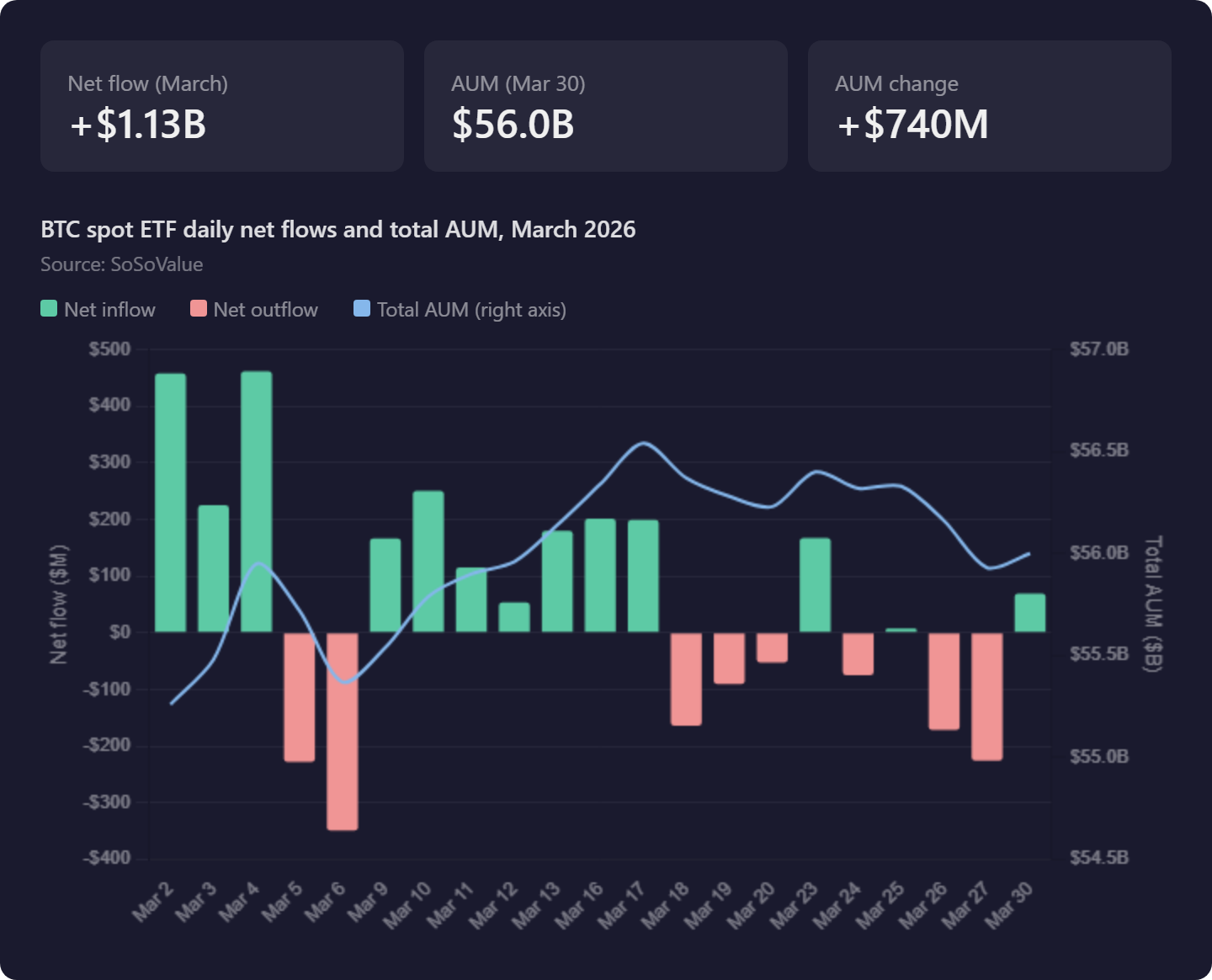
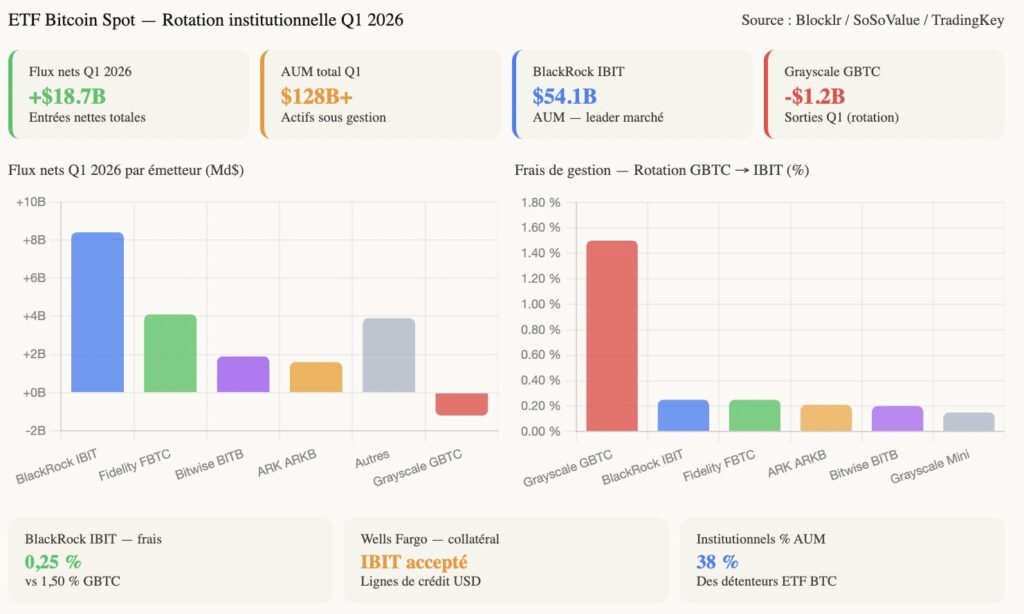
The other dynamic blurring the lines involves Spot Bitcoin ETFs. US Spot Bitcoin ETFs recorded $18.7 billion in net inflows in Q1 2026, pushing total assets under management beyond $128 billion. BlackRock IBIT dominated with $8.4 billion in net inflows, followed by Fidelity FBTC with $4.1 billion. Grayscale GBTC outflows slowed to $1.2 billion for the quarter.
GBTC outflows do not signal a flight from Bitcoin: the money is migrating toward cheaper products. GBTC charges a 1.5% management fee compared to 0.25% for BlackRock IBIT and Fidelity FBTC. This internal rotation gives the illusion of a stagnant market, when in reality it is a restructuring of institutional portfolios. The Bitcoin supply is not disappearing: it is simply changing hands.
BlackRock IBIT now boasts $54.12 billion in assets under management and has established itself as the primary vehicle for institutional liquidity. Wells Fargo now allows the use of Bitcoin ETF shares as collateral for dollar credit lines. This treats Bitcoin with the same financial utility as government bonds.
The current situation requires looking beyond daily charts. CryptoQuant data shows that Binance received 12,000 BTC from large wallets in a single day on February 6, ten times the monthly average. The whale signal is divided: some are accumulating, while others are positioning coins for sale. This confusion is reflected in contradictory on chain behaviors.
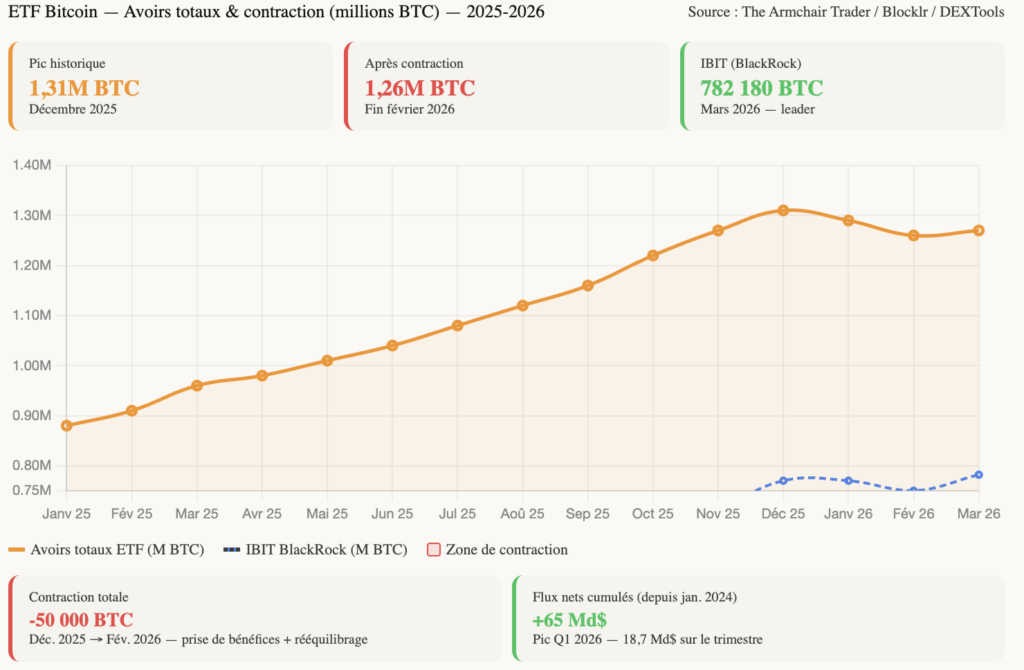
After reaching a peak of nearly 1.31 million BTC in December 2025, ETF holdings pulled back to around 1.26 million by the end of February 2026, marking the first sustained contraction since their launch. This development reflects a combination of profit taking, portfolio rebalancing, and increased volatility.
Traders who let themselves be blinded by the current bearish sentiment risk missing out on one of the biggest opportunities of this cycle. Once the selling pressure from whales is exhausted, the market could witness a spectacular breakout catching all short positioned traders off guard. How high can the price of Bitcoin soar once institutions have permanently locked up the available supply?
Sources:
Related Articles:

Crypto analyst with over 7 years of trading experience and a strong background in the iGaming and cryptocurrency industries, I cover crypto news with a rigorous yet accessible approach. Passionate about blockchain since 2019, I have published more than 1,200 articles and guides on cryptocurrencies, DeFi, and blockchain, recognized for their reliability and clarity.
Specializing in on-chain trading and whale activity analysis, I decode blockchain flows to anticipate market trends before they become obvious.
One of my articles was cited by Éric Larchevêque, co-founder of Ledger, highlighting the quality and credibility of my analysis.
My goal remains unchanged: to make crypto accessible and understandable for everyone, from beginners to experienced investors.
Follow me on LinkedIn and X to stay updated with my latest insights.
DISCLAIMER
This article is for informational purposes only and should not be considered as investment advice. Trading cryptocurrencies involves risks, and it is important not to invest more than you can afford to lose.
InvestX is not responsible for the quality of the products or services presented on this page and cannot be held liable, directly or indirectly, for any damage or loss caused by the use of any product or service featured in this article. Investments in crypto assets are inherently risky; readers should conduct their own research before taking any action and invest only within their financial means. This article does not constitute investment advice.

Risk Warning : Trading financial instruments and/or cryptocurrencies carries a high level of risk, including the possibility of losing all or part of your investment. It may not be suitable for all investors. Cryptocurrency prices are highly volatile and can be influenced by external factors such as financial, regulatory, or political events. Margin trading increases financial risks.
CFDs (Contracts for Difference) are complex instruments with a high risk of rapid capital loss due to leverage. Between 74% and 89% of retail investor accounts lose money when trading CFDs. You should assess whether you understand how CFDs work and whether you can afford to take the high risk of losing your money.
Before engaging in financial or cryptocurrency trading, you must be fully informed about the associated risks and fees, carefully evaluate your investment objectives, level of experience, and risk tolerance, and seek professional advice if needed. InvestX.fr and the InvestX application may provide general market commentary, which does not constitute investment advice and should not be interpreted as such. Please consult an independent financial advisor for any investment-related questions. InvestX.fr disclaims any liability for errors, misinvestments, inaccuracies, or omissions and does not guarantee the accuracy or completeness of the information, texts, graphics, links, or other materials provided.
Some of the partners featured on this site may not be regulated in your country. It is your responsibility to verify the compliance of these services with local regulations before using them.

