

Bitcoin Under Pressure: BoJ and Iran Dictate Market Tempo
The crypto market is navigating a phase of macroeconomic turbulence that few investors anticipated with such intensity. Two exogenous factors are currently dominating price action: the monetary policy of the Bank of Japan (BoJ) and the military escalation in the Strait of Hormuz. Combined, they create a risk-off environment that weighs heavily on all speculative assets, led by Bitcoin.
For investors looking to understand cryptocurrencies and their sensitivity to macro conditions, this market moment is particularly instructive.
The Bank of Japan maintained its benchmark interest rate at 0.75% during its March 2026 meeting. However, the signals sent by Governor Kazuo Ueda are far from trivial. Traders were pricing in a 69% probability of a rate hike at the April 28 meeting, according to Bloomberg data. One policy board member even explicitly called for stronger tightening in response to the inflationary impact of the Middle East conflict on Japanese society.
To understand why Tokyo is of such interest to crypto traders, we must look back at the mechanics of the yen carry trade. For years, capital borrowed at near-zero rates in Japan has been reinvested into higher-yielding assets, including cryptocurrencies. An accommodative BoJ keeps the yen weak, hovering around 160 against the dollar. This preserves cheap funding for long positions on Bitcoin via perpetual futures markets. Turning off this tap, even partially, triggers forced liquidations across all risk assets.
During the 25 basis point hike decided in January 2026, Bitcoin dropped by nearly 3% in the hours following the announcement. Bank of America warns that a further hike toward 1% could generate an additional 4 to 5% of downward pressure. This could potentially drag BTC back down to the $60,000 zone.
Strait of Hormuz: The Inflationary Spark
In parallel, the US-Iran crisis has introduced a variable that crypto valuation models struggle to price in accurately. In late January, Iran bolstered its naval presence around the Strait of Hormuz, causing WTI crude to surge from $73 to $118 in two months. This maritime corridor is critical for Japan: over 90% of its oil imports pass through this chokepoint. A prolonged blockade directly fuels Japanese inflation, mechanically increasing the pressure on the BoJ to act.
The US Consumer Price Index rose by 0.9% in March 2026, driven primarily by rising energy costs linked to the conflict. Core inflation, however, surprised to the downside at +0.2%, against an expected 0.3%. This divergence between headline and core inflation complicates the reading for central banks and sustains market uncertainty.
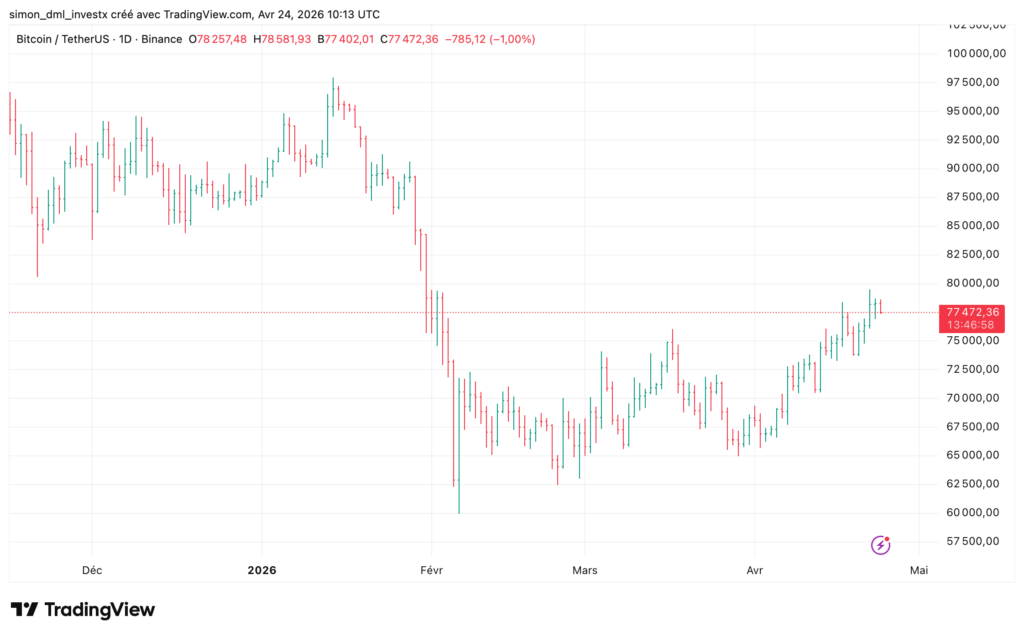
WTI climbed to around $95, up from $79 the previous week, while bond yields advanced across major economies. Analysts warn that Bitcoin’s recent rally toward $80,000 relies primarily on perpetual futures demand rather than spot buying, which heightens the risk of a correction if spot demand continues to contract.
What On-Chain Data Really Reveals
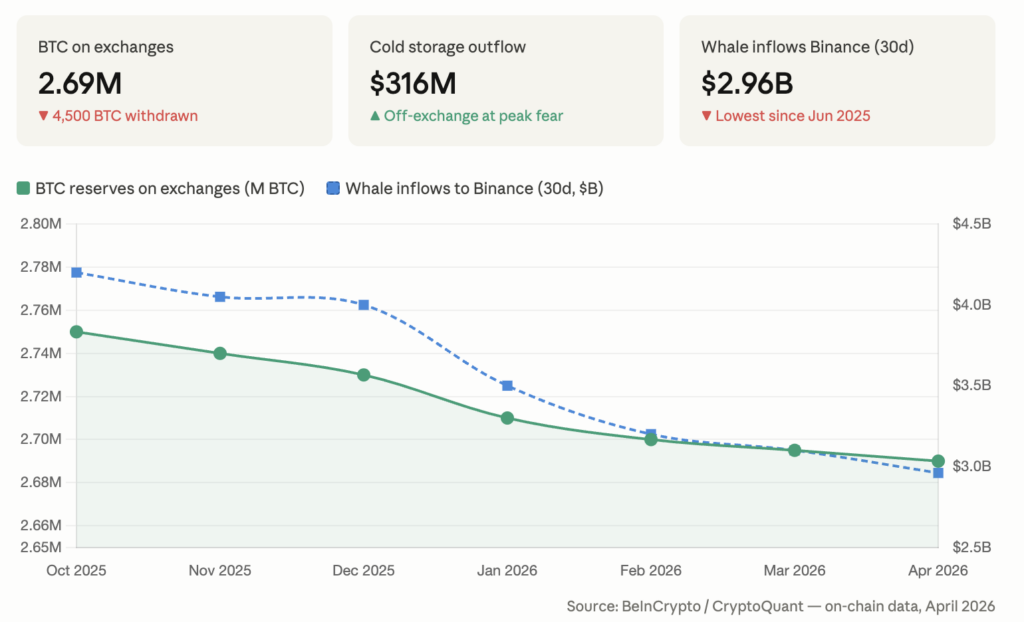
A surface-level reading suggests panic selling, but on-chain data tells a more nuanced story. Global Bitcoin reserves on exchanges have dropped to roughly 2.69 million BTC, with around 4,500 BTC withdrawn to cold storage at the peak of geopolitical uncertainty, representing $316 million moved off platforms.
Whale inflows on Binance over the last 30 days have fallen to $2.96 billion, their lowest level since June 2025. This behavior is consistent with a phase of quiet accumulation rather than massive distribution. Smart money is not fleeing Bitcoin: it is moving it out of the market’s reach.
For active investors who use these signals in their trading strategy, the distinction between institutional accumulation and retail selling is a crucial timing indicator. Knowing how to buy cryptocurrencies during these price compression windows requires discipline but can prove decisive for ultimate returns.
Is This Dip Market Noise or a Reversal Signal?
Our analysis clearly leans toward structural market noise, albeit with important nuances. The BoJ ultimately kept its rates unchanged during the April 28 meeting. Governor Ueda signaled a more cautious stance regarding the uncertainties of the Iranian conflict on the Japanese economy, which contributed to Bitcoin’s recovery above $74,000.
However, a delay is not an abandonment. Wage dynamics in Japan remain solid, with salary increases hovering around 5.15%. The more pronounced impact of energy prices and exchange rates argues for an earlier-than-expected monetary adjustment. An additional tightening of 25 basis points in the second half of 2026 remains the baseline scenario for many economists.
The real risk is therefore not immediate, but deferred. If US-Iran negotiations fail long-term and oil returns to $110, the BoJ will find itself under pressure to act urgently. This scenario would constitute a far more brutal global liquidity shock than the one seen in January for crypto assets.
In the meantime, technical supports around $73,000 to $75,000 remain key reference zones to monitor for any exposure decisions on available crypto exchanges.
Sources:
- 📊 CoinDesk — BoJ & Bitcoin
- CoinDesk on X
- FxGecko_Global on X
- TradingView
Related Articles:

