

How many PI tokens do you need to reach $1 million?
The question is straightforward, and the answer is just as direct. At a time when Pi Network is trading around $0.17 after losing over 90% since its ATH of $2.99 reached in February 2025, analysts have published numerical projections to answer what many holders are quietly wondering: at what price, and with how many PI tokens, can one hope to reach the million-dollar mark?
The basic calculation is simple, and that is precisely its appeal. It forces us to face the numbers rather than relying on vague narratives. For investors looking to understand cryptocurrencies before taking a position, this type of quantitative analysis is exactly what you need to read.
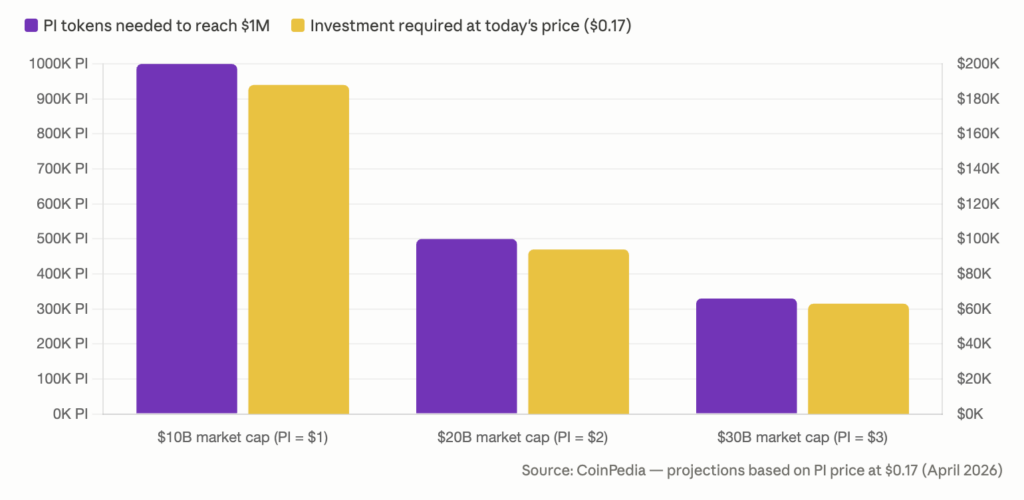
The projection model is based on realistic market capitalization scenarios rather than hype-driven assumptions. If Pi Network reaches a $10 billion market cap, the token price could hit $1, which would mean holding 1 million PI tokens to target the million-dollar milestone. At the current price, this represents an investment of approximately $188,000.
At a $20 billion valuation, the price could climb to $2, bringing the target down to 500,000 tokens, or roughly $94,000 invested today. In a more aggressive scenario at a $30 billion market cap, the token at $3 would only require 330,000 tokens, for an estimated entry point of $63,000.
The structure is clear: the higher the PI price goes, the fewer tokens are needed. But each trajectory requires a significant and early positioning. This is not an investment of a few dozen dollars based on speculative conviction: it is a gamble of tens of thousands of dollars on a project whose execution remains uncertain.
The structural problem no one wants to calculate
Before considering these bullish scenarios, we must factor in a metric that price projections often overlook: supply pressure. Out of approximately 9.2 billion tokens migrated to the mainnet, 5.4 billion remain locked, representing 58.6% of the total migrated. The maximum supply is capped at 100 billion PI. For the month of April 2026 alone, 231 million tokens are entering circulation, which corresponds to roughly $40 million injected at the current price, meaning 2% of the total market cap is released in a single month.
By comparison, the annual inflation of Bitcoin is below 1% and that of Ethereum has been near zero since the Merge. The effective inflation of PI, driven by monthly unlocks, vastly exceeds both of these networks.
This context is fundamental when evaluating price projections. Reaching a $10 billion market cap with a circulating supply growing by hundreds of millions of tokens every month requires highly sustained incoming demand. It is not impossible, but it is a demanding condition that optimistic scenarios often underestimate.
For investors looking to invest in cryptocurrency with a clear understanding, a project’s tokenomics remains one of the most decisive variables in the long run.
The project’s real strengths amidst the doubts
Pi Network is not without its fundamental strengths. The network claims over 60 million users worldwide, a community base that few crypto projects can rival. The mobile mining model, accessible without specialized hardware, has enabled mass adoption in regions where access to traditional cryptocurrencies remains limited.
The recent listing on Kraken improves liquidity and access to global markets. The network’s transition toward smart contracts and applications contributes to its potential valuation.
However, centralization remains the main point of friction. Although Pi uses the Stellar Consensus Protocol, a large part of the network validation and token distribution remains tied to the core team, creating a notable gap with the decentralized philosophy the project claims. For investors comparing available crypto exchange platforms, this point deserves special attention before making any financial commitment.
Technically, the price is trending below its 50-day and 200-day moving averages. The 50-day SMA around $0.17 acts as the first resistance. To envision a sustainable recovery, PI would need to break above $0.19 with solid volume.
To track price action and key levels to watch, crypto price predictions remain a useful reference tool.
One million is possible, but at what real cost?
The real takeaway from this analysis is not the projected numbers: it is the necessary conditions to achieve them. Reaching $1 on PI represents a 6x increase from the current price, which implies a market cap exceeding $8 billion based on the current circulating supply. This is possible in crypto, but it would require a major catalyst such as a Binance listing, a DeFi breakthrough, or a broader altcoin rally. Most conservative models do not anticipate this level in 2026.
Our analysis: the calculation model is useful precisely because it removes emotion from the equation. PI holders hoping for a million without evaluating their actual exposure, the pressure from token unlocks, and the necessary market conditions are taking a poorly calibrated risk. To deepen your knowledge of crypto trading basics and better manage positions on volatile assets like PI, educating yourself on market mechanics remains essential.
The potential exists, but it is conditional on an execution that the project has yet to fully demonstrate. Knowing how to buy cryptocurrencies at the right time and with a clear strategy remains the difference between a seized opportunity and an avoidable loss.
Sources:
Related Articles:

