

MARA Turns the Page: BTC Sales and Pivot to AI
The case of Marathon Digital Holdings perfectly illustrates the ongoing transformation within the mining sector. MARA has broadened its crypto management strategy for 2026 by authorizing the sale of all Bitcoin held on its balance sheet, including accumulated reserves, rather than just the year’s mined production. As of December 31, 2025, the company held 53,822 BTC valued at approximately $4.7 billion.
In February 2026, MARA signed an agreement with Starwood Digital Ventures to convert its US mining sites into data centers dedicated to AI and enterprise cloud computing. The partnership targets a short-term capacity of 1 gigawatt, with an ultimate goal of 2.5 gigawatts. The announcement caused MARA’s stock to surge by +17% in after-market trading.
MARA has also acquired a 64% stake in Exaion, positioning its energy sites as critical infrastructure for hyperscalers and AI companies struggling to secure large-scale power sources.
This evolution is not an isolated case. Core Scientific announced plans to monetize nearly all of its Bitcoin reserves in 2026 as part of a similar transition toward AI services and high-density colocation. The shift is structural: the April 2024 halving slashed miner rewards by half, squeezing margins to the point of forcing massive diversification. For those tracking these dynamics through a crypto trading lens, miner sell-offs remain one of the most closely monitored on-chain indicators of selling pressure.
The MARA Foundation: A Launch That Changes the Narrative
On April 27, 2026, during the Bitcoin conference in Las Vegas, Fred Thiel announced the creation of the MARA Foundation, an initiative that repositions the group far beyond simple mining. The foundation focuses on five core pillars: the long-term security of the Bitcoin network including quantum resistance, open-source development, global access to self-custody tools, education, and regulatory engagement.
To mark the launch, MARA has pledged $100,000 to be awarded via community vote to one of three organizations: SateNet, the 256 Foundation, or Libreria de Satoshi. Voting remains open until April 29 at 3:00 PM PST.
Fred Thiel stated during the conference: “Bitcoin is the most important decentralized system ever created, but its future is not guaranteed.” He described Bitcoin as “a public good that no one owns but everyone depends on,” adding that “decentralization does not mean it runs on its own.”
This positioning deserves attention. A company selling part of its Bitcoin reserves while funding research on the protocol’s quantum resistance is not abandoning the Bitcoin thesis. It is diversifying its revenue streams while strengthening its symbolic capital within the ecosystem. It is a coherent stance, even if it creates short-term selling pressure that the market must absorb.
Miners’ AI Pivot: A Risk or Opportunity for Bitcoin?
Our analysis is as follows: the miners’ pivot to AI is a double-edged sword for the Bitcoin market. On one hand, it reduces miners’ reliance solely on the price of BTC and decreases their need to compulsively sell to cover operational costs. On the other hand, it introduces a new risk: if the demand for AI infrastructure slows down, these players will find themselves exposed to two volatile markets simultaneously.
The sale of MARA’s BTC reserves to fund its energy and AI transition is a documented and measurable selling pressure. It contributes to capping the price in the current $76,000 to $80,000 range. However, once these sales are absorbed, and if the transition succeeds, MARA and its peers will become less dependent on the spot price of Bitcoin to survive, which is structurally positive for the network’s stability.
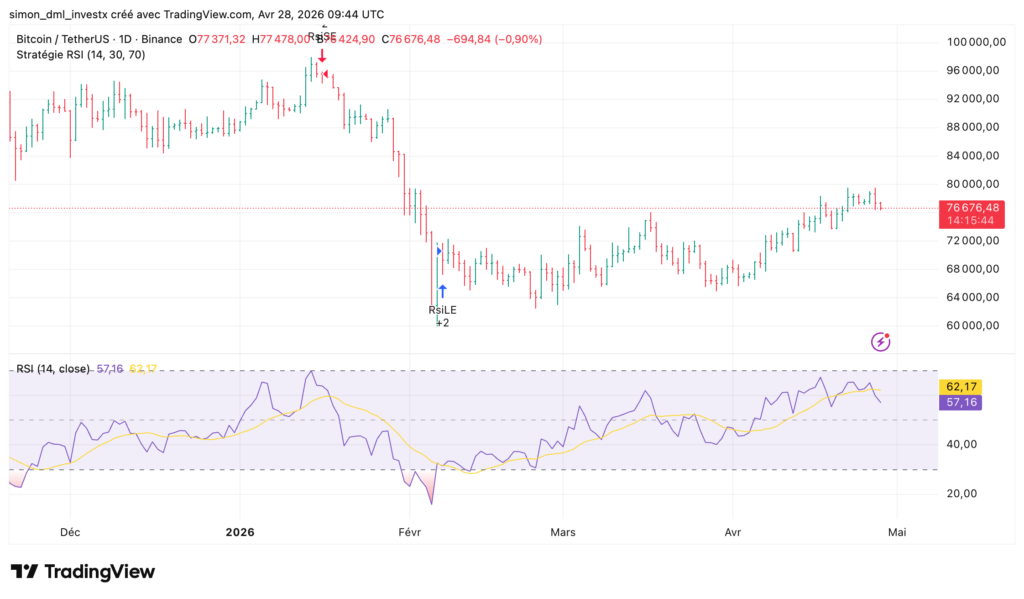
To track Bitcoin price forecasts and the catalysts that could alter this scenario, our Bitcoin price prediction page continuously integrates these on-chain dynamics. Those considering a market position in this context will find an analytical framework in our invest in cryptocurrency section, and our comparison of the best crypto exchanges remains the ultimate guide for choosing the right platform for your profile.
Sources:
- BSCNews on X
- MARAFoundation_ on X
- TradingView
Related Articles:

