

What is Canton: Wall Street’s Blockchain
Canton was not created by crypto developers looking to disrupt finance. It was designed by Digital Asset, a company founded by former engineers from Facebook and Amazon, to address a specific need: enabling financial institutions to conduct complex transactions on a shared blockchain while keeping the sensitive details of each transaction private from non-participants.
Currently, the network processes over $280 billion daily in repo transactions on U.S. Treasury securities, with around 600 active validators. The ecosystem includes DTCC, Goldman Sachs, BNP Paribas, Broadridge, Tradeweb, BNY Mellon, Nasdaq, Visa, Chainlink Labs, Moody’s, and Circle. Visa joined as a Super Validator in March 2026 — a particularly significant signal for the network’s credibility in the payments sector.
Furthermore, Digital Asset raised $135 million in June 2025 from institutions including BNP Paribas, Circle Ventures, Citadel Securities, DTCC, Goldman Sachs, Paxos, and Polychain Capital. These are not speculative investors making blind crypto bets; they are financial institutions and infrastructure providers making strategic capital commitments in a tool they use themselves in production.
The tokenomics is also unusual in the crypto landscape. CC employs a burn-and-mint model with no pre-mine, no presale, and no allocation for founders, meaning all tokens are earned through its utility. In summary, every transaction on the network burns CC tokens, creating deflationary pressure directly proportional to institutional usage.
Bitwise and 21Shares ETPs: A Strong Signal?
The launch of the BWCC by Bitwise on Xetra, with an annual management fee of 0.85%, represents additional institutional validation. It positions CC alongside Bitcoin, Ethereum, and Solana in regulated European investment products, which is far from common for a token launched in 2024.
Moreover, the DTCC plans to tokenize U.S. Treasury securities on Canton, with a targeted pilot launch for the second half of 2026. Visa, Goldman Sachs, and HSBC are already Super Validators, processing transactions in production. The 21Shares TCAN ETF provides a regulated access path, further cementing institutional demand.
The launch of ETPs structurally generates buying pressure on the underlying token: issuers must buy CC to cover subscriptions. However, the effect is conditional on the influx of capital into the product. If the ETPs struggle to attract significant AUM in the early weeks, the impact on the price will be marginal.
Problem: Network Stagnation and Price Stasis
This is where the reality of the data tempers enthusiasm. Canton’s network activity has significantly declined since late April, following strong momentum at the end of 2025 and early 2026. This stagnation in Q2 has kept CC within a tight range between $0.14 and $0.17 — a prolonged consolidation territory that is beginning to test investors’ patience.
Meanwhile, the price has remained nearly flat over the year (+1.2%) despite major partnerships with Visa, Goldman Sachs, and DTCC. The daily volume is only $5.44 million against a market capitalization of $5.79 billion, an extremely low volume/market cap ratio that reflects a base of institutional holders reluctant to trade actively, as well as insufficient liquidity to absorb significant price movements.
The XRP Ledger has recorded a 57% increase in the value of its RWA tokens in 30 days, compared to a decline of 4.8% on the same metric for Canton. Competition in the tokenized RWA segment is intensifying, and Canton can no longer rely solely on its first-mover advantage with institutions.
Technical Analysis: Range to Watch
In the short term, price forecasts for CC range between $0.12 and $0.25. Limited growth in network activity will keep prices in the lower part of this range, while achieved development milestones could push towards the upper part.
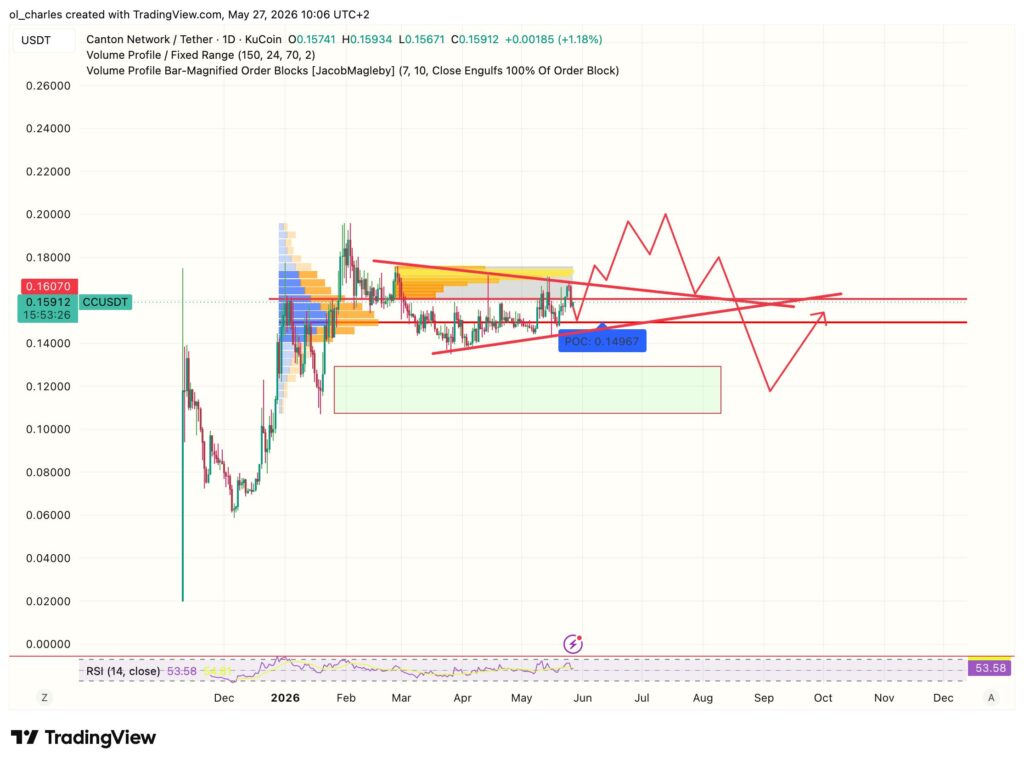
Key levels at the current price around $0.15-0.17 with a POC and a daily order block:
Immediate Support: $0.14 — the floor of the current consolidation range. A daily close below this level would open the $0.12 area as a bearish target.
Strong Support: $0.12 — a level identified as a risk zone for retracement if bullish momentum fails to materialize. A drop into this zone and a hold at this level offers an optimal entry point.
Pivot Resistance: $0.178 — the ceiling of the current range, a zone to break through for any hope of continuation. It is also the strong liquidity zone of the daily order block.
Target Resistance: $0.19-0.22 — a level corresponding to the Fibonacci extension of the initial 500% rally post-launch. This level has a high probability of being reached if CC breaks out above $0.17.
The extremely low volatility of the token offers a good risk/reward ratio in a struggling altcoin market. Indeed, CC will not move like a retail altcoin. Catalysts will be partnership announcements, network adoption metrics, or the start of the DTCC pilot on Treasuries, rather than speculative rotation.
What Experts Think: Should You Buy?
Andres Valencia, EVP of investment management at 21Shares, referred to Canton as a “institutional blockchain” at the launch of its ETF:
“When you see names like Nasdaq, Moody’s, and Deloitte supporting a common blockchain infrastructure, you are looking at an infrastructure that has the potential to reshape how data and capital move across global markets.”
On his part, Bradley Duke, Managing Director of Bitwise, repositioned Canton as “a dominant player in tokenization” at the launch of the BWCC, emphasizing that the network’s infrastructure “positions it as a significant player in digital financial markets.”
In summary, CC possesses one of the strongest fundamental theses in the altcoin market. The resilience of its price indicates that the token is largely held by strong hands. Moreover, its tokenomics already places it above most altcoins for long-term investment.
For an investor with a 6 to 18-month horizon, CC offers an interesting asymmetry at $0.15 if one believes in the scenario of massive tokenization of institutional assets. For a trader seeking short-term momentum, the network stagnation in Q2 and the token’s low liquidity make timing difficult in the absence of an identifiable catalyst.
Sources:
Related Articles: