

A Scandal Shaking the Base Blockchain
On April 16, 2025, the Base blockchain, the layer 2 solution of Ethereum supported by Coinbase, made headlines with the launch of its token “Base is for Everyone”. This token, designed to promote creativity through the Zora platform, turns all published content into tradable assets.
But before the official announcement was released on X at 7:30 PM UTC, three crypto wallets had already positioned themselves, buying millions of tokens at low prices to sell them at inflated prices, making a total profit of $666,000.
This incident, uncovered by the blockchain analysis tool Lookonchain, reignites criticisms about the opacity of token launches and speculations of a fabricated scam.
Coinbase : Behind the Scenes of this Controversy
According to Lookonchain, the three wallets operated with almost supernatural precision. Here’s how they executed their moves:
- Wallet 0x0992: At 12:30 PM UTC, this wallet invested 1.5 ETH (around $2,370) to acquire 256.39 million “Base is for Everyone” tokens. After the announcement, it sold its position for 108 ETH, pocketing a profit of $168,000 in just one hour.
- Wallet 0x5D9D: With 1 ETH ($1,580), this wallet bought a massive amount of tokens, which it sold for 169.7 ETH, resulting in a gain of $266,000.
- Wallet 0xBD31: This wallet wagered 1 ETH to obtain tokens, which it liquidated for 146 ETH, making a profit of $231,800.
Altogether, these wallets turned a modest investment into a fortune by exploiting an opportunity window before the public announcement. The “Base is for Everyone” token saw its market capitalization reach $15 million shortly after launch, before plummeting to less than $2 million when Base unveiled another token linked to its FarCon event, draining liquidity. This equated to a drop of over 90% in 30 minutes.
Since then, the valuation has recovered to $22 million, but is poised to fall back to $10 million at the time of writing.
The Issue of Insiders and Front-Running
This kind of maneuver, often referred to as “front-running”, is a hot topic in crypto. The wallets seem to have had access to privileged information, enabling them to buy before price surges. Speculations abound: internal leaks, blockchain analysis bots, or just intuitions? Nonetheless, this incident underscores the flaws in token launches, often criticized for their lack of transparency.
Jesse, the creator of Base, defended the project, stating: “The goal is to make on-chain creation accessible to everyone, by turning every content into a digital asset.” However, Coinbase clarified that “Base is for everyone” is not the official token of the Base blockchain and that the team did not directly sell these tokens.
“We posted on Zora, which automatically tokenizes the content,” a spokesperson told CoinDesk. Base also clarified on X: “These tokens are not official assets of Base or Coinbase, and we will never sell them. Our aim is to promote on-chain culture.”
The Base token incident thus highlights the cycles of “pump and dump” in low-cap tokens. After an initial peak, liquidity collapsed with the announcement of another token, leaving many investors with losses.
This phenomenon benefits a handful of well-informed players at the expense of the majority. Launches like those of LIBRA and TRUMP tokens in 2025 have already caused massive losses, marking price peaks for Bitcoin and the crypto market.
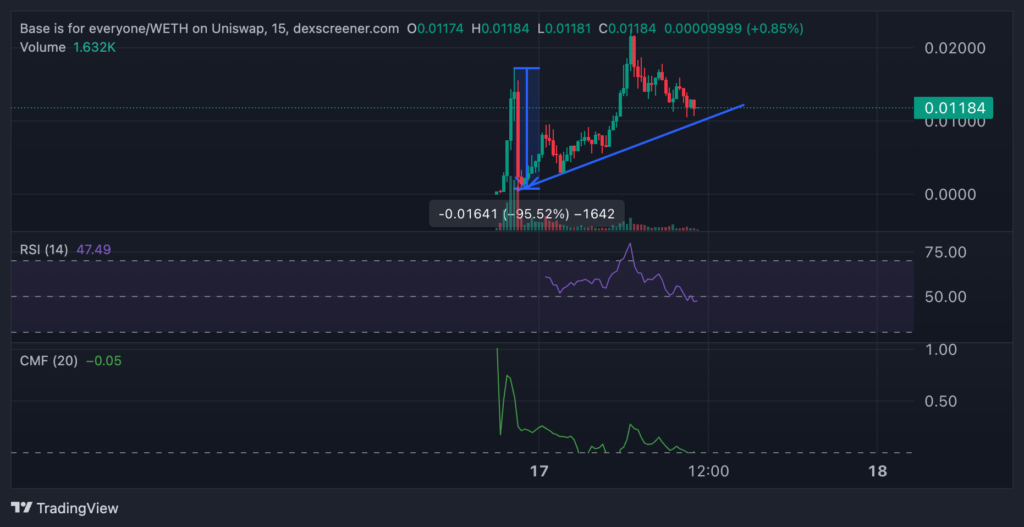
Currently, the Base token is on a critical support of its uptrend line. However, the CMF and RSI indicate that capital has already massively fled the token.
In conclusion, while this controversy showcases Base and Zora’s innovation, it also highlights the equity challenges in token launches. As DeFi continues to grow, industry players will need to find ways to enhance transparency to protect investors. It’s important to note that 97% of traders lose money. And in the world of memecoins and new tokens like this, less than 1% have made over $1 to $10,000 in profits.

