
Ethereum: Is a drop to $1300 inevitable for ETH?
Ethereum rebounds to $2000, but bearish signals persist. Is this a buying opportunity or a prelude to a further price decline? Find out now.



Ethereum rebounds to $2000, but bearish signals persist. Is this a buying opportunity or a prelude to a further price decline? Find out now.
After a black week that saw Ethereum’s price plunge nearly 43% in nine days, hitting a concerning low around $1,750, the market’s second-largest cryptocurrency is attempting to lift its head. Currently, ETH is trading in a zone between $2,100 and $2,000, benefiting from positive correlation with Bitcoin and the recovery of US equity markets (S&P 500).
This rebound of over 15% from the lows offers a breath of fresh air to investors, but caution remains warranted. The current movement looks more like a technical reaction on a major support zone rather than a genuine organic trend reversal. To validate a sustainable recovery, buyers will need to defend this level with volume, which is not yet guaranteed at this stage.
Despite the rise in spot price, the derivatives market displays a decidedly bearish sentiment. Analysis of futures contracts shows that the premium (the spread between future price and spot price) is stagnating around 3%. Normally, a healthy and neutral market evolves with a premium of 5% to 10%. This figure below 5% indicates that institutional traders hesitate to bet on a sustainable rally and are hedging against the risk of further downside.
Moreover, the fundamentals of the Ethereum network are weighing on investor sentiment. Inflation of ETH supply has climbed to 0.8% on an annualized basis over the last 30 days, undermining the deflationary “ultra sound money” narrative. With slowing on-chain activity and declining transaction fees, the burn mechanism is no longer sufficient to offset new issuance, adding structural selling pressure.
From a technical perspective, Ethereum finds itself at a crossroads. For the bulls, the immediate objective is to transform the $2,000 zone into solid support to then target the next resistance around $2,300. A confirmed breakout above this level could invalidate the short-term bearish thesis and attract new capital.
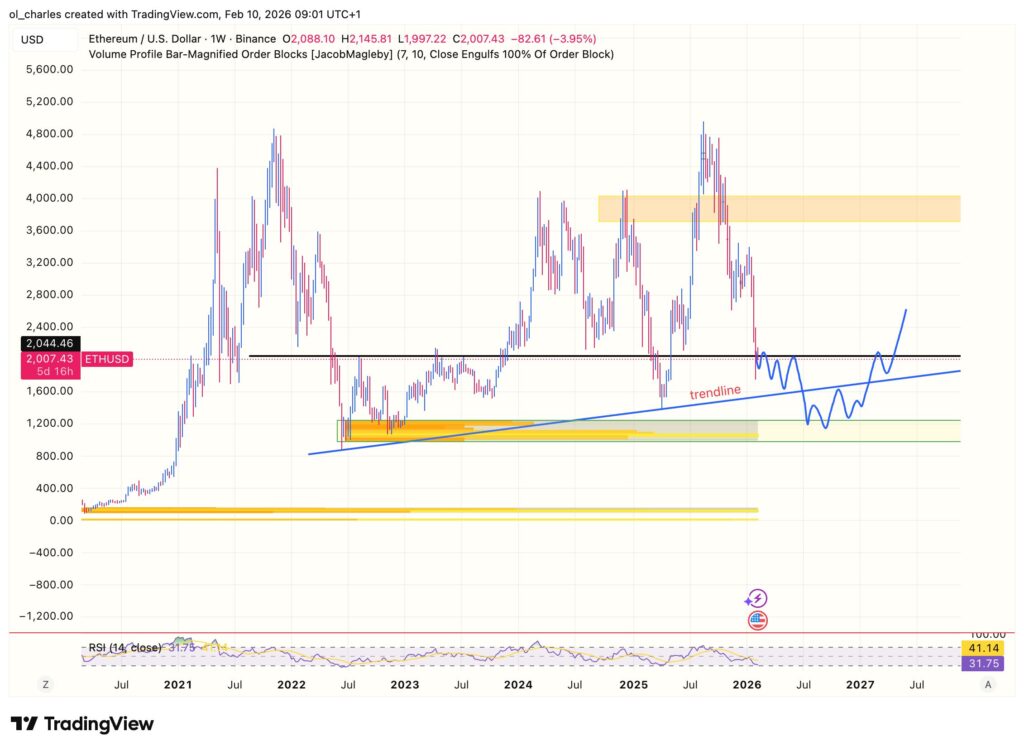
Conversely, if rejection is confirmed below $2,150, the risk of a return toward the $1,750 support is high. A break of this key level would open the door to a deeper correction, potentially toward the order block around $1,280.
This major demand zone and a downside liquidation of a bullish trendline in HTF would offer an ideal scenario for a bullish reversal of ETH. Indeed, this would allow ETH to relieve itself of late longs below the trendline and attract smart money.
As the market attempts to stabilize, the crucial question for the coming days is that of institutional participation. Without a clear return of confidence in derivatives markets and an increase in network activity, this rebound could be nothing more than an exit opportunity for “whales” trapped higher up.
Related Articles:

Charles Ledoux is a Bitcoin and blockchain technology specialist. A graduate of the Crypto Academy, he has been a Bitcoin miner for over a year. He has written numerous masterclasses to educate newcomers to the industry and has authored over 2,000 articles on cryptocurrency. Now, he aims to share his passion for crypto through his articles for InvestX.
DISCLAIMER
This article is for informational purposes only and should not be considered as investment advice. Trading cryptocurrencies involves risks, and it is important not to invest more than you can afford to lose.
InvestX is not responsible for the quality of the products or services presented on this page and cannot be held liable, directly or indirectly, for any damage or loss caused by the use of any product or service featured in this article. Investments in crypto assets are inherently risky; readers should conduct their own research before taking any action and invest only within their financial means. This article does not constitute investment advice.





Risk Warning : Trading financial instruments and/or cryptocurrencies carries a high level of risk, including the possibility of losing all or part of your investment. It may not be suitable for all investors. Cryptocurrency prices are highly volatile and can be influenced by external factors such as financial, regulatory, or political events. Margin trading increases financial risks.
CFDs (Contracts for Difference) are complex instruments with a high risk of rapid capital loss due to leverage. Between 74% and 89% of retail investor accounts lose money when trading CFDs. You should assess whether you understand how CFDs work and whether you can afford to take the high risk of losing your money.
Before engaging in financial or cryptocurrency trading, you must be fully informed about the associated risks and fees, carefully evaluate your investment objectives, level of experience, and risk tolerance, and seek professional advice if needed. InvestX.fr and the InvestX application may provide general market commentary, which does not constitute investment advice and should not be interpreted as such. Please consult an independent financial advisor for any investment-related questions. InvestX.fr disclaims any liability for errors, misinvestments, inaccuracies, or omissions and does not guarantee the accuracy or completeness of the information, texts, graphics, links, or other materials provided.
Some of the partners featured on this site may not be regulated in your country. It is your responsibility to verify the compliance of these services with local regulations before using them.

