

69,878 ETH move for the first time since 2015
The cryptocurrency market has just recorded an onchain movement that immediately put analysts on high alert. A crypto whale that had been inactive for over 9 years just transferred 69,878 ETH to three distinct new wallets. At the current Ethereum price, this stash represents the staggering sum of $157 million. This type of movement from a wallet dormant since the founding era of the network is extremely rare and systematically monitored closely by the onchain community.
The story behind these funds is even more fascinating than the amount itself. These ETH were acquired during the Ethereum ICO in 2015 at a price of roughly $0.31 per token. The accumulated return on investment since then is truly stratospheric: at a current value of $157 million, the multiplier exceeds 500x from the initial purchase price. This is the perfect illustration of the power of HODL on a fundamental asset over a timeframe that few investors have the discipline to maintain.
What particularly catches the attention of analysts is the destination of the funds. The 69,878 ETH were split across three distinct wallets without being sent to a centralized exchange. This segmentation maneuver is characteristic of sophisticated wealth management rather than preparation for an immediate sale. As long as the funds do not hit the order books of a platform like Binance or Kraken, the risk of a direct market dump remains limited.
Imminent sale or strategic rotation?
The question shaking up the market is simple: is this whale preparing to liquidate its positions after 9 years of patience? Onchain analysts are largely leaning toward a security rotation scenario rather than an immediate liquidation. Splitting funds into three wallets is a common practice among institutional holders looking to diversify their custody risk exposure without selling their assets. A single wallet holding $157 million represents a significant operational risk.
The hypothesis of an OTC sale is also plausible and deserves serious consideration. An over the counter transaction would allow this whale to offload all or part of its ETH to an institutional buyer without the order passing through public order books. This type of transaction, which is common for blocks worth tens of millions of dollars, would have no direct impact on the Ethereum market price. The OTC desks at Coinbase and Cumberland regularly handle this type of volume without triggering visible price movements.
The third hypothesis points to preparation for institutional staking. With the rise of Ethereum ETFs and the growing maturity of institutional staking solutions, converting a dormant position into productive assets via proof of stake is a financially rational decision. This option would generate an annual yield on the $157 million while maintaining exposure to the upside of ETH. For investors following Ethereum forecasts, this scenario would be the most bullish of the three.
The psychological impact on the ETH market
Even without an actual sale, the awakening of a dormant wallet of this size creates real psychological volatility in the market. Traders monitoring onchain flows immediately adjusted their positions in response to the perceived increase in risk. The RSI on ETH pulled back slightly in the hours following the detection of the movement, signaling that sentiment had temporarily shifted toward caution. This reaction illustrates just how much onchain data now influences real time crypto trading decisions.
Key support and resistance levels on ETH remain the technical benchmarks to watch in this context. The weekly MACD remains in positive territory, and the underlying bullish momentum has not been structurally altered by this whale movement. For fans of swing trading on ETH, this type of event creates precisely the pockets of localized volatility that allow them to optimize entry points without questioning the broader trend.
The open interest on ETH futures contracts will be the key indicator to monitor over the next 48 hours. An increase in open interest accompanied by price stabilization would confirm that the market is calmly absorbing the uncertainty generated by this movement. Conversely, a simultaneous drop in prices and open interest would signal a precautionary reduction in positions, potentially opening up an attractive accumulation zone for investors looking to buy Ethereum on temporary weakness.
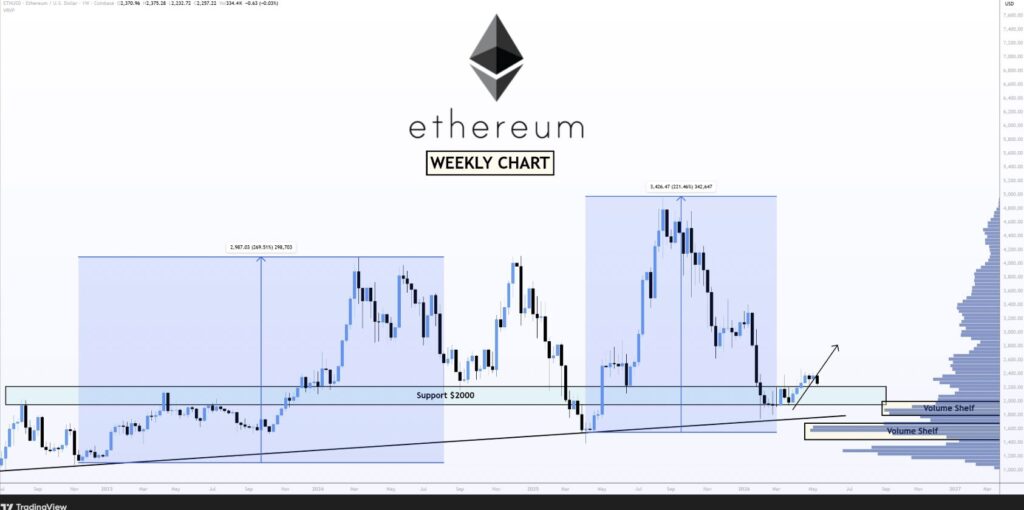
Can ETH reach a new ATH despite this uncertainty?
The fundamental context for Ethereum remains one of the strongest in the entire crypto ecosystem in 2026. The launch of the iShares Staked Ethereum Trust ETF (ETHB) by BlackRock and the deployment of the JLTXX fund by JPMorgan on the network confirm that institutional adoption is structurally underway. These institutional capital flows create sustained demand for ETH that far outweighs the impact of a single whale movement, no matter how spectacular it may be.
Historically, the awakening of dormant wallets coincides with market transition phases. In 2021, several similar movements on old Bitcoin wallets preceded phases of heightened volatility before a bullish recovery. This pattern does not repeat systematically, but it is worth factoring into the current market reading. For investors practicing fundamental analysis on ETH, the convergence of institutional adoption, growing onchain activity, and an expanding DeFi network paints a solid bullish scenario over the medium term.
Our takeaway: this $157 million movement is spectacular but not alarming given the current available data. The lack of a transfer to a centralized exchange is the most reassuring signal. Ethereum forecasts remain bullish on higher timeframes, and the broader crypto trend supports ETH as a top tier asset for institutional investors. Securing your ETH on a Ledger or MetaMask remains a basic precaution. The crypto taxation applicable to capital gains must also be anticipated for long term positions.
Sources:
- TradingView
- CryptoastMedia on X
- greg_miller05 on X
Related Articles:

