

Pi Network Takes on the AI Market
Pi Network is no longer a crypto project that can be easily dismissed. For years, the skepticism was justified: a mobile mining app without a public blockchain, a massive community with no proven utility, and ever-stretching launch delays. This cycle changes the game. The figures recently published by the founding team position the network as a serious player at the intersection of two of the most powerful narratives right now: decentralized identity verification and artificial intelligence infrastructure.
For anyone tracking the evolution of blockchain fundamentals, this pivot deserves close attention.
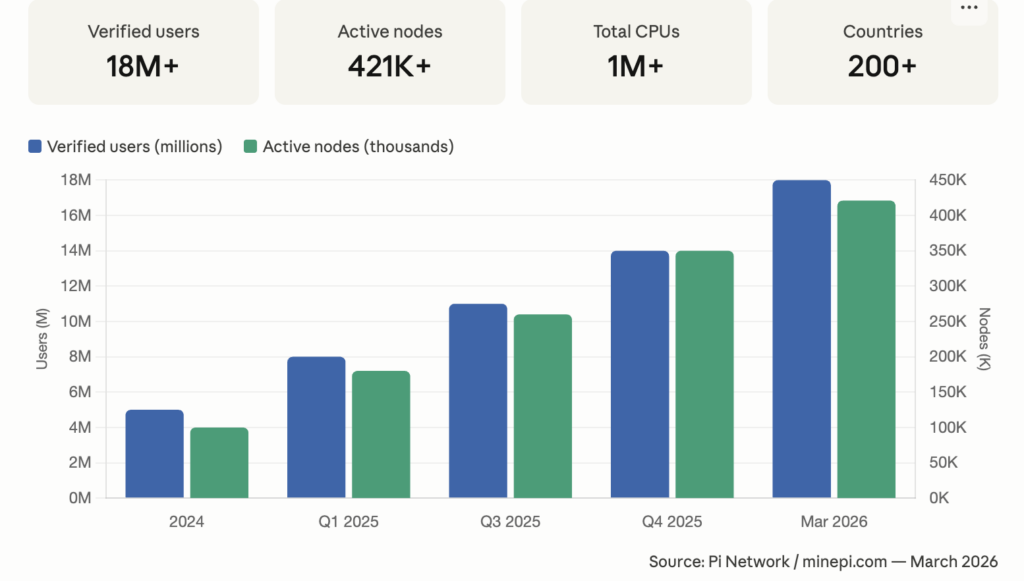
The raw data is impressive. Over one million human validators have collectively completed 526 million tasks via the network’s native KYC system. These tasks have successfully verified the identities of more than 18 million pioneers spread across over 200 countries.
But beyond the logistical performance, what is truly interesting here is the model itself. Pi Network did not outsource its verification process to a centralized provider like Jumio or Onfido. Instead, it built a system where verified humans verify others, earning $PI tokens in return. This is Web3 microwork, fully functional at scale, with onchain traceability.
This model solves a real problem: how to verify millions of identities without creating a centralized point of failure or exposing sensitive data to a single third party. On paper, this is exactly what European and American regulators are looking for amid ongoing discussions around decentralized digital identity.
AI Needs What Pi Network Has Already Built
The real strategic turning point is the pivot toward artificial intelligence. Large language models and generative AI systems have a chronic need for labeled, reliable, and diversified human data. It is the classic “garbage in, garbage out” problem: a model trained on biased or synthetic data will produce degraded results.
Today, Pi Network boasts 421,000 active nodes and a base of 18 million verified users, geographically distributed across all continents. For an AI developer looking to build a data labeling or model evaluation (RLHF) pipeline, this is a turnkey infrastructure that would have taken years to build from scratch.
The team has opened an official form inviting AI companies to collaborate on these use cases. This is a concrete signal, not a vague marketing announcement. Those who follow crypto trading trends know that projects finding real utility outside of pure speculation have historically weathered bear markets much better.
Market Reaction and What It Indicates
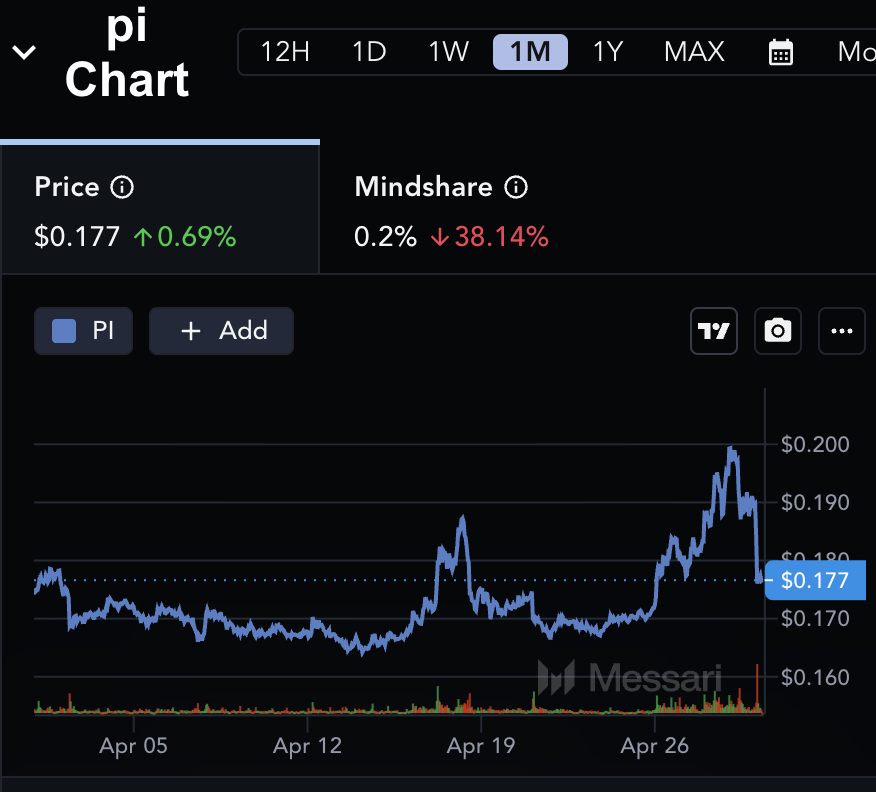
Following these announcements, the $PI token recorded an intraday surge of over 6%. While the movement is modest in absolute value, it is highly significant in context: the broader crypto market was in a consolidation phase at the time of publication, and $PI outperformed the entire sector during this period.
This type of reaction confirms that buyers are waiting for fundamental catalysts to enter or strengthen their positions. This is not irrational FOMO; it is a reassessment of the project’s risk/utility ratio. For those looking to understand how to evaluate a crypto asset, this case study perfectly illustrates how a solid narrative, backed by verifiable metrics, can generate sustainable buying pressure.
The question that remains open is whether this surge marks the beginning of a structural repricing or just an isolated technical bounce. The answer will largely depend on what is announced in Miami.
Consensus 2026: The Presentation That Could Change Everything
Nicolas Kokkalis and Dr. Chengdiao Fan will be attending Consensus 2026 in Miami this May. It is one of the most closely watched conferences by institutional investors and crypto funds. Speaking in this setting is no trivial matter: it means the team is ready to defend its thesis before a demanding audience, fully capable of asking the tough technical questions.
If concrete partnerships with AI players are announced during this event, the market will have an identifiable external catalyst. The crypto exchanges listing $PI could see unusual trading volumes in the days following the event, which is a classic pattern surrounding major industry conferences.
What would be truly transformative is a signed agreement with a major player in the AI sector (think data pipeline providers or model training labs) that would use the Pi network as a human verification layer. This type of partnership would anchor real demand for the token, completely independent of broader market sentiment.
The AI/Crypto Narrative: Why Pi Network Arrives at the Right Time
The intersection of artificial intelligence and blockchain infrastructure is the dominant narrative of this cycle. Projects like Bittensor, Render, and Fetch.ai have captured significant capital by positioning themselves in this segment. Pi Network arrives with a differentiating advantage: a verified human community at scale, something none of these competitors natively possess.
The real question is not whether the project will deliver, but how fast. Past delays have eroded the trust of a portion of the community. A successful Consensus 2026, featuring concrete announcements, could mark the beginning of a serious reassessment phase for the $PI token by the institutional market.
For those considering buying cryptocurrencies in this segment, monitoring the May announcements seems to be the absolute priority before making any decisions.
Sources:
- Pi Network – Official Blog
- BSCNews on X
- Messari
- Pi Network / minepi.com
Related Articles:

