

What Tom Lee sees that the market is still ignoring
April 2026 will go down as the month the markets chose resilience. While geopolitical tensions between the United States and Iran raised fears of a doomsday scenario for risk assets, the S&P 500 and the Nasdaq validated new ATHs, brushing aside several weeks of uncertainty. For the crypto ecosystem, this reversal is highly significant: historically, Bitcoin and major altcoins amplify the movements of tech indices with a high beta.
Tom Lee, founder of Fundstrat and one of the most closely followed analysts on Wall Street, has identified three catalysts explaining why this rally is not just a simple technical bounce but the beginning of a deeper structural movement.
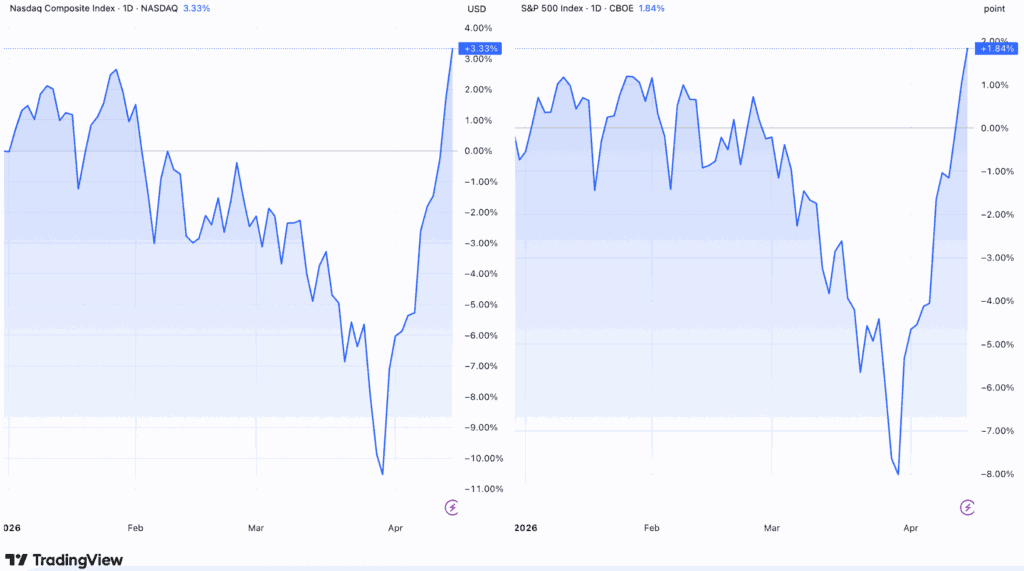
The first argument is based on economic strength in the face of conflict. Against all odds, the defense spending generated by geopolitical tensions is acting as a fiscal stimulus. The rise in oil prices remains at manageable levels for American households, avoiding the dreaded recessionary effect. The economy is running, employment figures are holding up, and the consumer has not capitulated. This is the foundation the bulls needed to regain confidence. For investors who follow the fundamental analysis of the markets, this type of macro setup is historically favorable for risk assets.
Tech company earnings contradict the bearish consensus
Tom Lee’s second signal concerns corporate earnings. Fears of a drop in profits in the first quarter of 2026 have not materialized. Tech giants and companies tied to artificial intelligence are posting solid balance sheets, sometimes exceeding analyst expectations. This sustained profitability justifies current valuations on the Nasdaq and attracts new institutional capital that had remained on the sidelines since the beginning of the year.
For the crypto market, this dynamic is directly visible in the flows. When large cap tech stocks outperform, portfolio allocators look for high beta assets to amplify their returns. Bitcoin and Ethereum are the primary beneficiaries of these rotations. Furthermore, onchain data available on specialized exchanges confirms a resumption of net inflows into institutional products exposed to BTC.
Dormant capital: The real fuel for the next rally
The third argument is perhaps the most powerful. During the weeks of correction, many institutional investors remained underexposed, accumulating considerable cash reserves while waiting to see what would happen. Today, with indices validating new highs, these players are forced to enter the market or risk underperforming their benchmarks. This is known as institutional FOMO, and it is one of the most powerful drivers of a bull run.
For Bitcoin, this context translates practically into buying pressure on derivatives. Crypto whales did not sell during the correction, they accumulated. Reserves on exchanges continue to drop, mechanically reducing the supply available for sale. This supply shock combined with revived institutional demand is the ideal setup for a breakout to new levels.
Bitcoin and crypto: How far can the movement go?
The correlation between the S&P 500 and Bitcoin is not an immutable law, but during periods of widespread risk appetite, it strengthens significantly. With traditional indices confirming their bullish trend, BTC has a favorable macro backdrop that it has lacked for several months. The most conservative Bitcoin price predictions target a consolidation above $75,000 initially, before an attempt on the previous ATHs.
For investors looking to understand cryptocurrencies in this macro context, Tom Lee’s analysis serves as a reminder of a simple truth: markets go up when the real economy holds strong and when liquidity seeks returns. Both of these conditions are met at the start of spring 2026. It remains to be seen whether the crypto bull run can turn this favorable environment into a sustainable movement, or if new geopolitical turbulence will once again test the resilience of the markets.
Sources:
- CoinDesk
- TradingView
- X (fundstrat / Tom Lee)
- X ( TedPillows )
Related Articles:

