
Top 5 Layer-1 Altcoins to watch before the Bull Run
Discover the top 5 Layer-1 altcoins to watch before the next bull run! Will Solana, TRON, BNB, NEAR & SEI explode? Get analysis & scenarios.


Discover the top 5 Layer-1 altcoins to watch before the next bull run! Will Solana, TRON, BNB, NEAR & SEI explode? Get analysis & scenarios.
The ranking of blockchains by daily active users in April 2026 reveals a radically different landscape than expected just six months ago. Ethereum is missing from the top 5. This is no accident; it signals a structural redistribution of on-chain activity across Layer-1 networks.
BNB Chain leads the race with over 4.3 million daily active users, followed by TRON with 3.2 million, NEAR Protocol with 2.5 million, Solana with 2.4 million, and SEI with 1.4 million.
BNB and TRON hold the top two spots for different yet complementary reasons. BNB Chain remained the most stable network during the week of March 30 to April 5, 2026, boasting consistent TVL and strong user activity, even as trading volumes continue to decline. TRON, on the other hand, owes most of its traffic to its role as payment rails for stablecoins, particularly USDT. These are two very distinct dynamics: one is driven by the DeFi ecosystem and dApps, while the other is fueled by sheer transactional volume.
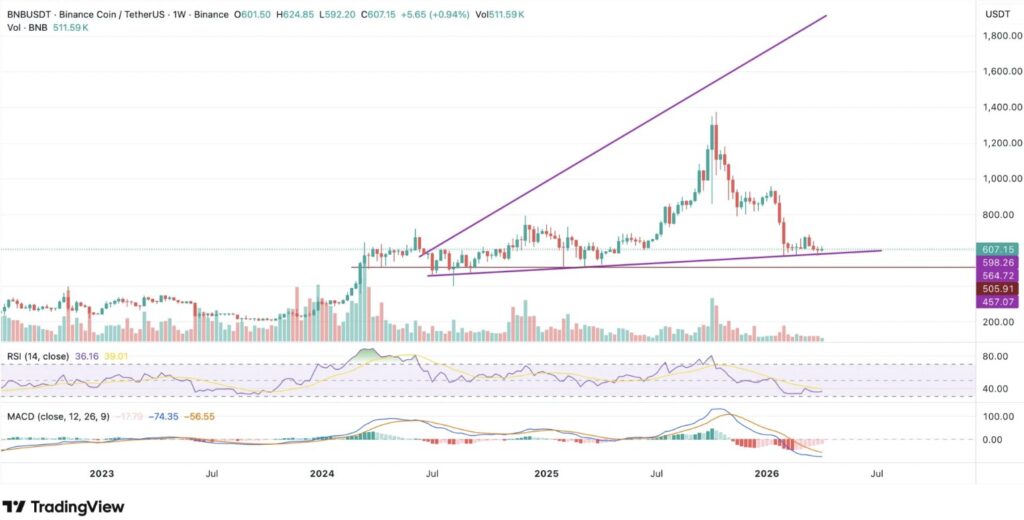
BNB is trading around $603, with TRX at $0.32. These price levels reflect a market that primarily values the stability of these networks over their short-term speculative potential. For investors looking to reduce their exposure to altcoin risk, this is a defensive setup rather than an offensive one.
Solana amassed 2.4 million daily active users in April, but holder metrics tell a more nuanced story. The number of SOL holders reached an all-time high of 166.9 million in April 2026, marking a 12% increase since October. However, the Realized Cap dropped from $96.9 billion to $78.5 billion since October, representing an $18.2 billion contraction — a signal of persistent distribution despite the expanding holder base.
Technically, SOL is trading in a compression zone between $79 and $84. Analyst Ali Martinez identifies clear resistance at $96.04 and a solid support anchored at $76.66. A decisive breakdown below this threshold could trigger a pullback to the yearly low of $68.54, with a possible extension toward $50. Conversely, holding current support levels could catalyze a return to the $81-$85 zone.
The institutional context adds an important nuance. Spot Solana ETFs in the US feature around eight sponsors at the end of Q1 2026, with the Bitwise BSOL product on the NYSE as the largest holder. These funds represent roughly $805.84 million in net assets, or about 1.69% of Solana’s total market capitalization. These are real inflows, but still too limited to support a genuine bullish breakout.
NEAR Protocol is trading at $1.37 with 2.5 million active users, surpassing Solana in traffic volume. Yet, its price action remains underwhelming. NEAR and Solana illustrate how adoption can lead to price cycles driven by momentum rather than stable fundamentals. Without a specific catalyst — a major partnership, a protocol upgrade, or institutional entry — user activity alone is not enough to trigger a sustainable uptrend.
SEI represents the most striking paradox in the ranking. Despite its presence in the top 5, SEI’s price has suffered significantly due to supply-side pressure and declining capital retention. The CMF indicates a loss of liquidity, while the RSI remains anchored below its moving average. The price is expected to trend downward despite the surge in network traffic. SEI is a textbook example of the potential disconnect between usage metrics and price performance.
The takeaway from this ranking is clear. High user activity does not automatically translate into price strength. BNB and TRON show how sustained usage can support stability, whereas Solana and NEAR reflect price cycles driven by momentum.
For traders tracking these networks on exchanges, the key signal to watch remains the same: capital flows, not just the number of active addresses. The $76 zone on SOL remains the ultimate litmus test for April. A confirmed bounce with volume would pave the way toward $85, then $96. A breakdown below this threshold, amid a still unstable geopolitical backdrop, would expose the asset to a deeper correction. When tracking price predictions for these Layer-1s, this is the level to keep on your radar in the coming days.
Sources:
Related Articles:

Crypto analyst with over 7 years of trading experience and a strong background in the iGaming and cryptocurrency industries, I cover crypto news with a rigorous yet accessible approach. Passionate about blockchain since 2019, I have published more than 1,200 articles and guides on cryptocurrencies, DeFi, and blockchain, recognized for their reliability and clarity.
Specializing in on-chain trading and whale activity analysis, I decode blockchain flows to anticipate market trends before they become obvious.
One of my articles was cited by Éric Larchevêque, co-founder of Ledger, highlighting the quality and credibility of my analysis.
My goal remains unchanged: to make crypto accessible and understandable for everyone, from beginners to experienced investors.
Follow me on LinkedIn and X to stay updated with my latest insights.
DISCLAIMER
This article is for informational purposes only and should not be considered as investment advice. Trading cryptocurrencies involves risks, and it is important not to invest more than you can afford to lose.
InvestX is not responsible for the quality of the products or services presented on this page and cannot be held liable, directly or indirectly, for any damage or loss caused by the use of any product or service featured in this article. Investments in crypto assets are inherently risky; readers should conduct their own research before taking any action and invest only within their financial means. This article does not constitute investment advice.



Risk Warning : Trading financial instruments and/or cryptocurrencies carries a high level of risk, including the possibility of losing all or part of your investment. It may not be suitable for all investors. Cryptocurrency prices are highly volatile and can be influenced by external factors such as financial, regulatory, or political events. Margin trading increases financial risks.
CFDs (Contracts for Difference) are complex instruments with a high risk of rapid capital loss due to leverage. Between 74% and 89% of retail investor accounts lose money when trading CFDs. You should assess whether you understand how CFDs work and whether you can afford to take the high risk of losing your money.
Before engaging in financial or cryptocurrency trading, you must be fully informed about the associated risks and fees, carefully evaluate your investment objectives, level of experience, and risk tolerance, and seek professional advice if needed. InvestX.fr and the InvestX application may provide general market commentary, which does not constitute investment advice and should not be interpreted as such. Please consult an independent financial advisor for any investment-related questions. InvestX.fr disclaims any liability for errors, misinvestments, inaccuracies, or omissions and does not guarantee the accuracy or completeness of the information, texts, graphics, links, or other materials provided.
Some of the partners featured on this site may not be regulated in your country. It is your responsibility to verify the compliance of these services with local regulations before using them.

