

Tether, 148 tonnes of gold and Bitcoin in reserve
During the London summit, Christoph Hock, Head of Tokenization at Union Investment (managing $620 billion), dropped a bombshell. In his view, USDT and USDC are simply not stablecoins. Their reserve structures are more akin to aggressive hedge funds than monetary stability instruments. This statement from an institutional player of this caliber cannot be ignored by the crypto market. It challenges the fundamental value proposition of the world’s two largest stablecoins.
Tether does not just accumulate US Treasury bills. In January 2026, its gold reserves reached 148 tonnes, or roughly $23 billion, not to mention its Bitcoin holdings. This highly volatile accumulation strategy exposes corporate treasuries to significant counterparty risk. A reserve asset meant to guarantee stability should not include commodities and cryptocurrencies on its balance sheet. This reality turns a stability tool into a risky bet on global financial markets.
If the market undergoes a sharp correction, these reserve assets could melt away rapidly. Institutional investors using these tokens for overnight interbank settlements would then find themselves trapped. The gold vs Bitcoin comparison within Tether‘s reserves perfectly illustrates this structural paradox. Far from guaranteeing the security of a fiat peg, these market giants are playing with potentially devastating systemic risk. The crypto trend toward institutionalization cannot be built on such fragile foundations.
The USDC depeg: When panic becomes real
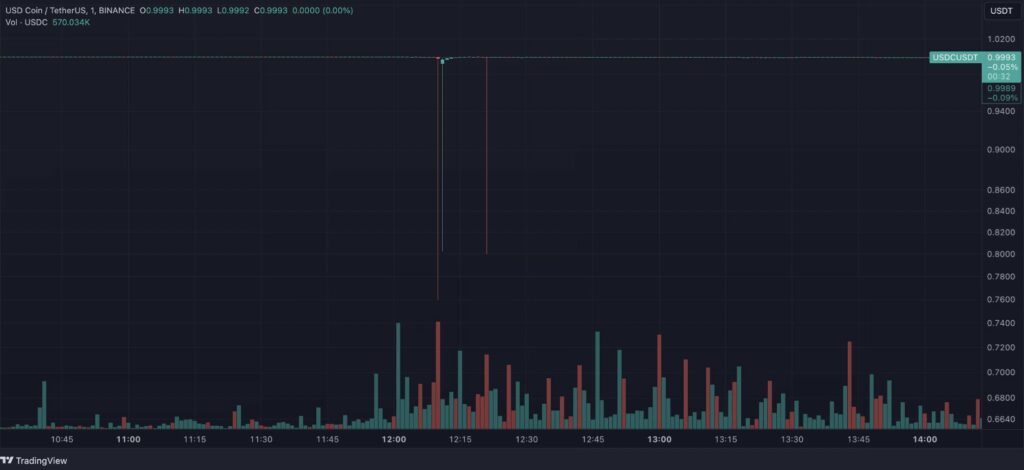
Recent history has already shown just how fragile the balance of stablecoins truly is. Christoph Hock recalled the panic caused by Circle when USDC lost its dollar peg. In March 2024, following a massive market sell-off, the token plunged to $0.74 on three separate occasions. A year earlier, it had already dropped by 13% to hit $0.87. These documented depeg episodes illustrate the colossal liquidity risk hanging over the ecosystem.
When a trader massively swaps USDC for USDT and liquidity dries up, the entire market wobbles. For institutional players, suffering an instant 13% loss on treasury positions is simply unacceptable. This type of event triggers cascading liquidations on leveraged positions, amplifying the crash well beyond the directly affected assets. The 2022 bear market had already illustrated this contagion mechanism. The entire DeFi sector relies on the reliability of these settlement instruments.
If such a liquidity crisis were to happen again today at current volume levels, the impact would be of unprecedented magnitude. Crypto trading volumes have multiplied by 17 since 2024, mechanically amplifying the contagion risk. DeFi protocols using these stablecoins as collateral would be the first victims of a massive depeg. The fear and greed index shifting into extreme fear would trigger a selling spiral that would be difficult to stop. Institutional investor confidence, painstakingly built over recent years, would collapse in a matter of hours.
Regulators closing in: USDT and USDC under mounting pressure
European regulators are intensifying their scrutiny of stablecoins that do not comply with the new MiCA standards. Tether‘s USDT has not obtained the necessary license to operate freely within the European Union, forcing several exchanges to delist its trading pairs. This growing regulatory pressure weakens the liquidity available on platforms like Binance and Coinbase for European users. If major asset managers like Union Investment start actively advising against these instruments, the capital flight could accelerate. The fundamental analysis of these stablecoins reveals a structural regulatory vulnerability that is hard to ignore.
The US CFTC and SEC are also closely examining the reserve structures of Tether and Circle. A forced audit revealing discrepancies between reported reserves and actual assets would trigger an immediate confidence shock. The smart contracts of DeFi protocols integrating these stablecoins would need to be urgently reprogrammed. This technical complexity amplifies systemic risk in the event of a crisis. Alternatives such as decentralized stablecoins or those backed by RWAs would directly benefit from such a flight-to-safety scenario.
The Web3 ecosystem is facing a fundamental contradiction. Stablecoins are supposed to be the bedrock of stability enabling blockchain development. If this foundation is perceived as unstable by institutions, the entire decentralized financial structure teeters. Yield farming and staking denominated in USDT or USDC now incorporate a risk premium that few investors had anticipated. Paradoxically, transparency forced by regulators could strengthen long-term trust if it reveals solid reserves.
USDT and USDC: Should you diversify your stablecoin reserves?
The risks identified by Christoph Hock demand immediate strategic reflection. Investors holding significant positions in USDT or USDC should consider diversifying across multiple stablecoins. Regulated alternatives like PayPal‘s PYUSD or stablecoins backed by RWAs offer different risk profiles. Keeping all liquid reserves with a single issuer exposes holders to a concentration risk that institutions can no longer ignore. Wallet management and asset diversification have become absolute priorities.
For day trading or scalping traders, the immediate liquidity of USDT remains an operational advantage that is hard to bypass. However, for long-term investors looking to invest in crypto with controlled risk exposure, reducing reliance on a single stablecoin issuer is a basic precautionary measure. Securing positions in a hardware wallet like Ledger remains essential. Crypto taxation on conversions between stablecoins will also need to be anticipated. This diversification should not be seen as a panic signal, but rather as professional risk management.
If institutions withdraw their billions en masse, the 2025-2026 crypto bull run would lose its main liquidity fuel. Conversely, if Tether and Circle manage to reassure the market with transparent audits, confidence would consolidate on healthier foundations. Medium-term Bitcoin forecasts and Ethereum forecasts incorporate this stablecoin risk as a secondary but significant variable. The coming weeks of regulatory scrutiny will be decisive. The market needs certainty regarding the strength of its liquid foundations before confidently eyeing new ATHs.
Sources:
Related Articles:

