

Arkham Intelligence: What They Discovered
The blockchain intelligence firm has published an exhaustive analysis of the Zcash network, leveraging address clustering tools and data from centralized exchanges. The outcome is unforgiving for the project’s reputation.
Indeed, Arkham successfully labeled 53% of all Zcash transactions, 48% of network inflows and outflows, and 37% of on-chain balances, amounting to roughly $2.5 billion identified among current holders. These figures, which Arkham themselves described as “remarkable for a chain explicitly designed to mask transactional data,” serve as an unprecedented public demonstration of a reality many suspected but dared not articulate: for the majority of users, Zcash does not truly protect privacy.
The fundamental nuance that Arkham is careful to highlight is that Zcash’s underlying cryptography, the zk-SNARKs, has not been broken. It remains mathematically sound. The issue is of a completely different nature, and this is precisely what makes the findings more dangerous in the long run.
Understanding the Dual Nature of Zcash: t-addresses vs z-addresses
To grasp why Arkham was able to achieve this, one must understand the network’s dual architecture. Zcash distinguishes between two fundamentally different types of addresses, generating four possible transaction types.
Transparent addresses (t-addresses) function exactly like Bitcoin addresses: the sender, the recipient, and the amount are entirely visible on the blockchain without any privacy layer. Shielded addresses (z-addresses) place funds into an encrypted pool where zk-SNARKs allow the validity of a transaction to be verified without revealing its contents.
The interaction between these two address types creates four configurations. t→t transactions are completely transparent, identical to Bitcoin. t→z transactions reveal the amount entering the shielded pool but hide the recipient. z→t transactions reveal the recipient and the amount but mask the origin. Only z→z transactions are entirely private. Arkham confirms that the latter remain opaque, simply labeled “SHIELDED” on their platform with no possibility of attribution.
The problem is that the majority of actual volume flows through t-addresses. Exchanges, custodians, and institutions systematically favor transparent addresses for regulatory compliance reasons, primarily KYC and AML. The entry and exit points of the shielded pool thus become obvious vectors for analysis: even if the inside of the pool is opaque, the borders are not.
Concrete Cases Illustrating the Problem
Arkham has documented examples that speak for themselves. The most symbolic case involves the US government holding a Zcash wallet on Arkham’s platform containing ZEC seized from Alexandre Cazes, the founder of AlphaBay, which was one of the most active darknet marketplaces. This wallet is visible in real time. The most active state in global financial surveillance holds, identifies, and tracks a “privacy coin” in real time, despite its core promise of invisibility.
Another documented case involves a trader who bought $4.49 million worth of ZEC during a market crash and transferred the funds to Gemini five weeks later after securing a $6.6 million profit. The entire history is traceable on Arkham through the transparent addresses involved in the operation.
These examples illustrate the same reality: Zcash’s privacy is not a default guarantee, it is an active choice. The reality is that almost all users do not make this research effort. Many buy Zcash on centralized exchanges for the privacy narrative. This makes no sense since the ZEC token is traceable when purchased on a CEX.
This is the fundamental lesson of Arkham’s research, formulated in their own conclusion: “how you use Zcash determines how private you really are.”
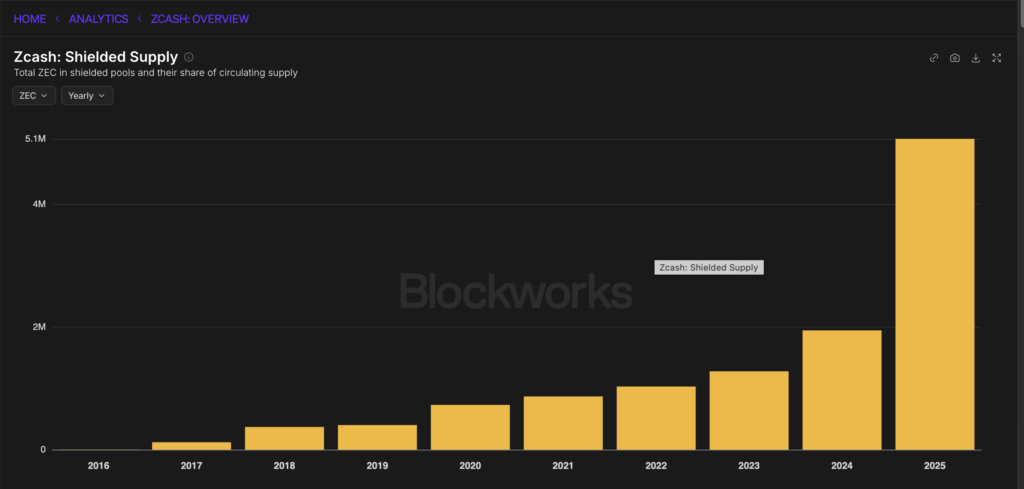
The shielded pool currently represents about 20% to 30% of the circulating supply, showing a slight increase thanks to wallets like Zodl that enable shielded transactions by default. Indeed, the progress made since 2024 is worth highlighting.
What Zcash Needs to Resolve
The stakes are clear. On a technical level, the priority is to massively increase the adoption of z→z transactions by making them the default for all users, just as Monero enforced from its inception. Unified Addresses represent a step in this direction, facilitating the use of shielded addresses without adding friction for the user.
Regarding anonymity, the challenge is one of scale: the more the percentage of purely shielded transactions increases, the more each individual transaction disappears into the crowd. At a 20% to 30% shielded pool, the anonymity set remains too limited to offer serious protection against sophisticated adversaries like blockchain intelligence firms.
The underlying question raised by Arkham’s research goes beyond Zcash. It questions the very viability of the optional privacy model in an ecosystem where regulatory obligations systematically push toward transparency. A network where privacy is a choice that the majority of participants do not exercise is, in practice, not a confidential network.
Sources:
Related Articles:

