

The Classic “Sell the News” Following the CLARITY Act Euphoria
The Senate Banking Committee vote in favor of the CLARITY Act is undoubtedly the greatest legislative breakthrough in the history of cryptocurrencies in the United States. This text finally clarifies the digital commodity status for major assets like Bitcoin and Ethereum, paving the way for massive institutional adoption. The community logically expected an explosive breakout toward a new ATH. The markets responded with the exact opposite of this scenario. The adage “Buy the rumor, sell the news” played out with surgical precision.
The anticipation of this vote had already been priced in over the preceding weeks. Crypto whales and institutional investors had accumulated beforehand, turning the official announcement into a massive profit taking signal. This sell the news mechanism is well documented across all financial markets. It strikes particularly hard on highly speculative assets like altcoins. The speed of the correction caught even the most seasoned traders off guard.
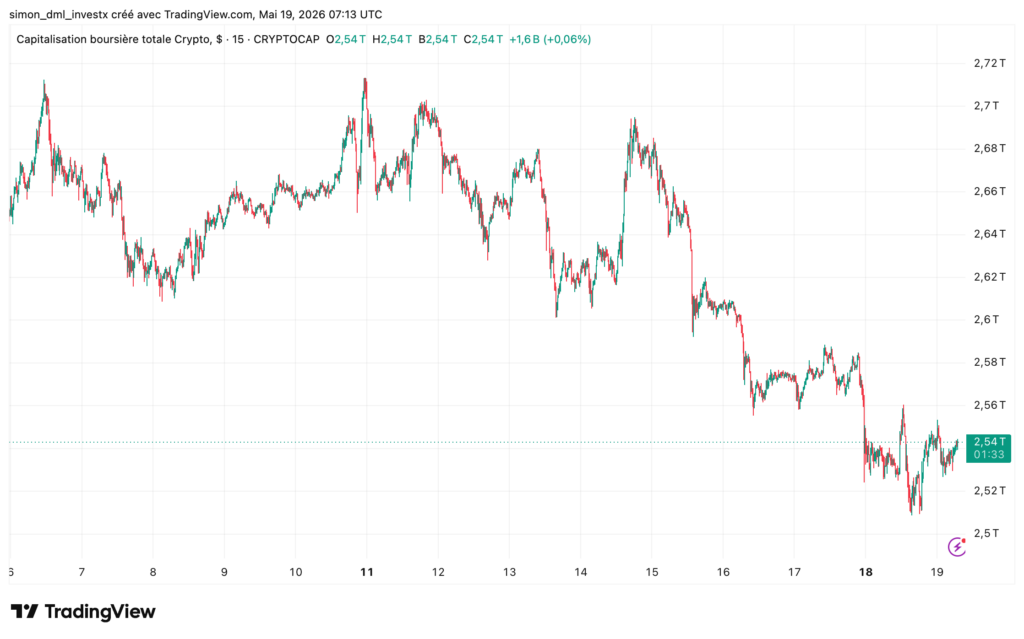
Bitcoin plummeted by more than $6,000, wiping out $126 billion in market capitalization within a few days. Ethereum plunged by over 10%, while XRP was not spared from this bearish pressure. In total, nearly $190 billion evaporated from the global market. This figure illustrates the sheer violence of a coordinated institutional sell off across the entire Web3 ecosystem.
Oil at $107, Iran/USA Tensions: The Perfect Macro Storm
Beyond profit taking, the crypto market is facing particularly violent macroeconomic headwinds. The resurgence of tension in the Middle East, notably between the United States and Iran, has propelled the barrel of oil above $107. This geopolitical uncertainty has triggered a widespread panic across risk assets. Institutional investors have massively rotated into traditional safe havens. The gold vs Bitcoin comparison perfectly illustrates this defensive rotation during times of geopolitical stress.
Sticky inflation in the United States further darkens the macroeconomic picture. Hopes for interest rate cuts by the Federal Reserve are fading as CPI data continues to disappoint. A strengthened dollar mechanically weighs on digital assets, whose valuation is denominated in USD. This context serves as a painful reminder of the 2022 bear market, triggered by the exact same cocktail of inflation and rising rates. The crypto trend has turned deeply bearish in the short term under the weight of these combined pressures.
The fear and greed index has flipped into extreme fear territory, amplifying the selling behavior of retail profiles. This self fulfilling psychological dynamic fuels the downward spiral well beyond what fundamentals justify. Traders engaged in day trading and scalping are capitalizing on this heightened volatility. For long term investors, these phases of collective panic have historically provided strategic entry points. Patience remains the rarest and most profitable skill in these market setups.
Rejection at the 200 MA and Cascading Liquidations: Technical Analysis
From a technical analysis standpoint, the BTC setup did nothing to stem the bleeding. Bitcoin suffered a violent rejection at its 200 day moving average, a key resistance level monitored by all institutional traders. This rejection triggered a cascade of liquidations across derivatives markets, mechanically amplifying the drop. The RSI sank deep into oversold territory on the daily chart with no clear signal of an immediate bounce. The MACD confirms a bearish crossover on higher timeframes.
Altcoins suffered the expected domino effect. Solana and Cardano posted heavier losses than BTC, in line with their high beta relative to the broader market. Fibonacci retracement levels place the next significant Bitcoin supports between $72,000 and $75,000. The open interest on futures remains abnormally high, keeping the pressure on both sides. The Bollinger Bands have violently expanded downwards, signaling an ongoing bearish expansion.
The CVD confirms seller dominance on net flows over the past several sessions. Elliott Waves suggest that the market is currently in a corrective wave before a potential recovery. A technical bounce toward the $80,000 resistance is possible in the short term without invalidating the overall bearish structure. Traders engaged in swing trading are waiting for volume confirmation before repositioning. Without a clear signal from the current support/resistance levels, caution takes precedence over action.
Is the Bitcoin and Ethereum Dip a Strategic Accumulation Opportunity?
Despite this brutal retracement, the long term fundamentals have never been stronger for the crypto market. The CLARITY Act, if definitively enacted, will protect the industry from SEC attacks and offer unprecedented legitimacy to the sector. Bitcoin ETFs will continue to structurally absorb supply. On chain crypto whales often perceive these corrections as accumulation windows ahead of the next cycle. The 12 month Bitcoin forecast remains largely positive for analysts factoring in the upcoming regulatory framework.
For investors looking to invest in crypto in this environment, a staggered accumulation strategy is the most suitable approach. Spreading entries across $75,000, $72,000, and $68,000 on Bitcoin helps smooth out the risk without missing an anticipated bounce. The Ethereum forecast follows a similar logic with entry levels between $1,950 and $1,800. Securing positions in a hardware wallet like Ledger remains essential in the face of extreme volatility. Crypto taxation on potential capital losses should also be anticipated.
The 2025 to 2026 crypto bull run is far from over. The regulatory clarity brought by the CLARITY Act acts as a structural catalyst whose effects will be measured over several quarters. HODLing remains the winning strategy for profiles with a time horizon greater than 12 months. The current correction looks more like a healthy flush out than a structural collapse. The coming weeks will dictate whether the supports hold before the next bullish cycle.
Sources:
- gmulun on X[EXT_LINK_2:]
- ShaykhSulaiman on X
- TradingView
Related Articles: