

Significant Decrease in Weekly ETF Flows
Institutional investors are closely monitoring the American economic indicators, leading to a 40% decrease in inflows into Bitcoin ETFs in cash last week. This increased caution is due to growing concerns about a stagflation scenario.
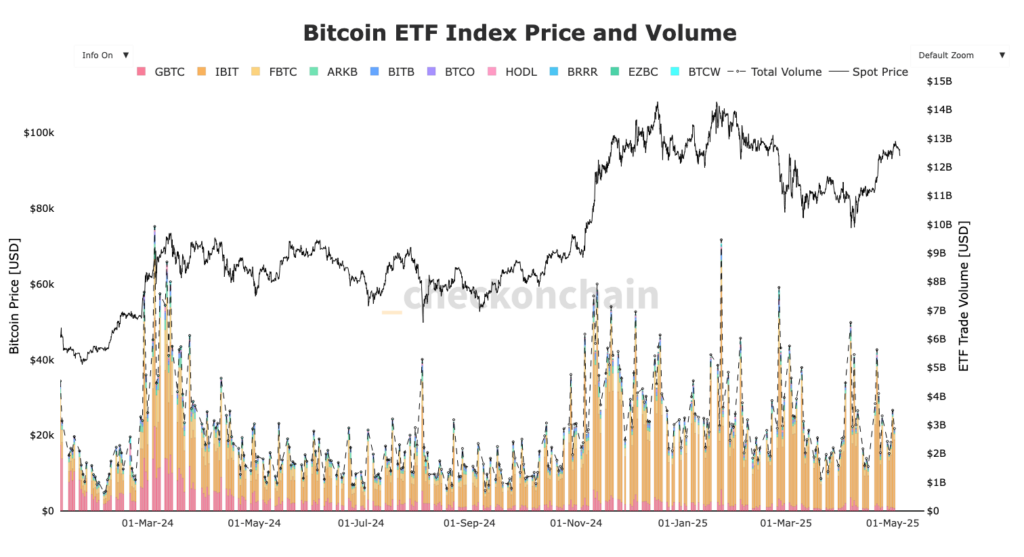
According to CheckOnChain data, Bitcoin ETFs in the United States recorded $1.81 billion in net inflows last week, compared to $3.06 billion the previous week. This 40% decrease reflects investors’ concerns regarding:
- Disappointing results of the April ADP employment report
- Unexpected contraction of the American GDP in the first quarter
- New protectionist measures announced by Donald Trump
These negative signals reinforce expectations of an explosive mix of sluggish growth and stubborn inflation, in other words, a sustainable “stagflation.”
For your information, stagflation is an economic phenomenon characterized by the combination of three elements:
- Economic Stagnation: Weak or no economic growth, often marked by a declining GDP or sluggish economic activity.
- High Inflation: Persistent rise in prices of goods and services, reducing purchasing power.
- High Unemployment: High unemployment rate, contrary to what one might expect in an inflationary context.
Division of Flows between Major and Minor ETFs
Despite this overall decline, some ETFs have continued to attract capital:
- The flagship ETF from BlackRock (IBIT) has garnered $2.48 billion
- VanEck (HODL) and Invesco (BTCO) funds also reported positive flows
- However, Fidelity (FBTC), ARK Invest (ARKB), as well as Grayscale (GBTC) and Bitwise (BITB) recorded net outflows
This dynamic reflects a concentration of flows on market leaders, to the detriment of smaller managers.
While last week saw a significant slowdown, the month of April as a whole remains positive with nearly $3 billion in net inflows. This demonstrates renewed institutional interest despite economic turbulence. As Crypto_birb indicates, ETF volumes have almost returned to levels not seen since the March crash.
Impact on Bitcoin Price: Expected Monetary Status Quo
Faced with these macroeconomic uncertainties, the price of Bitcoin has fluctuated between $93,500 and $96,000 in recent days. Investors are now closely watching the Federal Reserve’s monetary policy decision, which is expected to keep its benchmark interest rate unchanged at 4.5%.
This is compounded by Trump, and even Warren Buffet, casting doubt on a potential imminent market recession with a weakening dollar.
In conclusion, the sharp decrease in flows in Bitcoin ETFs reflects an increased nervousness among institutional investors regarding alarming economic signals. However, the fundamental appeal for cryptocurrency remains strong, as evidenced by the positive balance in April.
The coming weeks will be crucial for the future of Bitcoin ETFs, which will have to deal with limited economic visibility across the Atlantic. Their ability to overcome this phase of uncertainty will be crucial for their widespread adoption.
Related Topics:

