

Institutional adoption propels the Chainlink network
The crypto market is witnessing a real turning point for Chainlink. According to recent data, institutional demand for cross-chain settlement infrastructure and real-world asset (RWA) tokenization has significantly strengthened the network’s position. Traditional finance giants are now relying on Chainlink for continuous collateral management.
On the DeFi side, the massive migration of capital toward the CCIP interoperability protocol is accelerating. Following security breaches on other bridges, major protocols have transferred nearly a billion dollars in assets to Chainlink. This momentum has propelled the number of daily active addresses to over 282,000, an eight-month high.
But the biggest announcement this week for Chainlink is the confirmation of the blockchain’s collaboration with the DTCC. Indeed, in a major announcement on May 12, 2026, the DTCC (Depository Trust & Clearing Corporation), a central player in global post-trade infrastructure, revealed a decisive step toward 24/7 collateral mobility.
Its AppChain, a platform for collateral, will integrate the Chainlink Runtime Environment (CRE) and Chainlink data standards. This collaboration will enable near real-time collateral management across traditional markets and blockchains, seamlessly linking asset prices, valuations, and movements.
For Chainlink (LINK), this historic partnership validates its technology at the heart of institutional finance, strengthens its legitimacy, and opens the door to massive adoption.
Currently, the price of LINK is trading around $10.45, posting a slight correction of about 2.5% over the last 24 hours, but maintaining an increase of nearly 14% over the week. This resilience is explained by strategic accumulation: whales have amassed nearly 33 million tokens in a month, drying up exchange reserves.
Technical analysis: Is LINK ready for a major breakout?
On the technical side, the setup for LINK remains resolutely bullish in the short term, although the market is showing signs of overheating. The token is trending above its 7-day and 30-day moving averages, confirming the strength of the recent rally. However, the 14-day RSI is hovering around 70, signaling an overbought zone that could justify a consolidation phase.
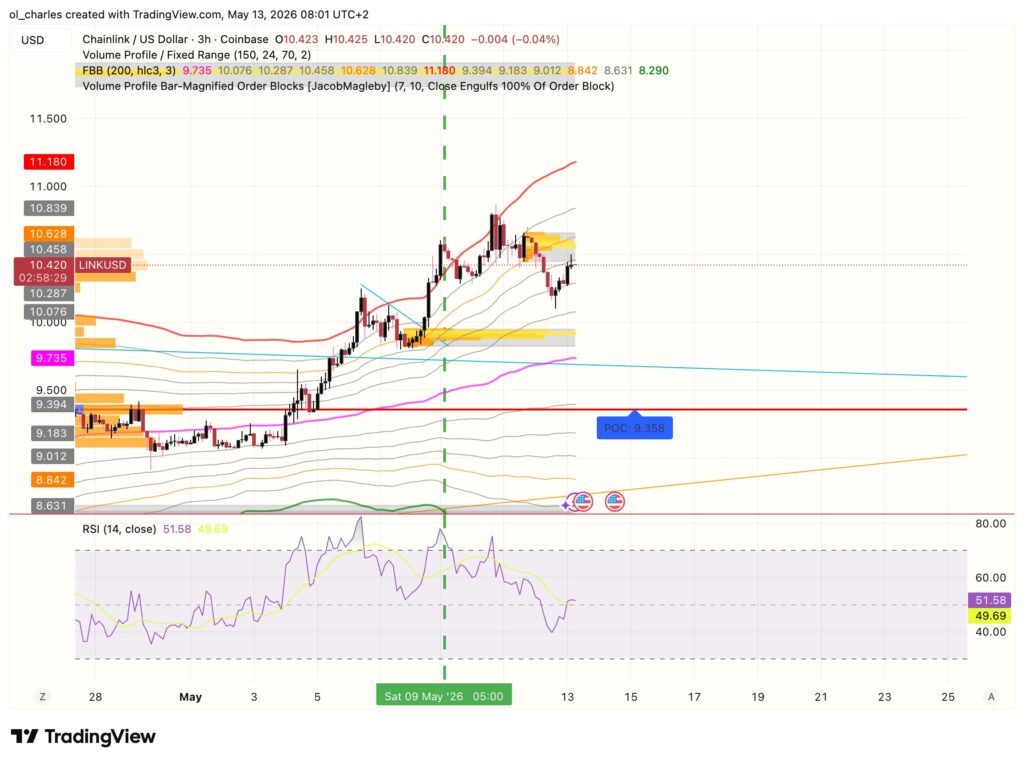
The immediate resistance level sits at $10.60, corresponding to a bearish order block formed on the 3-hour chart. If buyers manage to break this glass ceiling, a breakout could propel the price toward its major resistance around $11.30. This level corresponds to the median line of the daily FBB, a resistance that could slow down the price of LINK.
Conversely, in the event of a bearish scenario, the key support is found at $10.35 (the 23.6% Fibonacci retracement level), followed by the psychological threshold of $9.90. The order block at this level is crucial, even if the price might deviate toward the $9.50 – $9.70 zone. The upcoming direction will depend on the buyers’ ability to absorb the selling pressure. If this zone fails to hold off the sellers, the next support lies between $9.30 and $9.00.
How high can the price of Chainlink (LINK) go?
The institutional enthusiasm for Chainlink oracles, which now dominate nearly 84% of the market share, provides an extremely solid fundamental foundation. The reduction of liquid supply on exchanges, coupled with exploding network utility, creates the ideal conditions for a potential supply shock.
If the current momentum holds and the broader cryptocurrency market remains favorable, LINK could not only break through its short-term resistances but also target much more ambitious goals in the coming months. The question is no longer whether Chainlink is essential to the ecosystem, but rather how quickly this adoption will be reflected in its valuation.
Will retail investors follow the movement initiated by smart money before the market’s next massive surge?
Sources:
Related Articles:

