

Coinbase Targeted by Unprecedented Wave of Social Engineering Scams
The recent losses suffered by Coinbase users highlight an alarming trend in the world of cryptocurrencies. We are referring to the surge in crypto scams based on social engineering.
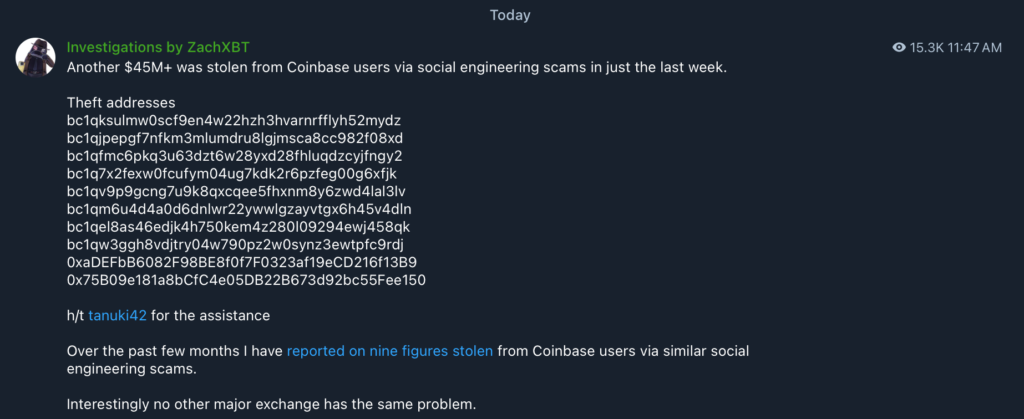
According to ZachXBT, over $45 million was reportedly stolen in early May 2025, in just a few days. While these attacks are not new, their frequency and sophistication are worrisome.
Scammers use advanced techniques to impersonate Coinbase’s customer support. They often reach out via phone, email, or through fake interfaces.
One of the most common tactics is to deploy a fake interface that perfectly mimics Coinbase’s interface. This prompts victims to transfer their funds to fraudulent crypto addresses.
These psychological manipulations exploit fear, urgency, and the technical complexity of platforms. Even experienced users fall prey to them! Online scams targeting Coinbase have thus resulted in losses exceeding $300 million over the past year.
Telegram and Fraud “Panels”: Key Tools for Scammers on Coinbase
A particularly troubling aspect of this case is the sale of tools called “panels” on Telegram. These tools are designed to impersonate Coinbase’s customer support. Essentially, these programs allow for creating highly credible communications, including simulating legitimate calls or emails.
ZachXBT points out that these tools are becoming more accessible and customizable, which amplifies the attacks. Users can even send automated messages with official logos and URLs close to those of the actual crypto platform Coinbase, making detection nearly impossible for victims.
Once the funds are stolen, they are swiftly moved via crypto mixers or converted on DeFi platforms like THORChain, making recovery impossible!
This facilitates money laundering, with assets circulating from one crypto address to another until they become untraceable. This reality makes fund protection more challenging. It also underscores the need for strengthened responses from crypto exchanges.
How Can Coinbase Users Effectively Protect Themselves ?
In the face of this growing threat, the best defense is constant vigilance.
First rule: never disclose your credentials, private keys, or 2FA codes, even if the caller seems legitimate. Coinbase’s customer support will never ask for this information through an insecure channel.
It is imperative to meticulously verify every link or message received. A fake interface can trap the user in seconds if they do not check for the presence of an SSL certificate or the URL’s spelling.
Finally, activating Coinbase’s advanced protections is highly recommended. This includes whitelisting withdrawal addresses and using a physical key for 2FA.
In any case, the case revealed by ZachXBT highlights the vulnerability of Coinbase users to constantly evolving crypto threats. More than ever, caution and ongoing education are essential to survive in the volatile cryptocurrency world.

