

Why is SG-FORGE betting everything on the Canton Network?
This is a massive announcement for the Canton Network. This week, the crypto subsidiary of the French bank announced its integration into the Canton Network, a permissioned blockchain designed for traditional finance. SG-FORGE is deploying its institutional stablecoins, EURCV and USDCV. The objective is clear: to provide a secure infrastructure for collateral management and digital settlements.
This announcement comes amid a wave of genuine mass adoption for real world assets (RWAs). The tokenized Treasury bond market has experienced explosive growth, quadrupling in value to cross the $15 billion mark since 2025. Faced with this rapidly expanding institutional demand, Société Générale is positioning itself as a key player.
By becoming an “Ecosystem Super Validator” on Canton, the bank is doing more than just issuing tokens. It is actively participating in securing the network and validating transactions. This strategy allows it to bypass the volatility of public markets while ensuring strict regulatory compliance for its clients.
EURCV and USDCV: The French surprise taking on market giants?
While behemoths like Circle and Tether dominate the public market, SG-FORGE has chosen a different battleground. EURCV, which already boasts a market capitalization of nearly $97 million, and USDCV (around $20 million), are perfectly suited for OTC operations and interbank transactions.
The major innovation lies in the use of these stablecoins for repurchase agreements (repos) and margin call management. Where traditional systems require several days for settlement, blockchain technology enables almost instant execution. This gain in time and liquidity could propel the use of bank issued stablecoins into a new era of adoption.
Far from being a mere technological advancement, this infrastructure offers the granular privacy that is essential for banks. Institutions can thus generate yield and exchange securities for stablecoins in a matter of seconds, redefining the standards of market finance.
How far can institutional tokenization go?
Société Générale’s offensive raises a crucial question for the ecosystem: will private and institutional blockchains cannibalize the liquidity of public DeFi? As JPMorgan and other giants multiply similar initiatives, the RWA space seems ready to become the leading sector in crypto DeFi.
If traditional banks manage to impose their standards on networks like Canton, we could witness a split in the crypto market. On one side, a retail driven decentralized finance prone to brutal corrections and extreme speculation; on the other, a highly liquid and regulated institutional ecosystem.
Should you buy CC?
At the time of writing, the Canton Network’s CC token is trading at $0.164 and is testing its daily order block. This massive liquidity zone at $0.175 is the final hurdle before a potential CC breakout.
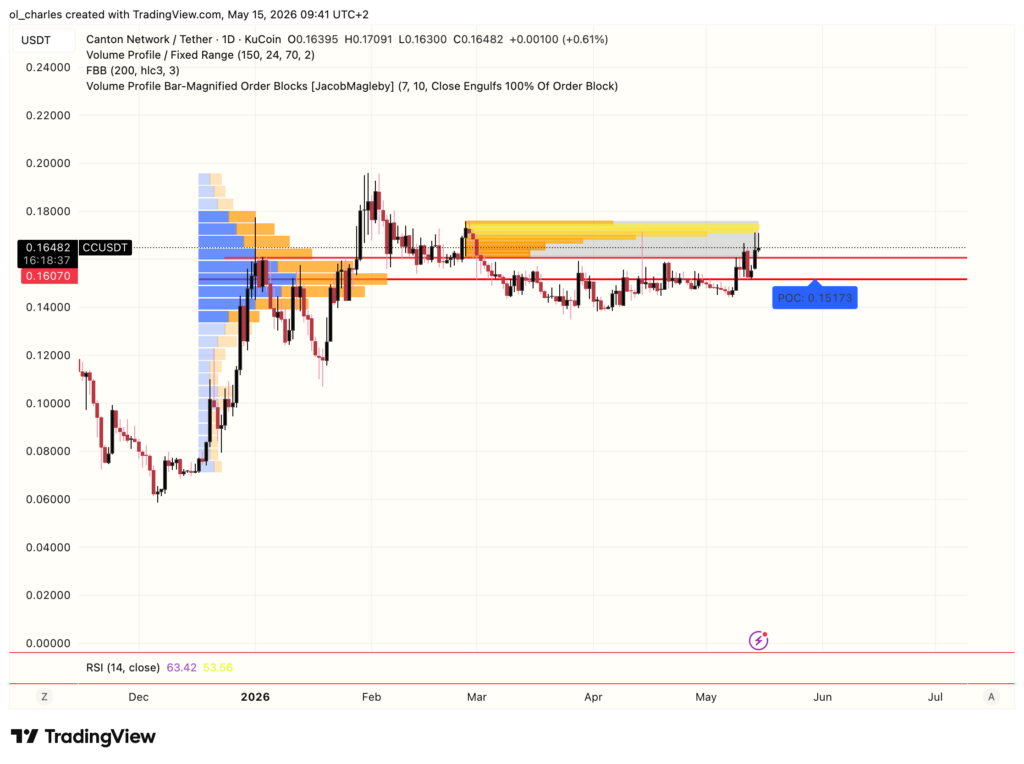
For now, it is a waiting game. The two key levels that will dictate the trend in the coming weeks are the resistance at $0.175 and the POC support at $0.151.
But from a fundamental perspective, CC is dominating the crypto market. Indeed, CC is also benefiting from an ETF launched by the giant 21Shares. If major names like Société Générale and 21Shares place their trust in the network, the future can only be promising.
Nevertheless, the shadow of short term volatility in the crypto market will always be present. It is therefore better to wait for the market’s decision and keep a close eye on these two key levels.
Sources:
Related Articles: