

A Massive Quantum Threat to the Bitcoin Network?
In a recent video addressed to Bitcoin maximalists, Charles Hoskinson highlighted a critical vulnerability. According to him, as of March 1, 2026, over 34% of the total Bitcoin supply has had its public key exposed on the blockchain. This flaw primarily stems from address reuse or the use of legacy wallet formats (P2PK). This leaves approximately 8 million BTC at the mercy of a quantum attack.
These coins, originating from legacy addresses (P2PKH or P2PK) or address reuse, could be stolen in a matter of hours by a sufficiently powerful quantum computer. Hoskinson therefore speaks of a concrete risk, not a hypothetical one.
Far from being a sci-fi scenario, Hoskinson estimates that sufficiently powerful quantum computers will emerge in the 2030s. He even quipped about the subject, stating that this threat will strike with full force.
The Quantum Threat: What It Really Means
To explain this threat that has been growing for several years, imagine your Bitcoin private key is an ultra-secure padlock. Traditionally, to crack it using the public key (which everyone sees when you spend funds), it would take billions of years of calculations on the best supercomputers. This is the Elliptic Curve Discrete Logarithm Problem (ECDLP), the mathematical foundation of the ECDSA used by Bitcoin on the secp256k1 curve.
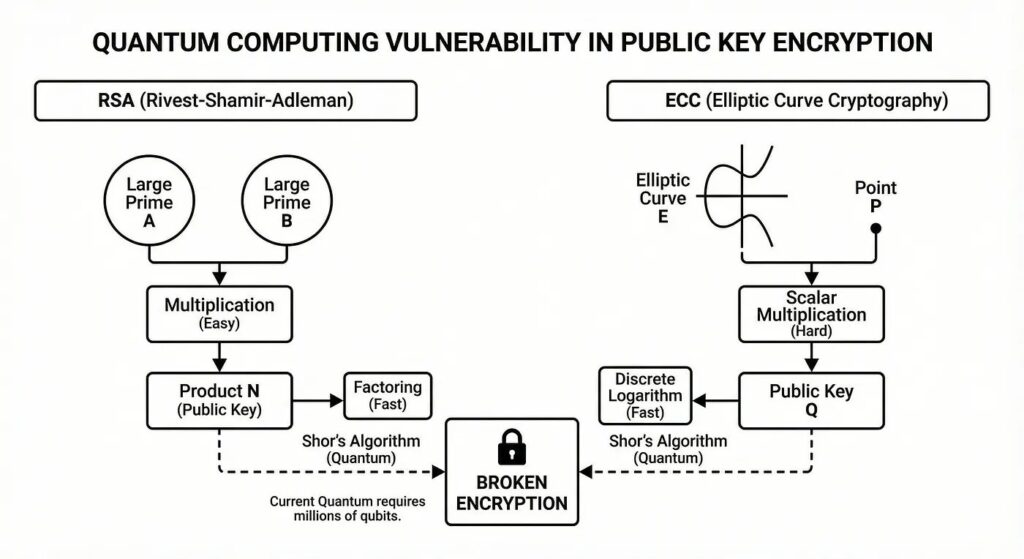
Formally: the public key Q is calculated as Q = d × G, where d is your secret private key (a 256-bit number) and G is a fixed point on the elliptic curve. Finding d from Q and G is exponentially difficult in classical computing (complexity of ~2¹²⁸ operations).
However, in 1994, mathematician Peter Shor invented a quantum algorithm that solves this problem in polynomial time: O((log N)³), where N is the size of the number. On a fault-tolerant quantum computer (with thousands of stable logical qubits), it only takes a few hours to find d. Once the private key is known, the attacker can sign any transaction and drain the wallet.
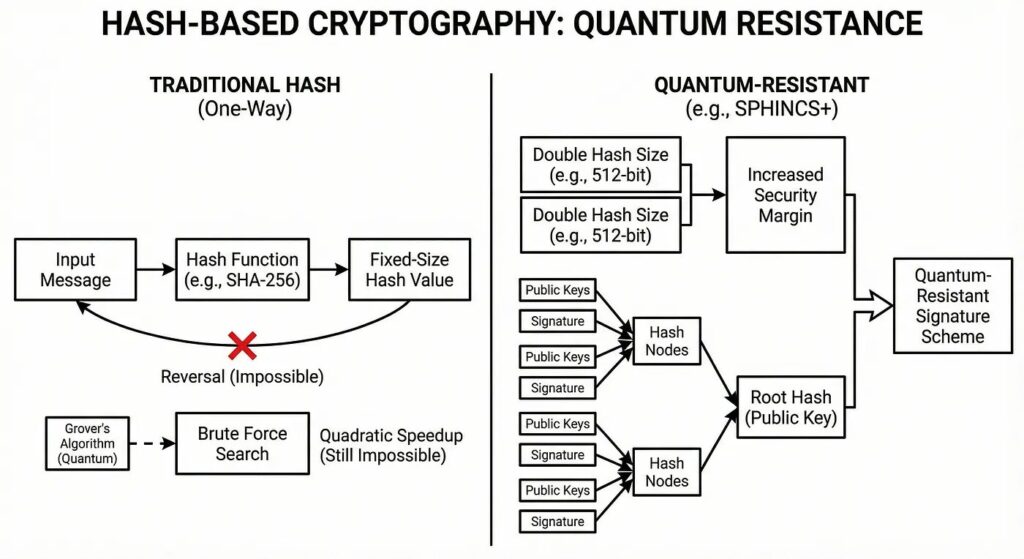
Furthermore, Grover’s algorithm (another quantum tool) also accelerates SHA-256 hash searches. Ultimately, the ~34% of BTC whose public keys have already been revealed (during a spend or in legacy formats) become easy targets for quantum computers.
The 1.7 million BTC in pure P2PK (including part of Satoshi’s stash) are even more critical: their public keys have been literally engraved on-chain since 2009-2010.
Is the Rescue Plan (BIP-361) Doomed to Fail?
Faced with this emergency, a Bitcoin Improvement Proposal, BIP-361, is currently circulating. Its goal is to freeze vulnerable funds and force a migration to post-quantum addresses. However, Hoskinson strongly criticized this initiative. According to him, this upgrade would require a hard fork, a radical code modification that the Bitcoin community has always rejected on principle.
Even more concerning, the proposed recovery system using Zero-Knowledge Proofs only works for wallets based on the BIP-39 standard, introduced in 2013. As a result, approximately 1.7 million Bitcoins, including the famous stash of Satoshi Nakamoto, would be lost forever. Such a loss of liquidity could paradoxically create a supply shock, but the psychological impact would leave a deep scar.
Hoskinson points out that developers understand the stakes, but current solutions are inadequate. If the network fails to agree on a smooth transition, user trust could collapse, shattering any hope of a major new bull run beyond 2030.
Will Bitcoin Survive This Technological Revolution?
Peter Shor himself (the inventor of the algorithm) and most top-tier cryptographers (those working at Google, Microsoft, or NIST) are unanimous: the mathematical threat is real and inevitable.
And the evidence has been there for 30 years. The only debate is about engineering. Indeed, it requires millions of error-corrected physical qubits to run Shor’s algorithm on a 256-bit curve. DARPA timelines estimate a “useful” quantum computer around 2033-2035.
What is a difficult problem for classical computers is “easy” for a quantum computer. Even though Bitcoin is not doomed (it can migrate to post-quantum signatures such as lattice-based or hash-based ones), decentralization makes consensus extremely slow.
Sources:
Related Articles: