

Why Charts Are Not Enough for XRP
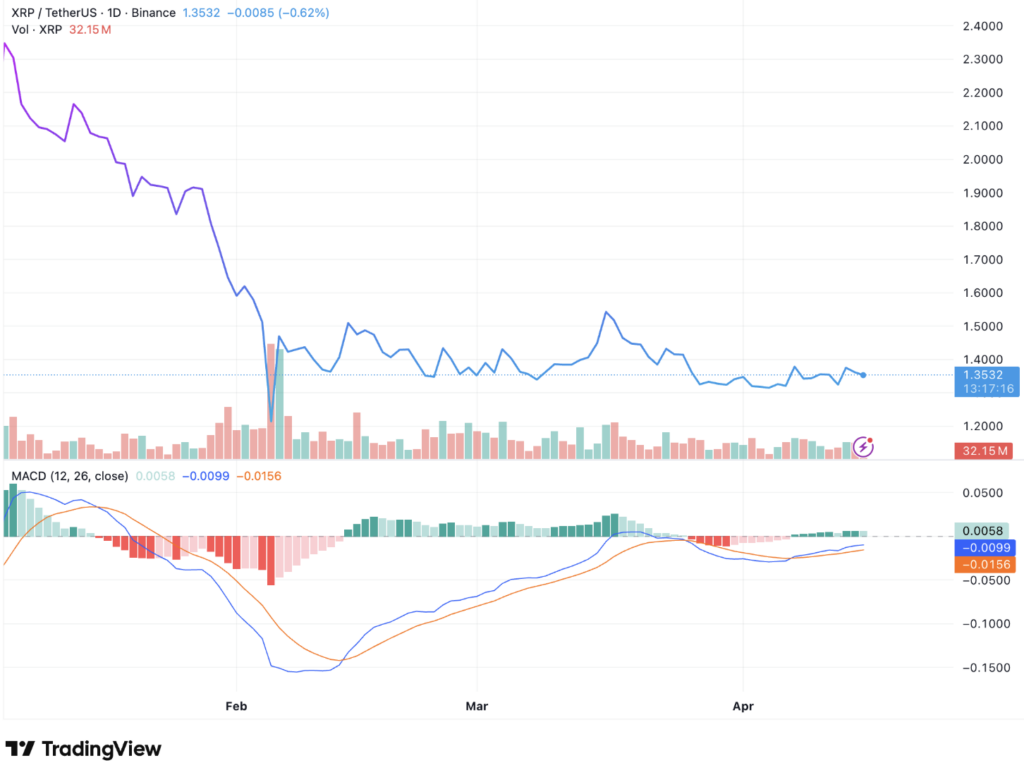
XRP is currently trading around $1.40, and the debate over its true potential has never been more polarized. On one side, chartists are scrutinizing support and resistance levels with a magnifying glass. On the other, financial analyst Luke Suther has published a thesis on X that completely disrupts the usual framework: technical analysis is not only insufficient for evaluating XRP, but it is also actively misleading.
Suther’s argument is structural. XRP was not designed as a passive store of value like Bitcoin. Its architecture is that of a settlement infrastructure, built to move capital between financial institutions at the speed of the internet, frictionlessly and at a marginal cost. Evaluating this asset solely using Fibonacci retracements or Bollinger Bands is like measuring the performance of a fiber-optic network with a stopwatch.
This perspective is not unfounded. The XRP Ledger processes transactions in 3 to 5 seconds for sub-penny fees. This is a level of performance that neither Ethereum nor Solana can achieve for compliant institutional settlements. The real question, therefore, is not where the next resistance level lies, but at what pace institutions are deploying this infrastructure within their actual payment flows.
The Price Ladder: A Valuation Scale Based on Utility
Suther proposes an alternative analytical framework he calls the Price Ladder, a valuation scale correlated not with market sentiment but with actual institutional adoption. The first tier sits at $2, corresponding to the rollout of initial banking pilot programs for cross-border settlements. This is an achievable short-term level if ongoing Ripple partnerships come to fruition.
The second tier targets $18, contingent upon complete regulatory clarity in the United States and Europe. The third, at $100, represents a scenario where XRP becomes the central bridge asset for global interbank payments, requiring deep liquidity and massive institutional transaction volumes. For investors tracking XRP price predictions, these tiers offer a framework far more rooted in fundamentals than purely technical projections.
The $500 and $10,000 Targets: Speculation or Calculation?
Suther’s most audacious projections, at $500 and then $10,000, inevitably raise eyebrows. At $10,000, XRP’s market capitalization would surpass that of the entire current global banking system. To achieve this, the network would need to manage liquidity pools worth trillions of dollars and replace a significant portion of the SWIFT infrastructure, which currently processes around $5 trillion per day.
This is mathematically consistent within the framework Suther has established, but it relies on assumptions that still border on regulatory and political science fiction. Replacing SWIFT is not a technical decision; it is a geopolitical one. No G7 government will surrender this infrastructure without resistance. Our take: the $2 and $18 tiers are credible targets for the 2026-2027 horizon. The $500 targets and beyond belong to a total adoption scenario for which the conditions are simply not met today. For traders looking to position themselves, specialized exchanges allow you to track institutional flows in real time and adjust your exposure accordingly.
What Ripple Partnerships Really Say About XRP’s Potential
Beyond theoretical projections, the hard data is encouraging. Ripple is multiplying its partnerships with financial institutions across Asia, the Middle East, and Latin America. The recent integration of ZK Proofs on the XRPL, announced during Paris Blockchain Week, bolsters the network’s credibility for confidential institutional transactions that comply with regulatory requirements. To dive deeper into the mechanics of decentralized finance and understand why this combination of privacy and compliance is rare, our guide details the technical stakes involved.
For those looking to buy XRP with a true understanding of what they are purchasing, Suther’s thesis offers a much stronger framework than chart analysis alone. XRP is neither a memecoin nor a passive store of value. It is an infrastructure whose value depends directly on the volume of capital that will flow through it. And that volume, while still modest today, is experiencing structural growth.
Sources:
- CoinDesk
- X (LukeSuther33435 / KillaXBT)
- TradingView
Related Articles: