

ASTER Under Selling Pressure
The cryptocurrency market is experiencing a new phase of volatility, and Aster is not immune to this trend. The token has suffered a severe correction of 16% over a short period, primarily fueled by massive whale movements. On-chain data reveals that these major players liquidated 17.857 million Aster tokens, representing a total value of $22.88 million. This wave of outflows comes amid a sustained price decline, placing retail investors in a precarious position.
The $1 level now constitutes a major technical support that the community is watching closely. Historically, this psychological threshold has played a crucial role in Aster’s price dynamics. If selling pressure persists and this support breaks, technical analysts anticipate a move toward the $0.85 zone, or potentially lower depending on the sell-off intensity.
Whales Trigger Panic Wave on Aster
The scale of liquidations by large Aster-holding addresses raises legitimate questions about the project’s short-term prospects. When $22.88 million leaves the market in such a short time, the impact on price action is immediate and brutal. These movements are never insignificant and often reflect strategic repositioning or a loss of confidence in the token’s fundamentals.
Volume data confirms this unusual intensity. Exchanges have recorded a significant increase in outbound transactions, indicating that long-term holders are beginning to take profits or limit losses. Market sentiment has notably deteriorated, as evidenced by analysis of social media and specialized forums.
Whale behavior often serves as a leading indicator for retail traders. When these major players massively reduce their positions, it creates a cascade of selling driven by fear of missing the optimal exit point. This self-fulfilling dynamic amplifies downward pressure and complicates the defense of key support levels.
$1 Support: Last Bastion Before a Deeper Fall?
Technical analysis of Aster’s chart reveals that the $1 level has previously served as a bounce zone multiple times. This horizontal support coincides with a significant concentration of buy orders, mainly from retail investors attempting to accumulate at this attractive price. But the question remains: will this liquidity be sufficient to absorb the selling pressure from whales?
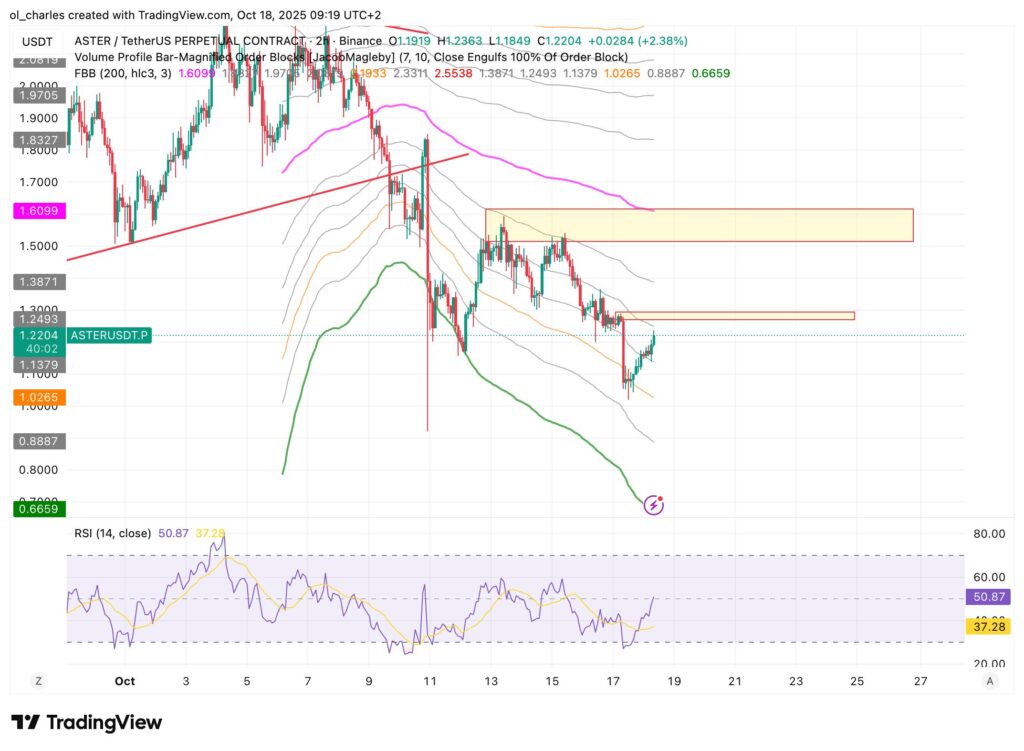
Technical indicators send mixed signals. The RSI is in oversold territory, which could theoretically suggest a technical rebound. However, the moving averages display a clear bearish crossover, and buying volume remains insufficient to reverse the trend. If the $1 support breaks, the next significant demand zone is indeed around $0.85.
Conversely, a recovery above $1.3 could push Aster toward the crucial $1.6 zone.
Take advantage of ASTER’s potential 20%+ rebound and a $10 bonus offered on Bitget right now.
Activate Bitget’s free AI agent to maximize your gains and avoid losses with AI and automated stop losses and take profits:

What Strategy to Adopt Facing This Aster Correction?
Caution remains essential in the current context. Investors should assess their risk tolerance and adjust their exposure accordingly. For those maintaining a long-term vision for Aster, the current zone may represent an interesting entry point, provided they accept increased short-term volatility.
Positioning with DCA (Dollar Cost Averaging) appears to be a reasonable approach in this type of configuration. Rather than concentrating a purchase at a single point, spreading entries allows averaging the acquisition price and limiting the impact of a potential downward continuation. The $1 and $0.85 levels constitute logical zones for staggering orders.
It’s also important to stay attentive to official communications from the Aster project. Often, severe corrections are accompanied by strategic announcements aimed at restoring investor confidence. A major partnership, technological update, or token buyback mechanisms could quickly reverse sentiment and restart bullish dynamics.
On the same subject:

