

Long-Term Bitcoin Holders Accumulation
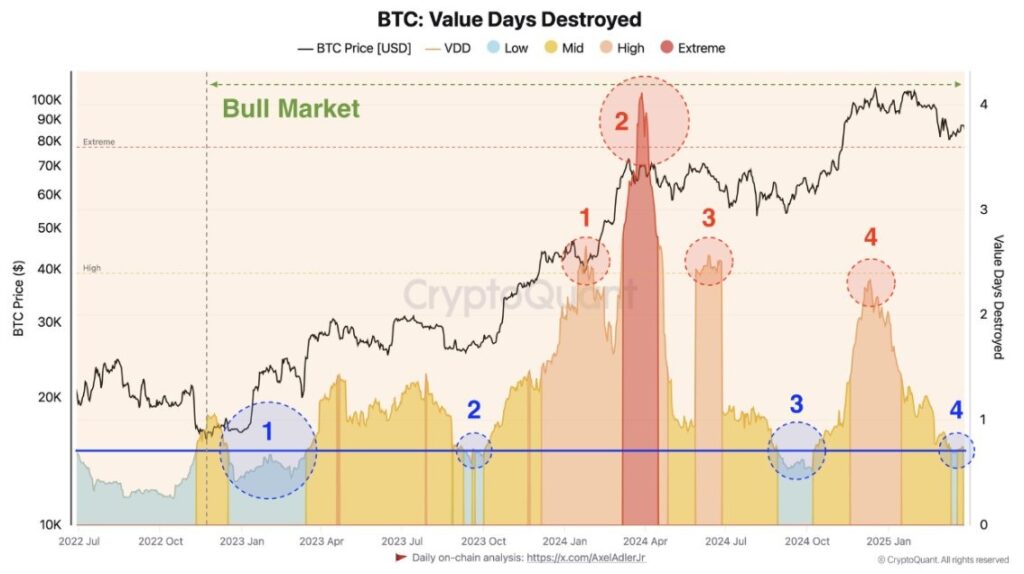
Bitcoin (BTC) could be at the heart of a new position building phase, with long-term investors making a strong comeback in the market. Initially, this trend is reflected in a decrease in the “Value Days Destroyed” (VDD) metric, a revealing indicator of intentions. The analysis of the VDD curve shows four major accumulation phases since 2023: in January, October 2023, October 2024, and now in March 2025.
Each of these phases is characterized by a significant drop in VDD, highlighting a decrease in token movements and an increased conviction among long-term investors. The current reading, the lowest since mid-2024, is particularly significant. Historically, such low VDD levels have preceded significant bullish price movements. Each time, Bitcoin has experienced a new upward phase shortly after these accumulation phases.
This behaviour of traders, who buy at low prices and sell near local peaks, provides a reliable barometer of the overall market sentiment. However, their current position suggests that they do not see current price levels as a distribution opportunity.
No Signs of Profit-Taking Among Investors
The red circles on the VDD chart indicate four distinct peaks of value destruction, corresponding to local peaks. However, at present, none of these peaks are visible, highlighting no significant profit-taking.
This absence of realized value destruction supports the assumption that strong hands remain in the market. Furthermore, their conviction adds credibility to the establishment of a price floor around $82,000, discouraging aggressive short sales in the current structure.
Despite a short-term bearish structure, with Bitcoin priced at $82,011 and below the 50 and 200-day moving averages, the Accumulation/Distribution line remains steady at 4.93 million, indicating that distribution pressure has not intensified.
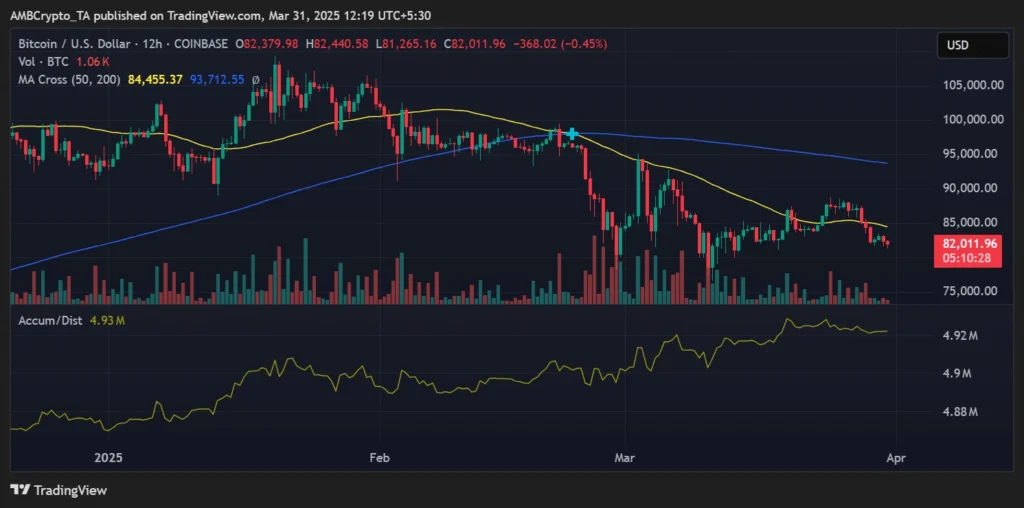
This divergence, with price weakness but stable A/D levels, could signal the formation of a hidden bullish divergence pattern. This could be confirmed if prices stabilize and break through the resistance zone of $84,000 to $85,000.

